Researchers from the Massachusetts Institute of Technology presented the results of a test on Mars
The experimental setup was delivered toMars with the Perseverance rover in February 2021. According to scientists, by the end of 2021 they were able to successfully conduct seven test runs of the device. The experiments were carried out both during the day and at night. With each launch, the device successfully converted carbon dioxide from the Red Planet's atmosphere into oxygen.
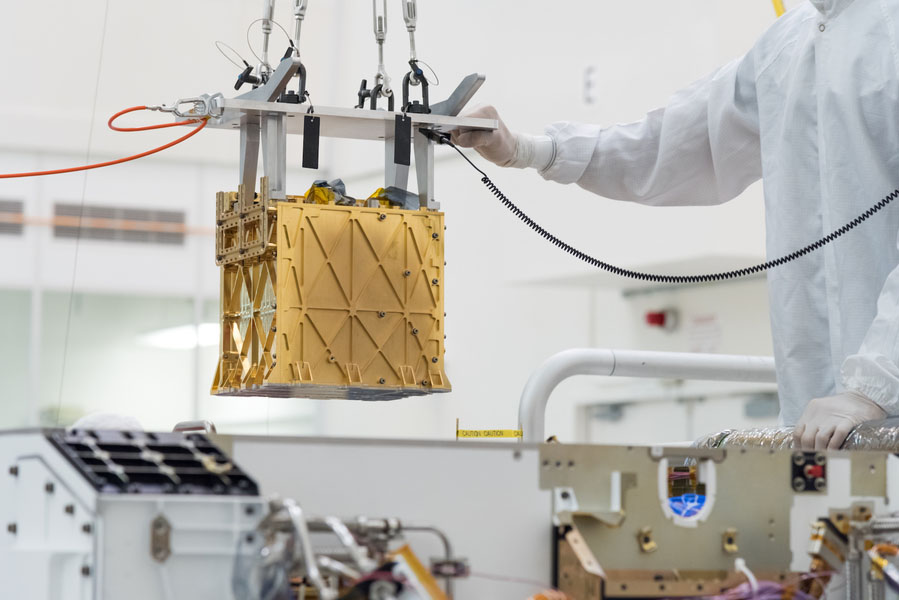 Installation of MOXIE before sending to Mars. Photo: NASA, JPL-Caltech
Regardless of external conditions per hour MOXIEproduced about 6 g of oxygen. This is the mass of oxygen contained in 6.2 liters of terrestrial air. About the same amount of oxygen produces an average tree on Earth, scientists say.
When the device is turned on, it draws in the Martianair through a filter that removes pollutants from it. The mixture of gases is then pressurized and passed through a solid oxide electrolyzer, which electrochemically splits the carbon dioxide-rich air into oxygen ions and carbon monoxide (carbon monoxide). After this, the device releases oxygen ions, which recombine into molecules of gas suitable for breathing.
The developers note that MOXIE is a smalla prototype that is artificially limited in size and function to fit aboard a rover. Because of this, it emits a small amount of gas and can work for short periods of time. For a full-fledged mission to Mars, more powerful analogues can be created that will work without interruption and produce oxygen at the rate of several hundred trees.
Read more:
The first images of the underground part of Mars surprised scientists
A galaxy located 12 billion light-years from Earth 'curled up' into an Einstein ring
From the body to the mouth: scientists have understood where the teeth came from
On the cover: the sky above Mars. Image: NASA, JPL-Caltech, MSSS