What is the Earth's surface made of?
The Earth's interior can be divided into layers according to their mechanical properties (in particular
- Core
The central, deepest part of the planetEarth, the geosphere located under the Earth's mantle and, presumably, consisting of an iron-nickel alloy with an admixture of other siderophilic elements. The depth is 2,900 km.
- Mantle
The Earth's mantle extends to a depth of 2,890 km, making it the thickest layer of the Earth. The pressure in the lower mantle is about 140 GPa (1.4 · 106 atm).
The mantle consists of silicate rocks rich iniron and magnesium in relation to the overlying bark. High temperatures in the mantle make the silicate material plastic enough to allow convection of material in the mantle to emerge through faults in the tectonic plates.
- Bark
The thickness of the earth's crust can be from 5 to 70 km indepth from the surface. The thinnest parts of the oceanic crust that underlie ocean basins (5–10 km) are composed of dense iron-magnesium silicate rock such as basalt.
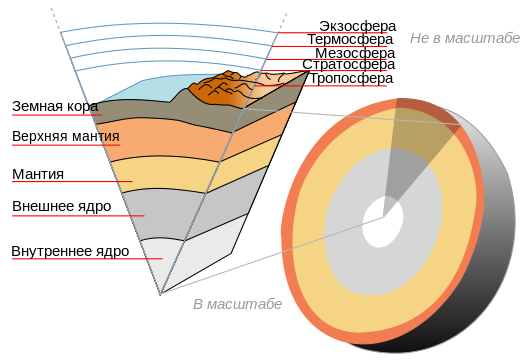
In our material we will talk about the upper part of the Earth's structure: lithospheric plates.
How are lithospheric plates arranged?
There are two fundamentally different types of earthlycrust - continental crust and oceanic crust. Some lithospheric plates are composed exclusively of oceanic crust, others consist of a block of continental crust soldered into the oceanic crust.
Total thickness (thickness of the lithosphere)oceanic lithosphere varies from 2–3 km in the region of rift zones of the oceans to 80–90 km near the continental margins. The thickness of the continental lithosphere reaches 200–220 km.
Lithospheric plates are constantly changing theiroutlines, they can split as a result of rifting and weld together to form a single plate as a result of collision. Lithospheric plates can also sink into the planet's mantle, reaching deep into the outer core.
On the other hand, the division of the earth's crust into platesis ambiguous, and as geological knowledge accumulates, new plates are identified, and some plate boundaries are recognized as non-existent. Therefore, the outlines change over time and in this sense. This is especially true of small plates, for which geologists have proposed many kinematic reconstructions, often mutually exclusive.
The speed of horizontal movement of lithosphericslabs in our time varies from 1 to 6 cm per year (the speed of moving slabs apart is from 2 to 12 cm per year). The rate of plate movement from the Mid-Atlantic Ridge in its northern part is 2.3 cm per year, and in the southern part - 4 cm per year.
Slabs move apart most quickly nearEast Pacific Ridge near Easter Island - their speed is 18 cm per year. The slowest plates are moving apart in the Gulf of Aden and the Red Sea - at a speed of 1–1.5 cm per year.
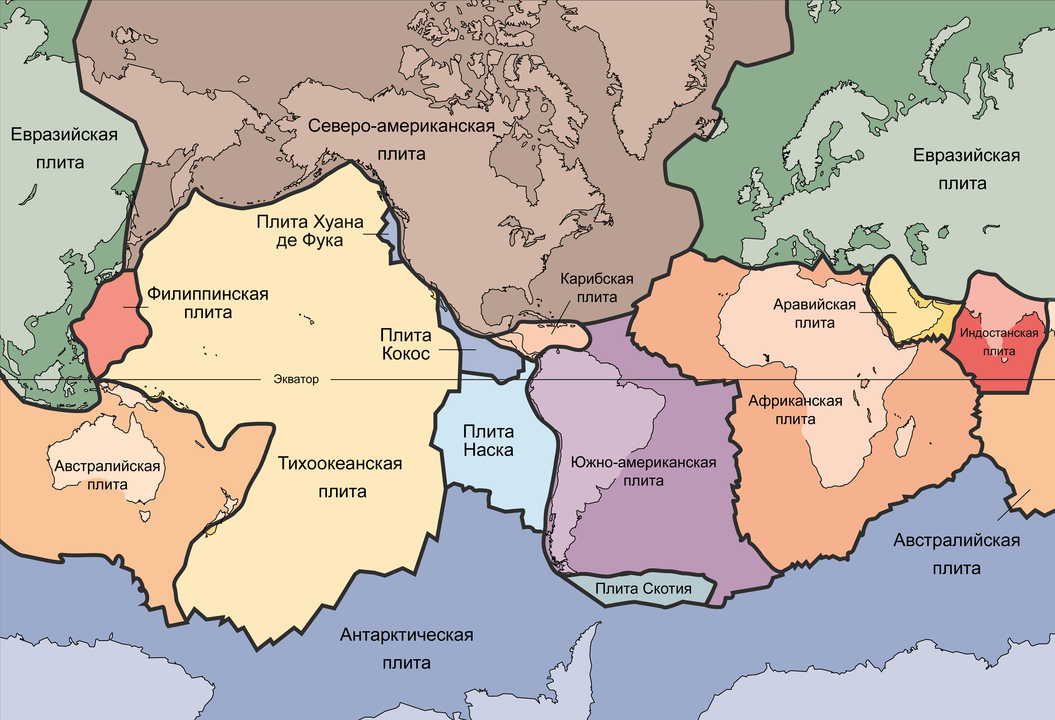 Lithospheric plates map
Types of lithospheric plate collisions:
- Oceanic-continental collision
The collision boundary runs between the oceanicand a continental plate. The oceanic crust plate moves under the continental plate. Collision examples: Nazca plate with South American plate and Coconut plate with North American plate.
- Ocean-oceanic collision
One of the slabs moves under the other - the one onwhich is a group of islands. Collision examples: North American plate with the Okhotsk plate, with the Amur plate, with the Philippine plate, with the Indo-Australian plate; South American Plate with Caribbean Plate.
- Continental-continental clash
A type of collision in which neither plate is inferior to the other and they both form mountains. Examples: Hindustan plate with Eurasian plate.
How do lithospheric plates move?
According to the modern scientific approach to plate movement, the earth's crust consists of relatively integral blocks - lithospheric plates, which are in constant motion relative to each other.
At the same time, in expansion zones(mid-ocean ridges and continental rifts) as a result of spreading (eng. seafloor spreading - spreading of the seabed), new oceanic crust is formed, and the old one is absorbed in subduction zones.
Thermal convection in the mantle material occursas an effective mechanism for transferring thermal energy from the Earth's core and represents convective cells up to several thousand kilometers in size. Above the ascending flows of mantle matter, that is, hot and less dense, there are zones of spreading of the ocean floor.
Descending jets of the cooled and densermantle material is carried away by lithospheric plates in subduction zones. The movement of the plates is carried out due to the viscous adhesion of the material of the upper mantle, which is in convective motion, with the uneven base of the lithosphere.
Modern movements of lithospheric plates are recordedseveral methods, the most common of which are space geodesy methods. Modern GPS receivers are capable of recording plate movements with an accuracy of fractions of a millimeter per year.
The consequences of the movement of lithospheric plates can also beobserve in seismic dislocations - disturbances in the continuity of rocks resulting from earthquakes, which, in turn, are a consequence of the instantaneous release of stress in the earth's crust.
A well-known example of a seismic dislocation is a fence on a farm in California, near San Francisco, divided into two parts, shifted along the San Andreas fault relative to each other by several meters.
Model of plate tectonics on the surface of a volcanic lava lake
More than 90% of the Earth's surface in the modern era is covered by the eight largest lithospheric plates:
- Australian plate
- Antarctic plate
- African plate
- Eurasian plate
- Hindustan plate
- Pacific plate
- North American Plate
- South American Plate
What have scientists learned about plate tectonics theory?
Scientist Bradford Foley of PennsylvaniaUniversity of the USA is sure that the Earth's surface cannot be considered static, because it is constantly agitated. Moreover, according to the expert, tectonics is acting correctly, putting everything in its place. Fractures in the earth's crust are also the result of the interaction of underground plates.
For centuries, science has believed thatthe surface of the Earth, its outermost layer is static and cruel. It doesn't move or change. However, the emerging theory of plate tectonics changed the whole understanding of soil formation. It clearly indicates the constant movement of the planet's surface. And proof of this are earthquakes, volcanic eruptions, the formation of mountains and volcanic pools.
All these events are somehow connected with hotbowels of the Earth. All the familiar landscapes that exist on the planet are products of the aeonic cycle, in which the planet is busy with constant improvement of itself.
Plate tectonics today describes the entire externallayer of the earth. It occupies a thickness of about 100 km and is broken into peculiar puzzles from plates of rock that carry the continents and the seabed. In this case, the plates formed in the course of this movement sink into the interior of the planet. This cycle, scientists say, creates many geological wonders, but it is also the cause of many natural disasters on our planet.
It connects many incompatiblethings: spreading of the seabed and magnetic stripes in places of formation of earthquakes and mountain ranges. Geodynamicist Bradford Foley of the University of Pennsylvania believes plate tectonics works in the right way because it puts everything in its place.
Therefore, the theory seems not just convincing, butreal. The surface of the Earth cannot be considered stationary. She is constantly agitated and restless. The formed faults are also the result of the interaction of tectonic plates. They support the idea of drifting continents, which is considered unusual.
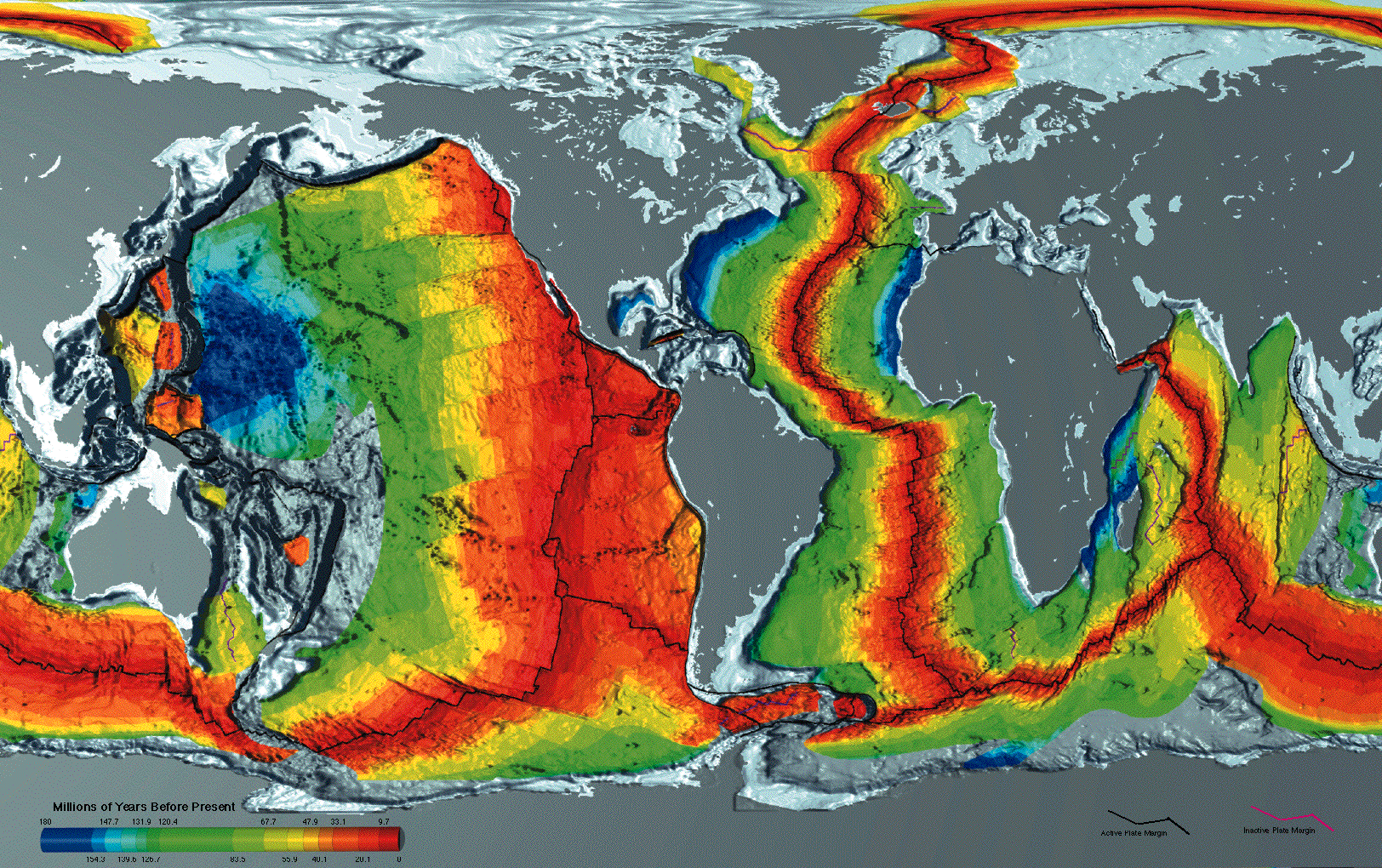 Age of the ocean floor (red corresponds to young crust)
What is the future of the science of tectonics?
Despite its apparent simplicity and elegance, the concept of plate tectonics is continuously evolving as new data accumulates.
One of the pressing issues of modernTectonics and geodynamics remains an explanation of the causes of intraplate magmatism and hotspot magmatism, as a result of which chains of oceanic islands arise, for example, Hawaii or supervolcanoes like Yellowstone, as well as large igneous provinces, for example, the Siberian traps and the Deccan plateau traps in India.
One of the most common hypotheses isexplaining the causes of intraplate magmatism is the concept of mantle plumes - jets of hot mantle matter rising from the core-mantle boundary and being a source of excess (compared to the average value for the mantle) heat, which initiates the melting of huge volumes of magma.
When erupted onto the surface of a continent or the ocean floor, these melts, whose composition corresponds to basalts, form large igneous provinces.
If, when rising to the surface of the earth, the plumerests against the oceanic crust, then it burns through it, resulting in the formation of volcanic islands - underwater volcanoes, whose tops rise above the ocean surface, or large oceanic basalt plateaus like the Ontong Java plateau in the Pacific Ocean.
Read more
Abortion and science: what will happen to the children who will give birth
Earth will reach critical temperature in 20 years
In space, they found gravitational waves that change space and time. What does it mean?