Researchers from Kyoto University studied the dependence of neuronal development on the availability of nutrients.
As a model, the researchers useddendritic branching of class IV Drosophila neurons (Drosophila C4da). This is a group of dendrites (neuronal processes) that are located between the epidermis and the muscles of the body wall, perceive harmful thermal, mechanical and light stimuli and transmit information to the central nervous system.
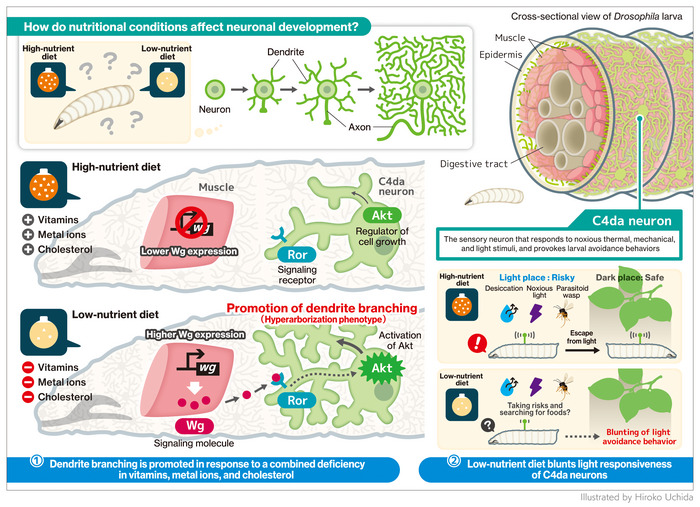 Device, principle of development and operation of C4da neurons in fruit flies. Image: KyotoU/Biostudies/Uemura Lab
In a series of experiments, scientists have shown thattransferring the larvae to a diet poor in yeast, these processes begin to grow actively. At the same time, it is not a low concentration of amino acids (the main nutrient obtained from yeast) that leads to the development of neurons, but a deficiency of vitamins, metal ions and cholesterol.
The lack of these elements and substances stimulatesthe production by the muscles of the body walls of the larva of special signaling molecules Wingless. Entering C4da neurons, these molecules activate the Akt protein, which promotes complex branching of dendrites, the scientists found.
Although this overgrowth of C4da neurons, despiteon a nutrient-poor environment, contrary to common sense, we were even more intrigued by the fact that these neurons become less sensitive to harmful light stimuli.
Tadashi Uemura, study co-author
Scientists believe that the development of somatosensoryneurons dependent on nutrients, part of the evolutionary mechanism. It allows you to find a compromise between the search for foods with a high content of nutrients and the escape from harmful environmental conditions.
Read more:
The strongest class X flare occurred on the Sun
Look at the consequences of the collision in 1181 of two stars
Blazar, which was found 20 years ago, turned out to be an extreme object