Engineers at the Tokyo Institute of Technology have increased the force generated by an actuator for artificial muscles,
As a ferroelectric materialThe researchers used liquid crystals in a special nematic phase. This is a phase in which the long axes of the molecules are arranged in parallel lines rather than in layers. Scientists have found that the material can flow as a liquid at room temperature, while possessing a rod-shaped molecular structure similar to that of solid crystals.
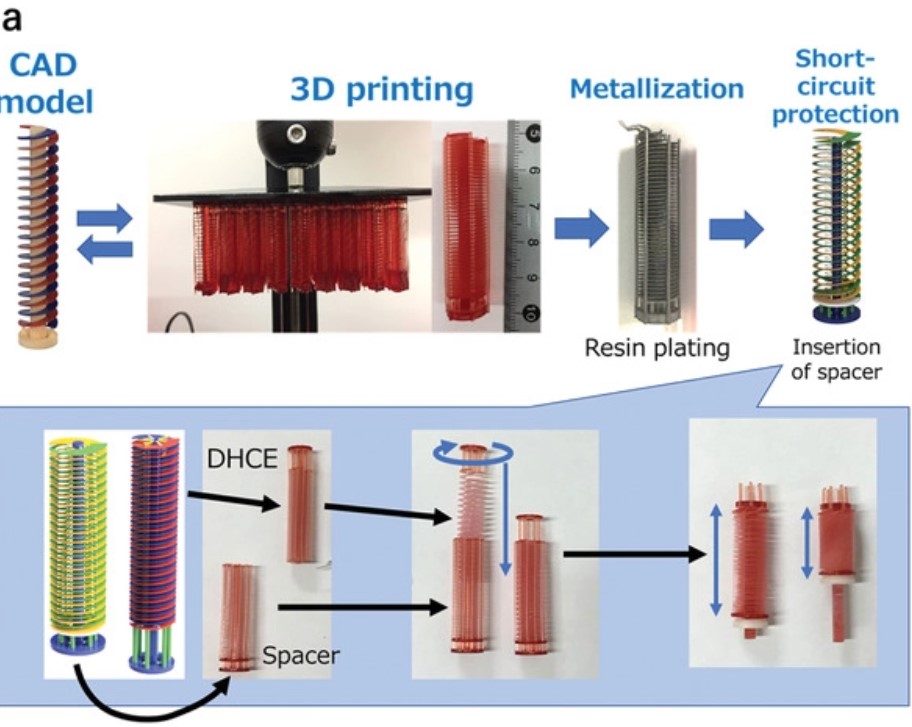 3D printing technology for a ferroelectric drive. Image: Suzushi Nishimura et al., Advanced Physics Research
Due to these characteristics, these materialshigher polarization. In testing, it was found that the ferroelectric liquid crystal generates forces on the electrodes that are 1,200 times greater than conventional paraelectric materials such as insulating oils.
Using ferroelectric liquid crystalsand a 3D-printed double helix electrode, researchers have developed an electrostatic actuator that operates at low voltage and is able to contract and expand like muscles do.
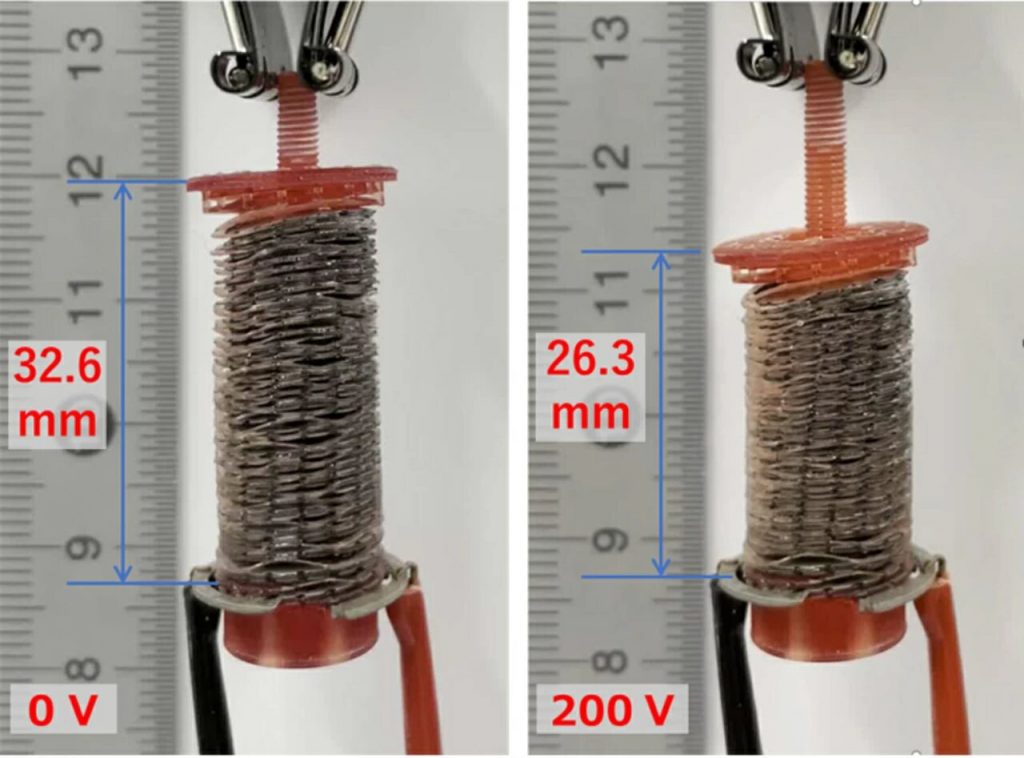 19% drive reduction under 200V voltage. Image: Tokyo Institute of Technology
Use of ferroelectric mediumgenerated forces sufficient to achieve a contraction of 6.3 mm (19% of the length) when 200 V was applied. The device was also observed to move slightly at 18 V, indicating that it could even be powered by a simple battery, the researchers note. .
Electrostatic actuators are simple and lightweightdevices that mimic human muscles. Their use so far has mostly been limited to moving small weights, as they require high voltage to generate significant forces, the scientists explain. To create forces sufficient to support human movement and activity, traditional devices require voltage, which can be dangerous to the body.
Read more:
The main theory of the origin of man was refuted: where did we come from
World's first stool 'transplant' pill approved in Australia
Found the world's first "kitchen": they fried fish there 780,000 years ago