Pregnancy leads to striking changes in the brain, including changes, according to a new study.
All of this “provides adaptive benefits forgestational and maternal behavior of women, as well as the establishment of the relationship between them and the child,” write researchers from the University of Amsterdam Medical Center.
Scientists observed 80 Dutch womenwho were not pregnant and had not given birth before. During the study, 40 women became pregnant. Everyone had their brains scanned at the beginning of the experiment, throughout pregnancy, after giving birth, and a year after.
Researchers have found that pregnant womenwomen lose some gray matter after childbirth. This has previously been observed in Italian mothers. According to the scientists, repeating the results of their previous study proves the reliability of the results. As scientists emphasize, loss of gray matter is not necessarily harmful. It is rather a “fine-tuning” of the brain that is necessary when caring for a newborn. Interestingly, the loss of gray matter has been associated with so-called “nesting behavior,” which is useful in preparing for the birth of a child, such as organizing the home.
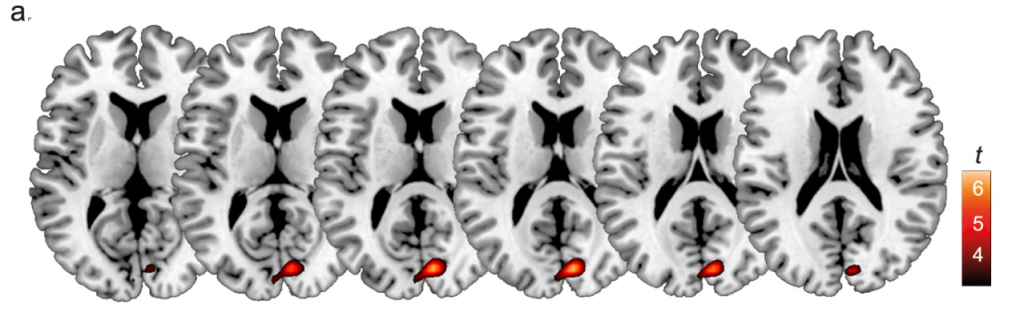 Increase in DMN intranet connectivity in women who became pregnant during the study superimposed on axial sections.
Source: Nature Communications
The study also found that in women,who became pregnant experienced changes in a brain system known as the default mode network (DMN). This neural network of interacting areas of the brain is active in a state when a person is not busy performing any task related to the outside world, but, on the contrary, is inactive, resting, daydreaming, or self-absorbed. It is thought to be involved in self-reflection and autobiographical memory, as well as social processes such as empathy.
It turned out that women with significantChanges in the default mode network reported feeling more connected to the baby and getting more pleasure from interacting with it than other women. Also, mothers with an altered DMN reported feeling less resentment or anger toward their child. And such emotions often arise in women who are tired after childbirth and have sleepless nights.
However, scientists cannot rule outthe possibility that other factors not measured in the study, including exercise, nutrition, and genetic markers, are associated with these brain changes. They called for further, larger studies to explore these factors.
Read more:
A magnetic storm is about to hit Earth
Named the main danger of the lunar mission "Artemis"
The true meaning of mummification is revealed: all this time, scientists were wrong
On the cover: image of the National Institute of Mental Health, National Institutes of Health