The Astra Rocket 3.3 space rocket was supposed to launch the first two satellites of the TROPICS constellation to low Earth
The current flight is the third attempt to launch a rocket from the private space company Astra into orbit. Prior to this, only two of the six launches of the new rocket reached orbit.
TROPICS is planned, which means“Time-Resolved Precipitation Pattern and Storm Intensity Observations with a Constellation of Small Satellites” will consist of six satellites launched by a total of three Astra Rocket 3.3 flights scheduled for summer 2022.
On each observation satellite, 3U CubeSats,a passive microwave spectrometer and a radiometer were installed to study and monitor tropical storms and hurricanes. These satellites are about the size of a shoe box. The target orbit for the mission is at an altitude of 500 km.
It is noted that the constellation of satellitesdesigned so that the system can work even if only four of the six satellites reach the desired orbit. But the successful delivery of all six CubeSats will improve the quality of the data received.
TROPICS will make very frequent imagestropical cyclones, providing insight into their formation, intensification and interaction with the environment, as well as providing important data for storm monitoring and forecasting.
Scott Brown, Research Meteorologist at NASA Goddard Space Flight Center
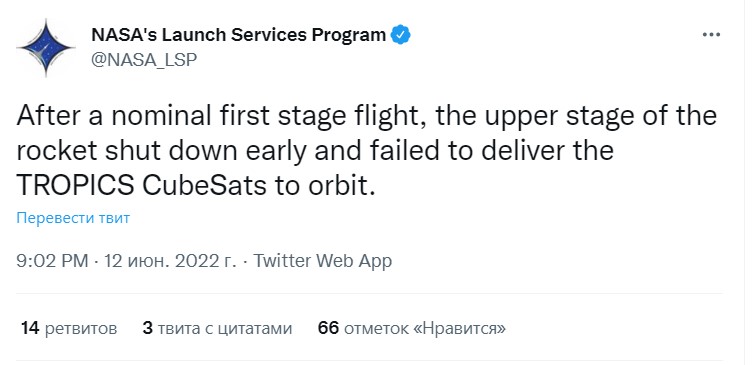
UPD 21:10:After a successful launch and separation of the first stage, the second stage separated prematurely, which prevented the satellites from being put into a given orbit. This was reported on Twitter by the NASA division responsible for spacecraft launches.
Read more
The Japanese dumped a giant turbine into the ocean to get endless energy from the current.
Hubble has found the first rogue black hole in our galaxy
Astronomers from Japan have found an unknown structure in the galaxy