Physicists from the University of Waterloo have created a device that generates neutron spiral waves. Previously
In their experiments, the scientists builtmicroscopic fork-like structures of silicon lattices. These devices are so small that in a square with a side length of 0.5 cm there are more than six million individual fork dislocation phase lattices.
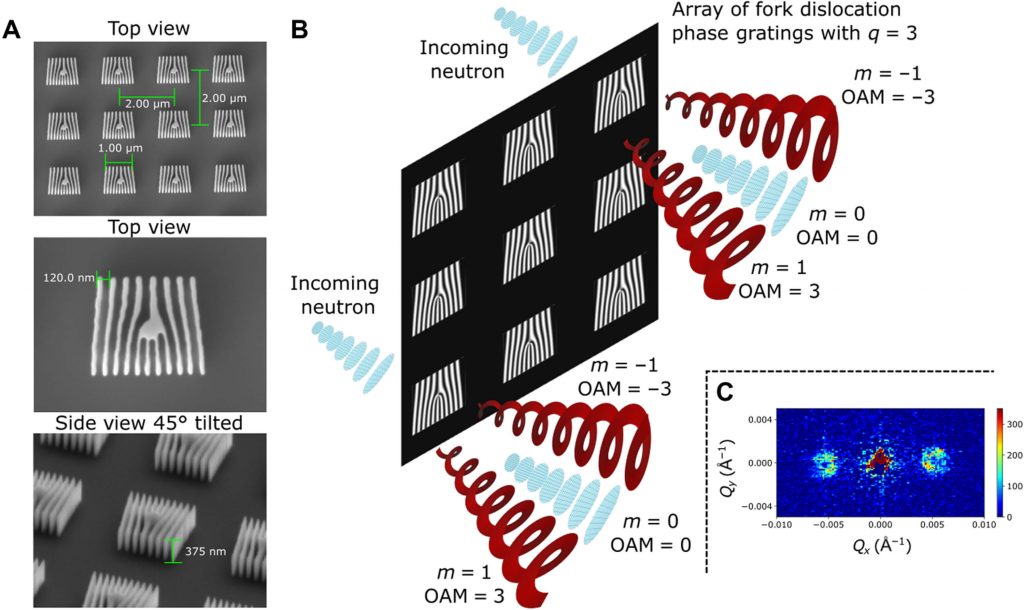 Image under a microscope and how a spiral neural wave generator works. Image: Dusan Sarenac et al., Science Advances
When a beam of single neutrons passes throughthis device, individual neutrons begin to twist in the form of a corkscrew. The researchers captured images of neutrons obtained using a special camera at a distance of 19 m from the radiation source. The results of the observations showed that each neutron expanded to
donut-like signature, 10 cm wide.
Ring structure of propagating neutronsindicates that they were placed in a special helical state and that the group's lattice devices generated beams of neutrons with quantized orbital angular momentum, the scientists note.
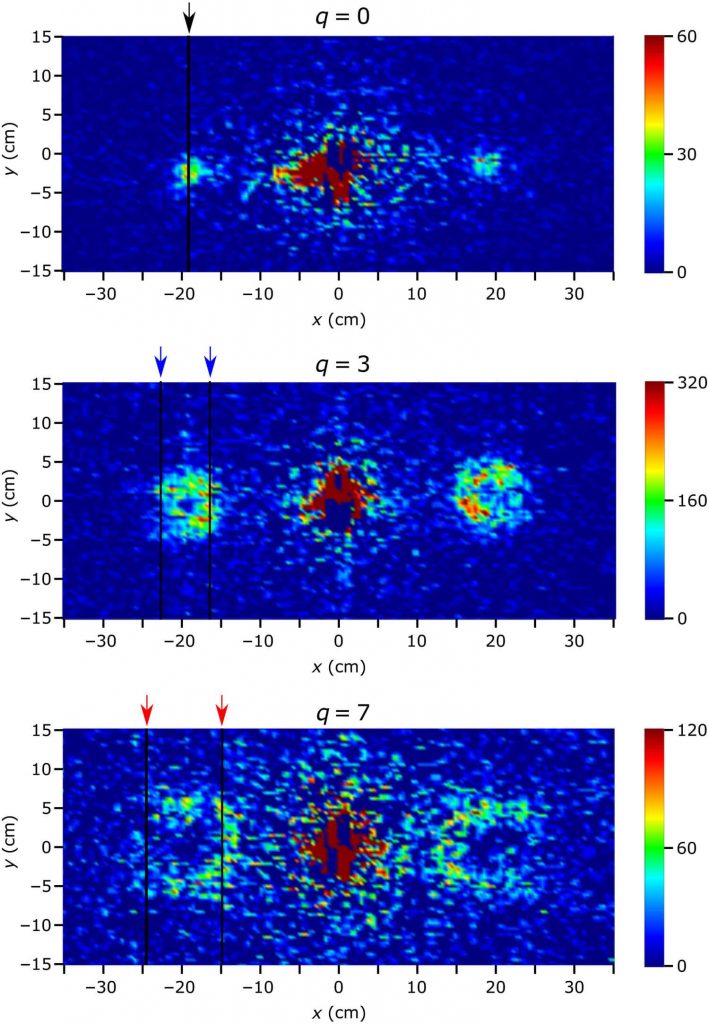 Ring-shaped structures obtained for systems with different topological charges (q). Image: Dusan Sarenac et al., Science Advances
Although methods for experimentally obtaining and analyzing the orbital angular momentum of photons and electrons are well understood, the design of a device using neutrons has not yet been demonstrated.
Neutrons are a powerful tool for determiningcharacteristics of new quantum materials, since they have a number of unique features. They have nanometer-sized wavelengths, electrical neutrality, and relatively large masses. These features mean that neutrons can pass through materials, unlike X-rays and light.
Dusan Sarenak, co-author of the study at the Institute for Quantum Computing at the University of Waterloo
Read more:
Created a navigation system that is more accurate than GPS
An ancient amulet rewrote the history of Europe's most mysterious language
Tiny satellite sends last photo before crashing into Earth's atmosphere