Scientists from the École Polytechnique Fédérale de Lausanne used nanoplasmonics to observe
Visualization of protein secretion in a single cell. Video: EPFL
For observation, researchers place individualcells into microscopic wells in a nanostructured gold-plated chip. After that, they cause plasmon resonance on the surface of the chip. These are resonant oscillations of electrons that occur when a surface plasmon is excited by an external electromagnetic wave. These fluctuations make it possible to map secreted substances as they are formed, observing the shape and movement of cells.
The method of scientists is based on a nanoplasmonic chipan area of 1 cm², consisting of millions of tiny holes and hundreds of chambers for individual cells. The chip is made of a nanostructured gold substrate covered with a thin polymer mesh. Each chamber is filled with cell media to keep the cells alive and healthy during the imaging process.
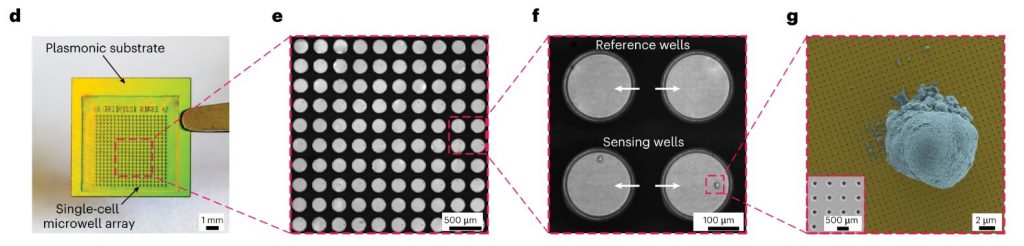 The structure of the chip with which the research was carried out. Image: Saeid Ansaryan et al., Nature Biomedical Engineering
Plasmon resonance is triggered bya beam of light that causes the electrons in the gold atoms to oscillate. The nanostructure is designed in such a way that only certain wavelengths can penetrate it. When something—such as protein secretion—occurs on the surface of the chip, it changes the transmitted light and the spectrum shifts. An image sensor and an LED detect such changes.
Because this method immerses cells inculture medium and does not require toxic labels used in other imaging technologies, the studied cells are easy to recover. This gives the method great potential for use in the development of pharmaceuticals, vaccines and other treatments, the authors note. For example, it can be used to study how cells respond to various treatments at an individual level.
Read more:
New image of Hubble puzzled scientists
Scientists have deciphered the mysterious manuscript of Ptolemy. It was hidden under other text
Look at the highest resolution map of Mars: 110,000 frames and 5.7 trillion pixels
On the cover: illustration of living cells in microchip cells. Image: BIOS EPFL