Scientists have developed a new method for providing information about 3D printed products. They
The technology is known as interiqr(“internal QR”), it is being developed by employees of the Japanese Osaka University. As a proof of concept, they recently 3D printed cookies that were smooth and looked normal on the outside, but had a pattern of air voids on the inside.
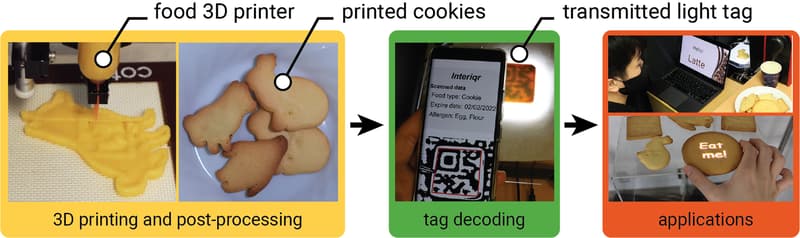 Diagram illustrating how interiq technology can be used.
Copyright: CC BY-ND, 2022 Miyatake et al., ACM UIST 2022
Although the patterns are not visible under normal lighting,they appear as silhouettes when the cookies are viewed from the front and illuminated from behind. A regular smartphone can read codes, revealing the data the code stores inside.
In its current form, the technology is applicablein relatively thin, somewhat translucent, 3D printed food products. But scientists hope it will ultimately provide producers, retailers and consumers with an alternative to the more wasteful and expensive paper labels typically found on fruit or RFID tags on packaging.
Later this month, scientists will present a report onresearch at the 35th Annual ACM Symposium on User Interface Software and Technologies. For more information on how the interiq system works, see the video above.
Read more:
Living organisms have made Mars uninhabitable
The most powerful black hole collision in the universe proved Einstein's theory
The bones in the Midnight Terror Cave were carefully examined and found inexplicable footprints.
On the cover: a 3D printed edible QR code (left) and a finished cookie containing it. Credit: CC BY-ND, 2022 Miyatake et al., ACM UIST 2022