Researchers from the Institute of Basic Sciences in South Korea in collaboration with Giuliano Benenti from
A micromaser is a system in whicha beam of atoms is used to pump photons into the cavity. Simply put, a micromaser can be thought of as a mirror configuration of an experimental quantum battery model: energy is stored in an electromagnetic field, which is charged by a stream of qubits sequentially interacting with it. Korean and Italian researchers have shown that micromasers have properties that make them ideal models for quantum batteries.
One of the main problems with usingThe electromagnetic field for energy storage is that it absorbs a huge amount of energy, more than necessary. It's like a phone battery that, when connected to the network, charges endlessly. In this case, forgetting that the smartphone is connected to the network is very dangerous; there is no mechanism that will stop the process.
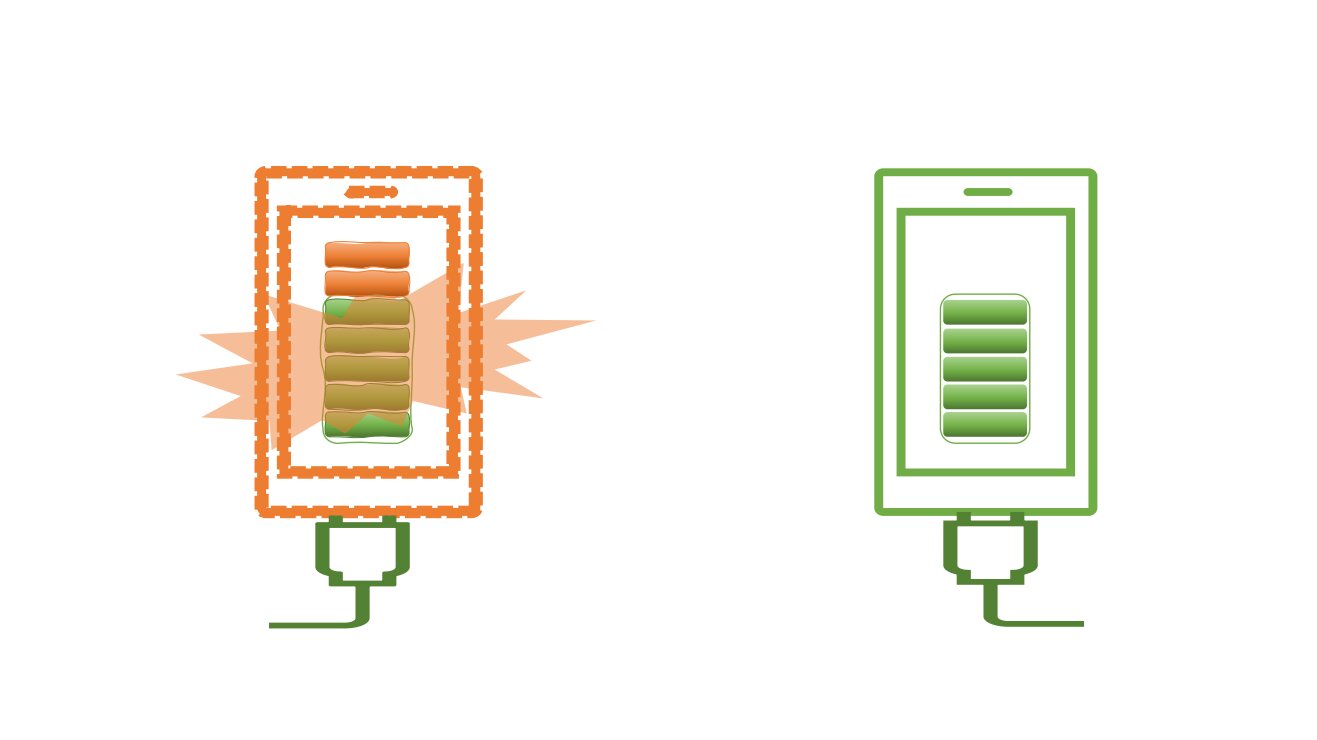 Two examples of "quantum phones", both chargingquantum batteries based on electromagnetic fields. Left: Charging protocol without using a micromaser leads to uncontrolled charging of the battery with possible damage. Right: A micromaser-based charging protocol is able to independently control the amount of charge put into a quantum phone. Credit: Institute of Basic Sciences
However, the scientists' numerical results showed thatThis situation is impossible in micromasers. The electromagnetic field quickly reaches a final configuration (technically called a steady state), the energy of which is determined a priori when the micromaser is built. This property provides protection against the risks of overcharging.
Scientists also found that the finalThe configuration of the electromagnetic field is in a pure state. This means that it does not “bring” the memory of the qubits that were used during charging. The last property is especially important when working with a quantum battery. This ensures that all of its energy can be extracted and used when needed. There is no need to track qubits used in the charging process.
Previously, researchers from the Center for Theoreticalcomplex systems physicists in South Korea have set tight limits on the possible charging performance of a quantum battery. In particular, they showed that a set of quantum batteries will lead to a significant increase in charging speed. Especially when compared with the classic protocol. This is possible thanks to quantum effects that allow the elements of quantum batteries to be charged simultaneously.
Despite these theoretical advances,There are still few experimental implementations of quantum batteries. The only recent known counterexample used a set of two-level systems (much like qubits) to store energy. In this case, the energy was provided by an electromagnetic field (laser).
Read more:
The largest migration in the history of the Earth will affect all living organisms on the planet
Astrophotographers have collected a detailed photo of the Moon from 200 thousand images
Nearly half of cancer cases linked to preventable risk factors
Cover photo: Rosser1954, CC BY-SA 4.0, via Wikimedia Commons