A team of researchers led by NASA's Jet Propulsion Laboratory has developed a detector for
The PEACOQ detector consists of 32 nanowiresonly 7.5 nm thick (about 10,000 times thinner than a human hair). When cooled to an ultra-low temperature of about 1 K (-272.15 °C), such wires become superconducting. When a photon hits a superconducting wire, it is absorbed and creates a hot spot, which noticeably increases the electrical resistance of the wire. Researchers use a computer and a digital-to-time or time-domain-to-digital converter to detect these changes in resistance and count the photons.
When the detector measures a photon, it outputsan electrical impulse, and a digital-to-time converter very accurately measures the time of arrival of that electrical impulse with a resolution of less than 100 picoseconds, or 70 million times faster than a snap of the fingers.
Ioana Craiciu, study co-author at NASA's Jet Propulsion Laboratory
To demonstrate the operation of the device,The researchers cooled the detector with a special cryostat to 1 K. They used a custom-made test setup to direct light into the cryostat to the detector and a chain of electronics to transmit, amplify, and record the detector's output signal from the cryostat.
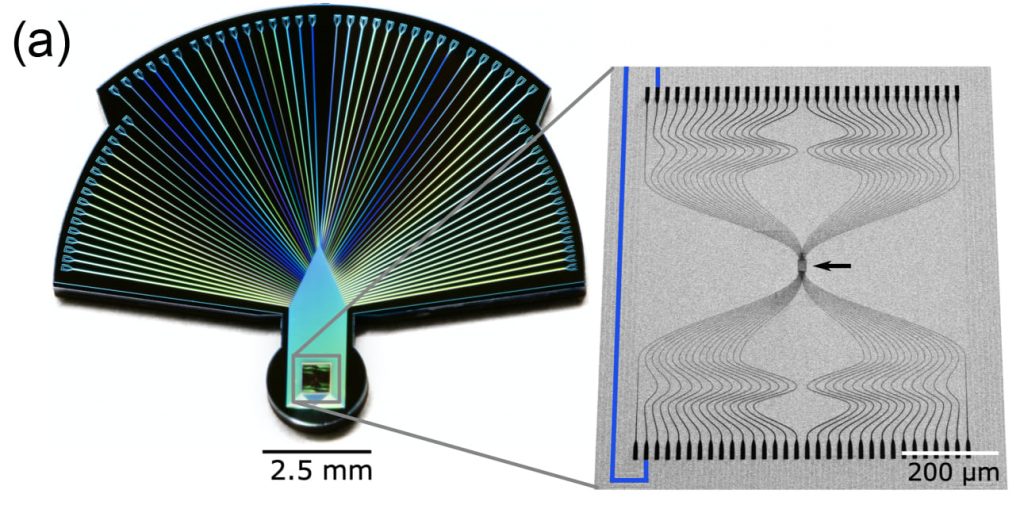 PEACOQ detector. Image: Ioana Craiciu et al., Optica
The analysis showed that the detector detects photonswith a wavelength of 1550 nm with a detection efficiency of up to 78%. In this case, the dark count rate is 158 cps, and the maximum rate exceeds 1.5 billion cps with a compression of 3 dB. The researchers note that there is currently no other detector that can count individual photons so quickly with the same time resolution.
The development will find application in quantum communication,the authors of the study believe. As a rule, the transmitted quantum information is tuned to the clock, with each piece of data encoded into one photon. How accurately the instrument measures the arrival time of photons at the receiver determines how often individual photons can be sent and, accordingly, how quickly information is transmitted.
Read more:
Found a fragment of a mysterious artifact that was used in magical rituals
Real "Terminator-2" turns into a liquid and flows through obstacles
Sword thought to be fake turns out to be a 3,000-year-old Bronze Age artifact