An international team of researchers has developed a quantum dot-based system for transmitting
Physicists used to create singlephotons are quantum dots deterministically coupled to microresonators. The device can be tuned using resonance. Recall that quantum dots are particles of a conductor or semiconductor in which charge carriers (electrons or holes) are spatially limited in all three dimensions. Such devices are small enough, typically only a few nanometers, for quantum effects to show up.
To eliminate the inhomogeneity of quantum dots andshifting the wavelength of radiation in the telecommunications range, scientists have used quantum frequency conversion. Experiments have shown that in the new approach, the observed interference visibility is up to 93% when a signal is transmitted over a 302 km fiber.
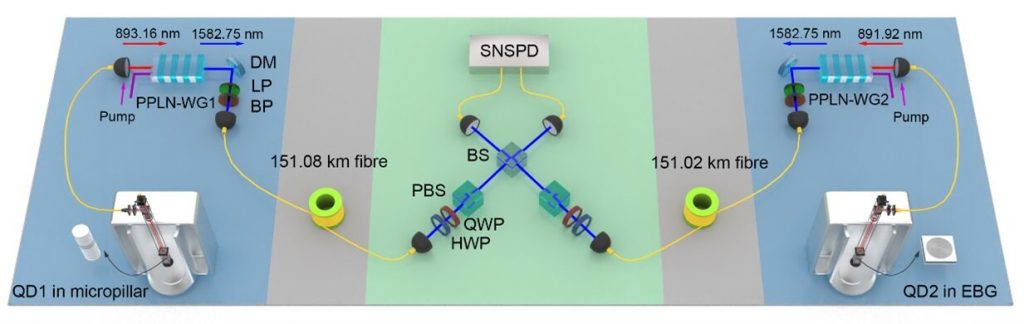 Experimental setup. Image: Xiang You et al., Advanced Photonics
In classical telecommunications, signals can beamplify silently to transmit over long distances. But quantum states in superposition cannot be amplified because they cannot be perfectly cloned, the scientists explain. Therefore, to create such a network, not only quantum channels with ultra-low losses and quantum memory are required, but also high-performance quantum light sources.
Quantum dots are an ideal candidate forcreating massive networks. They provide the necessary properties of a single photon source, but over the past two decades, the visibility of quantum interference between independent QDs has rarely exceeded the classical limit of 50%, and the maximum distances have reached only a few kilometers.
Our work has gone beyond previous quantumexperiments on the basis of QD at scales from about 1 km to 300 km, which is two orders of magnitude greater, and thus opens up an exciting prospect for solid-state quantum networks.
Chao-Yang Lu, professor at China University of Science and Technology
Read more:
The tomb of the “midwife of Jesus” was unearthed: scientists told what they found there
Today, scientists from Earth will hit the asteroid with a radio pulse
Named smartphones on which WhatsApp will stop working from 2023