Physicists at Rice University used ultracold atoms and a one-dimensional light channel to
Electrons are fermions, antisocialquantum particles that refuse to share space with each other, the authors of the study explain. According to the Pauli exclusion principle, two or more identical fermions cannot simultaneously be in the same quantum state in a quantum system.
Separation of spins and charges is a manifestationsuch mutual aversion in one-dimensional space. Physicists Shinichiro Tomonaga and Joaquin Luttinger developed a theoretical model of 1D electron behavior, known as the Luttinger liquid, about 60 years ago, but so far it has been almost impossible to measure the effect quantitatively.
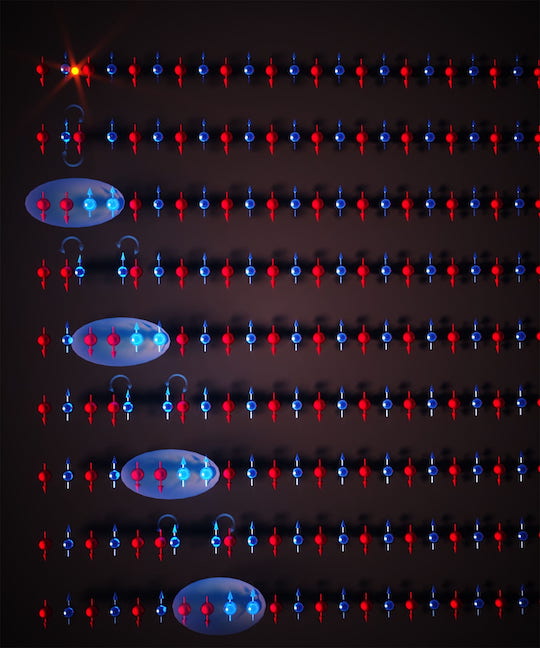 Model of the experiment with the creation of a spin wave(similarly for a charge wave). A laser beam (top left) creates collective waves in a wire that transfer either spin or charge. The spin should point up (blue) or down (red) and the atoms with the opposite spin naturally arrange themselves in an alternating pattern (top row). The wave transfers the spin, successively changing neighboring values. Illustration: Ella Maru Studio, R. Hulet, Rice University
Quantum simulators use quantumproperties of real objects such as atoms, ions or molecules to solve problems that are difficult or impossible to solve with conventional computers. In Rice University's spin charge simulator, ultracold lithium atoms replace electrons, and the light channel is a one-dimensional wire.
When one electron collides with another, ittransfers energy that brings the latter to a higher energy state. In a 3D material, an excited electron is carried away, collides with something, loses some energy, flies in a new direction to collide with something else, and so on, the scientists explain.
In the one-dimensional space of the wire, the movement will becollective: when you "press" on one electron, it transfers pressure to the next, and so on. Tomonaga and Luttinger predicted that spin excitation waves would travel slower than charge waves. Experimental data confirmed this theory, with the wave propagation velocities exactly matching the predictions of modern calculations for the Luttinger fluid.
Researchers observed separation of spin and chargein solid-state materials, but they did not see it in a clear or quantifiable form. Our experiment is indeed the first in which quantitative measurements are obtained that can be compared with an almost exact theory.
Randy Hewlett, Rice University physicist and co-author of the study
The authors of the work note that the results are notnot only theoretical but also practical. The constant reduction in the volume of microcircuits leads to the creation of wires close to one-dimensional space, which means that quantum effects will begin to affect the operation of such devices. In addition, the research will help in the development of technology for topological quantum computers that will encode information in decoherence-free qubits.
Read more:
The Japanese dumped a giant turbine into the ocean to get endless energy from the current.
Astronomers from Japan have found an unknown structure in the galaxy
Researchers filmed a 'hidden' ecosystem in an Antarctic river