Researchers from the ALICE experiment studied howQuark-gluon plasma influences charmonies - mesons (particles) consisting of a charm quark and its antiquark. The results of the work open up new opportunities for studying the strong interaction - one of the four fundamental forces of nature - under conditions of extreme temperature and density of quark-gluon plasma.
Quark-gluon plasma is extremely hot anda dense state of matter in which quarks and gluons exist not inside hadrons (compound particles such as protons and neutrons), but on their own. It is believed that this form of matter existed in the early universe after the Big Bang. It can be recreated by colliding at a huge speed of lead atomic nuclei in the LHC.
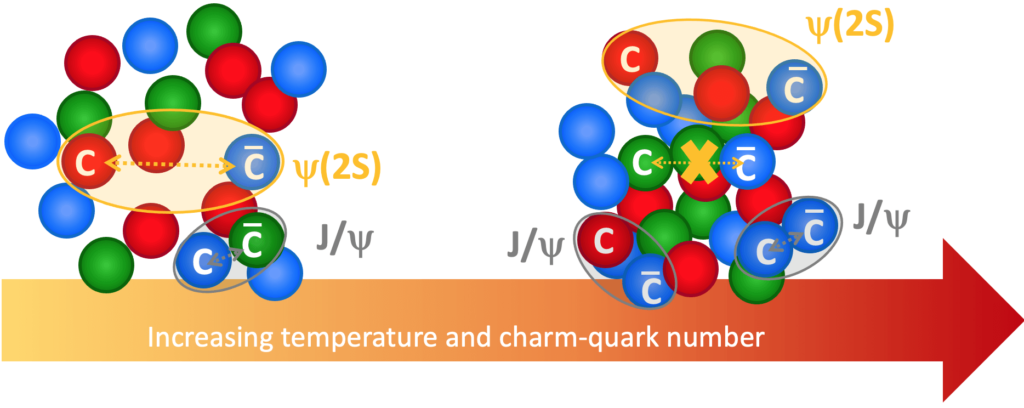 Illustration of the influence of quark-gluon plasma onformation of charmonium in collisions of lead nuclei. As the plasma temperature rises, the more weakly bound state ψ(2S) is more likely to be "shielded" and thus not produced due to more quarks and gluons in the plasma (colored circles). An increase in the number of charmed quarks and antiquarks (c and c̄) can lead to the formation of additional charmoniums as a result of quark recombination. Image: ALICE collaboration)
Bound states of the charmed quark andantiquarks are held together by a strong force, the scientists explain. In plasma, their production is suppressed due to "shielding" by the large number of quarks and gluons present in this form of matter. At the same time, theoretical calculations predicted that these effects manifest themselves differently in different states of charmonium.
Physicists analyzed the data obtained duringthe time of the first two launches of the LHC in 2015 and 2018. The measurement results show that, regardless of the momentum of the particle, the charmonium state ψ(2S) is suppressed approximately twice as strongly as the J/ψ state. This is the first observation of a hierarchy of inhibition of total charmonium production, the scientists say.
The researchers believe that data from the LHC's third run will help to definitively establish how charmonies change and understand the nature of the strong force that holds quarks together.
Read more:
A monster black hole was found in the "backyard" of the Earth: it is very close to our planet
NASA revealed the origin of Haumea - the most mysterious planet in the solar system
Webb photographed the Pillars of Creation. Compare how Hubble shot them before