Researchers from the University of Cologne have discovered that radiation damage to mature sperm
Scientists used the nematode Caenorhabditiselegans as a model for studying the effect of radiation on genetic changes. The study showed that radiation damage to DNA does not interfere with the functioning of sperm, while eggs with similar damage either fully recover or become non-viable if the damage cannot be repaired.
When an egg merges with a damagedWith the sperm, maternal repair proteins attempt to repair paternal DNA. But for this purpose, a mechanism is used that randomly unites broken DNA fragments. This leads to a large number of mutations, the researchers note.
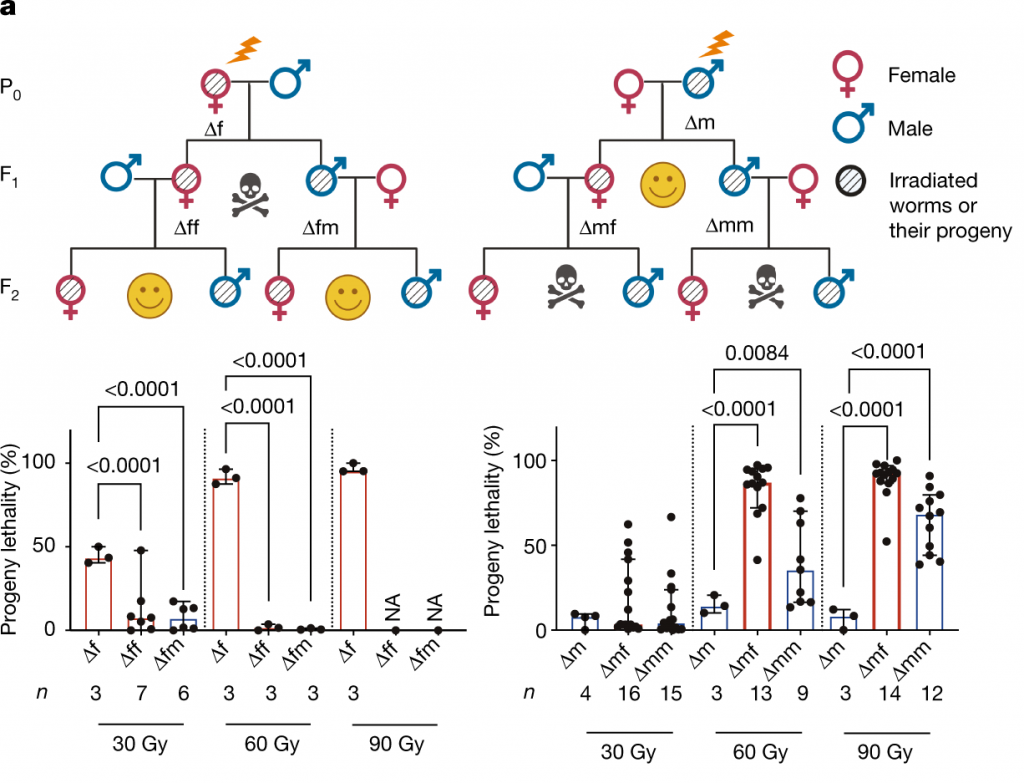 The effect of radiation exposure on women (left) andmale (right) germ cells for embryonic lethality in nematodes. When exposed to radiation on females, lethality is observed in the first generation (non-viable eggs), while in future generations, the born offspring are fully restored to normal levels. Exposure of males to radiation slightly increases mortality in the first generation, but it increases in future generations. Image: Siyao Wang et al., Nature
The offspring resulting from this“repairs” carry chromosomal damage that is not eliminated by standard DNA repair mechanisms. The linked genes are held together by specific histone proteins HIS-24 and HPL-1, which interfere with normal repair, the scientists add.
To check if a similar process works forpeople, the researchers studied genetic datasets collected for the 1000 Genome Project and Islandic deCODE. Scientists found in these sets the same DNA structural variants or randomly assembled chromosomes. As with nematodes, chromosomal aberrations were specifically transmitted from fathers, not from mothers.
The researchers note that such damagecan potentially be applied, for example, during radiation or chemotherapy. Therefore, when planning a pregnancy after such treatment, it is necessary to take into account the possible risk that persists for the two months required to create new sperm instead of damaged one.
Read more:
17-year-old engineer came up with a magnetless motor: it can be used in electric vehicles
A shock wave from the Sun has opened a crack in the Earth's magnetic field
It turned out how old the water we drink today