European astronomers report the discovery of a new powerful radio-loud quasar with a redshift
Quasar selected from cross-correlation datareview of the NRAO VLA Sky, the rapid response system (Pan-STARRS PS1) and the AllWISE Source Catalog. All of them are “responsible” for their range—radio, mid-infrared and visible.
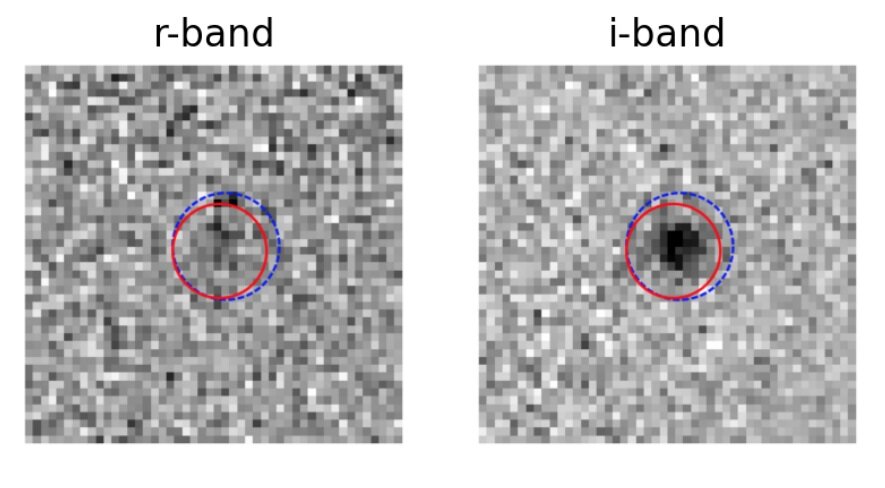 Pan-STARRS PS1 r-band and i-band cut-out images of PSO J191+86.
Image Credit & Copyright: Belladitta et al., 2022
The radio spectrum peak of PSO J191+86 makes a new discoveryThe quasar is one of the most powerful sources ever discovered, with a gigahertz spectrum at high redshift. And the very high radio volume makes the object similar to the main population of blazars that lived in the early Universe. In this case, the linear size of the quasar ranges from 32 to 100 light years.
Redshift is a phenomenon in which the lengthThe wavelength of electromagnetic radiation for an observer increases relative to the wavelength of the radiation emitted by the source. Also called redshift is a dimensionless quantity that characterizes the change in wavelength for a given phenomenon.
Quasars, or quasi-stellar objects, areextremely bright active galactic nuclei containing supermassive central black holes with accretion disks. Their redshift is measured by the strong spectral lines that dominate their visible and ultraviolet spectra.
Astronomers are especially interested in findingnew quasars with a high redshift (above 5.0), since they are the brightest and most distant compact objects in the observable Universe. The spectra of such quasars can be used to estimate the mass of supermassive black holes, which constrain models of the evolution and formation of quasars. If they are also radio bright, then they “help” to learn about the activity of supermassive black holes in the early Universe.
Read more:
A massive impact from a space object triggered the Earth's magnetic field
Scientists Confirm Alternative Gravity Theory: Why It Changes Physics
Pig heart beats slower after transplant to human