Physicists have identified the source of a quasi-periodic pulsation during a Class C solar flare.
Quasi-periodic pulsations are often foundin solar and stellar flares, the authors of the work say, but their nature has not yet been understood. The researchers observed the solar flare with the EOVSA radio telescope. This instrument probes the Sun over a wide range of microwave frequencies from 1 to 18 GHz and is sensitive to radio emission emitted by high-energy electrons in the Sun's atmosphere.
Researchers have identified a strong signalquasi-periodic pulsation at the base of the electric current layer, which stretches for more than 25 thousand km through the flare region. In this area, opposing magnetic field lines converge, break, and reconnect, generating intense energy that powers the flare.
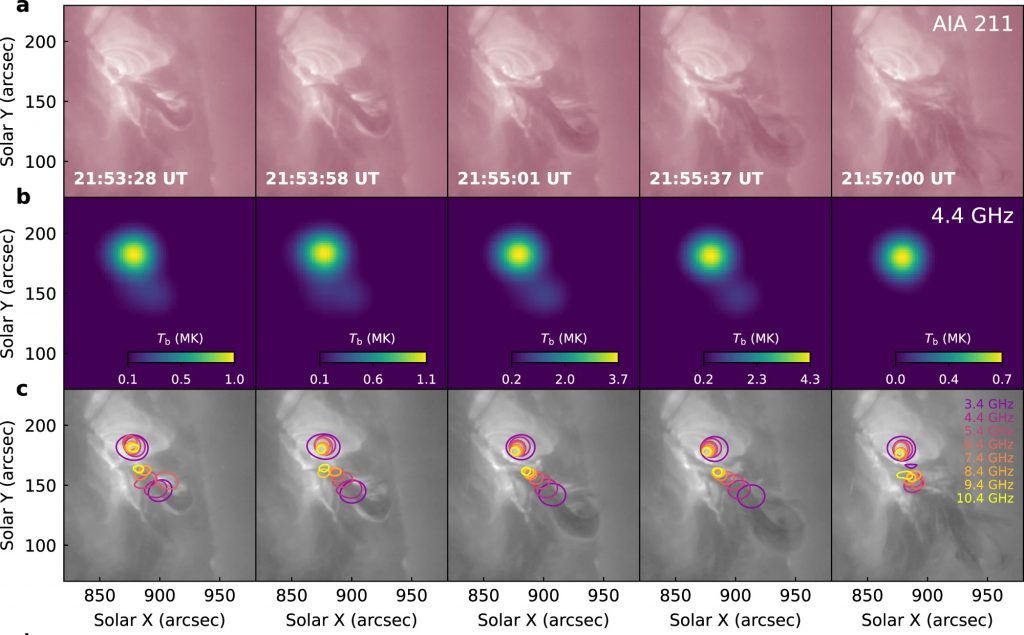 Two regions of sources of quasi-periodic radiation. Image: Yuankun Kou et al., Nature Communications
Similar signals with a repeating “pattern” are notrare for solar flares, the researchers note. But for the first time they were able to detect a second source located along the stretched current layer of the flare, which pulsates in the same way as the main one.
For the first time, a quasi-periodic radio signal located in the reconnection region has been discovered. This discovery will help us determine which of the two sources caused the other.
Siji Yu, study co-author
Further studies showed that in the currentlayer, magnetic islands or bubble-like structures are formed, which quasi-periodically move towards the flare region. They play a key role in adjusting the rate of energy release. The quasi-periodic process results in a repetitive production of high-energy electrons, manifesting itself as pulsations in the microwave and soft X-ray ranges.
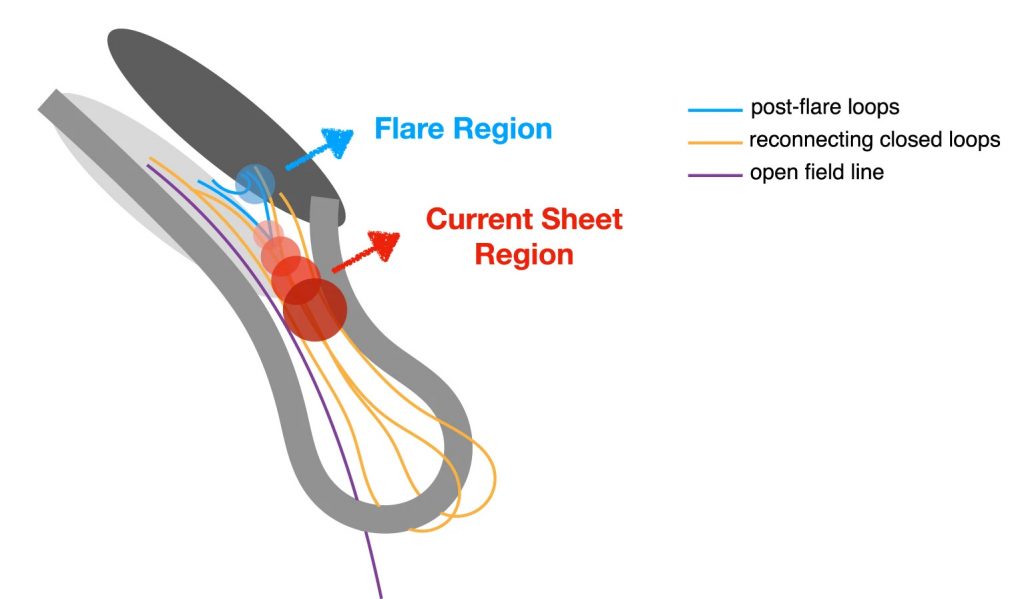 Artistic illustration of the structure of a solar flare. Image: Yuankun Kou et al., Nature Communications
Read more:
Giraffe mating is even stranger than previously thought
Biologists understand why naked mole rats give birth 'infinitely'
It's not about the Earth: scientists explained why the solar system is the rarest