Australian astrophysicists combined observations from two radio telescopes to find missing remains
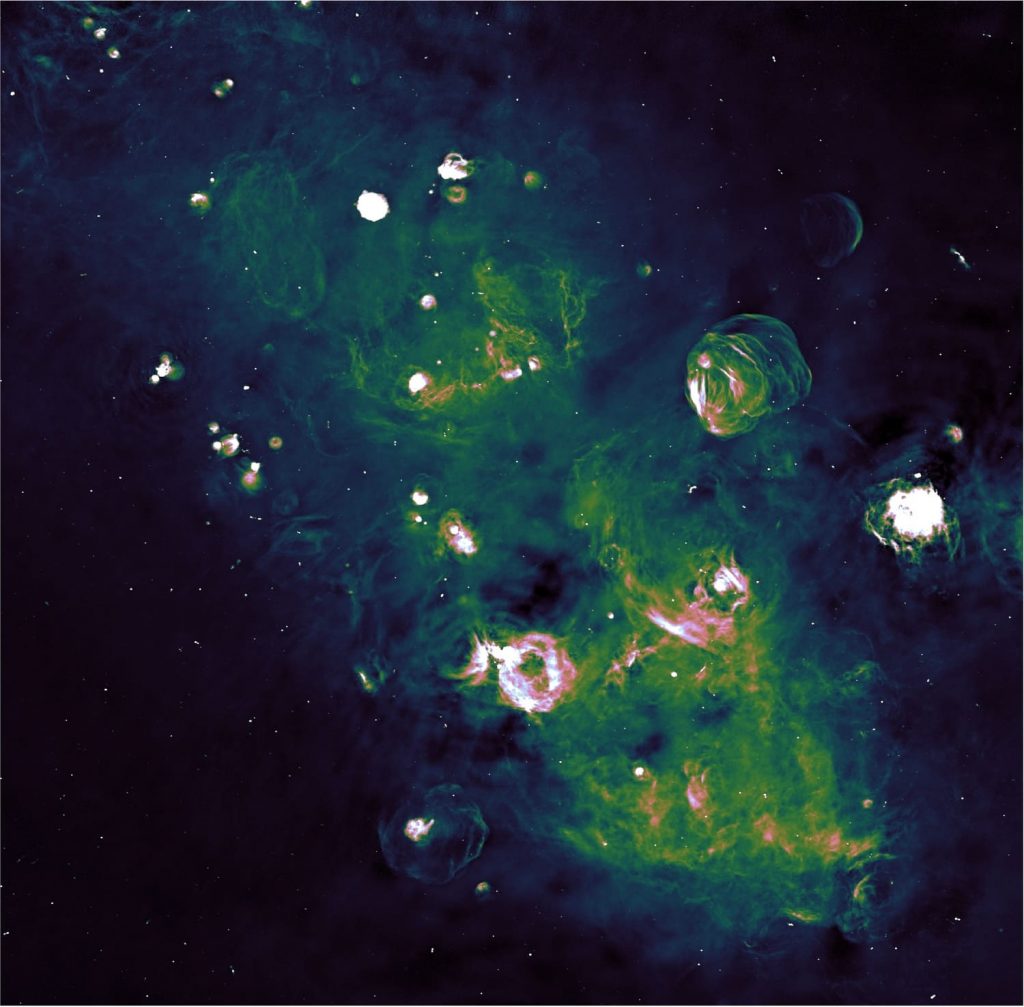 Combined data from two radio telescopes. Image: R. Kothes (NRC) and the PEGASUS team
Models of the universe predict that in spacethere must be many more supernova remnants—expanding clouds of gas that form after the explosive death of stars. For example, even in the Milky Way, researchers have observed five times fewer supernova remnants than theories predicted.
In the new work, scientists used observationsthe radio telescope of the Parkes observatory and the ASKAP interferometer to find the lost traces of stellar explosions. The first one captures wide areas of the sky, while the second one is high resolution and captures images with a lot of detail.
Having studied only 1% of the galactic plane of the MilkyAlong the way, the researchers found over 20 supernova remnants in an area that normally only shows seven exploding star trails. The researchers note that each telescope individually does not see these supernovae. Pictures taken by the Parkes Observatory show only a greenish haze. And the ASKAP images contain a lot of detail, but overlook the connections between them.


Image of one area in different imagestelescopes. Left: photograph from the ASKAP telescope. Image: R. Kothes (NRC) and the EMU and POSSUM teams. Right: Photo from the Parkes Observatory radio telescope. Image: E. Carretti (INAF) and the PEGASUS team
The researchers note that both telescopescontinue to explore the Milky Way. Once the projects are completed, the scientists hope to map much of the galaxy and cover an area nearly 100 times larger than the test image. Astrophysicists believe that this will help discover up to 1,500 new supernova remnants.
Read more:
The strongest class X flare occurred on the Sun
Look at the consequences of the collision in 1181 of two stars
Blazar, which was found 20 years ago, turned out to be an extreme object