How and where it was discoveredeinsteinium?
Einsteinium (253Es) is a radioactive element in the periodic table
Einsteinium was discovered almost simultaneously with fermiumis the result of research into the products of the explosion of a thermonuclear device produced by the Americans in the Pacific Ocean in November 1952 (test "Mike").
Ivy Mike (Mike Test, M Test) is the world's first thermonuclear explosive device test.It was produced by the United States on November 1, 1952 at one of the motus of Eniwetok Atoll.Due to its weight and dimensions, as well as its use of liquid deuterium as a fuel for thermonuclear fusion, the device had no practical value as a weapon and was intended solely for experimental verification of the "two-stage" design proposed by Ulam and Teller.The experiment was a success; The estimated power of the explosion was 10-12 megatons of TNT.
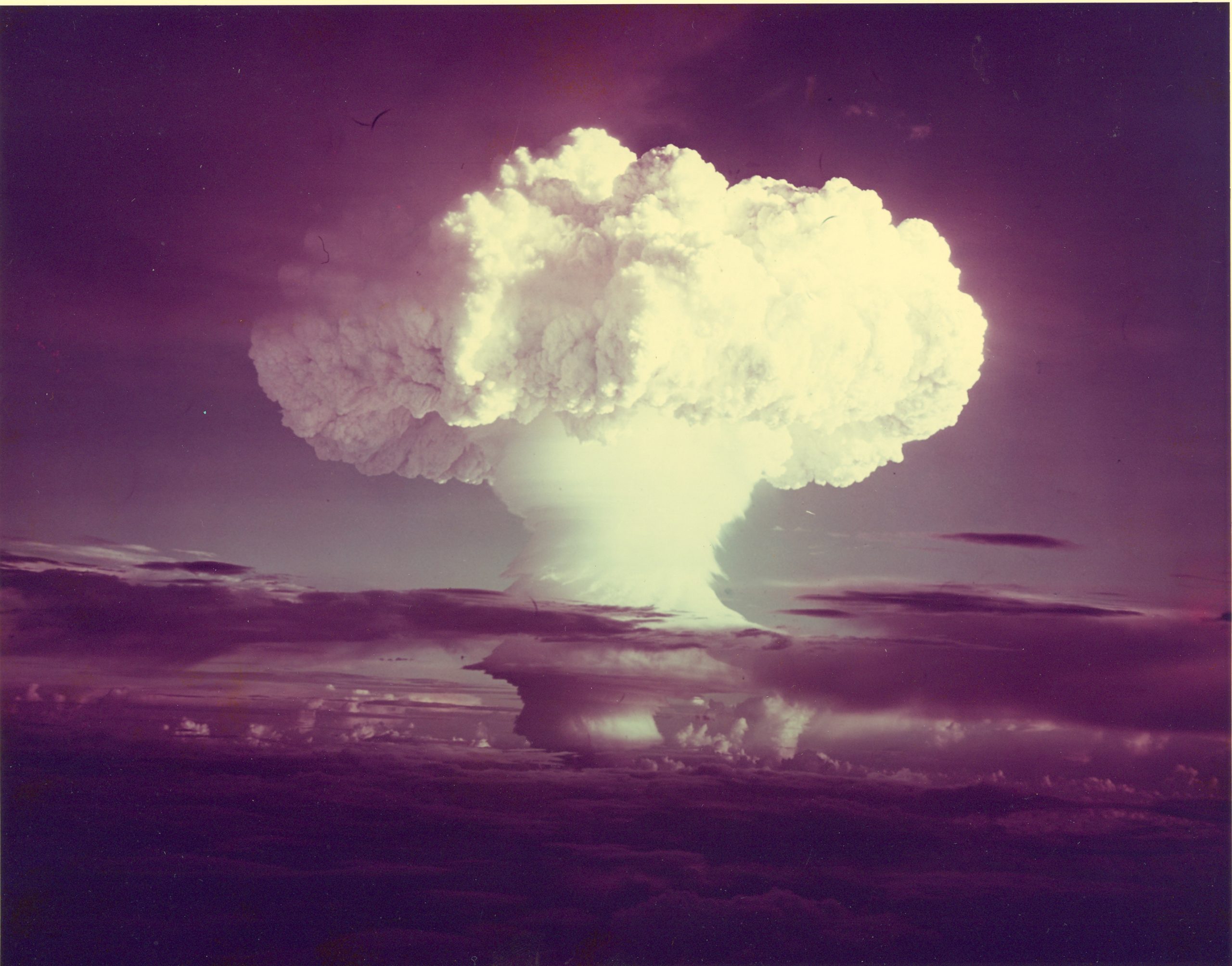 Eevee Mike (power 10.4 Mt) - atmospheric nuclear tests conducted by the United States on Enewetak Atoll on November 1, 1952. This is the first successful test of a hydrogen bomb.
The explosion products were found to contain particularly heavy uranium and plutonium nuclei, including 224Pu and 246Pu.The formation of such nuclei could only be the result of the instantaneous capture of several neutrons by 238U nuclei (from6 to 17!). This suggested that the nuclei of elements with an atomic number greater than 98 could have been formed simultaneously with the heavy isotopes of uranium and plutonium.
Indeed, the separation of the explosion products revealed the presence of a new heavy element, and after processing a large amount of coral sediment and dirt brought from the site of the explosion, it was possible to isolate two isotopes (253 and 255) of the new element.It was given the name "Einsteinium" in honor of the greatest mathematician and physicist of the 20th century.Later, the element99 was produced artificially by other methods, mainly by prolonged irradiation of plutonium with high-energy neutrons.With this method, several grams of einsteinium can be obtained in 2-3 years; In a thermonuclear reaction, it is formed in a few thousandths of a second.The most stable isotope, einsteinium-254, has a half-life of about 270 days.
Why is it poorly understood and how is it used?
Einsteinium is a radioactive metal and belongs to the actinide family.oxidation states of 2 and 3.An example is its iodide with the chemical formula EsI3.In an ordinary aqueous solution, einsteinium exists in its most stable form in the form of ions.
Also, this metal is distinguished by a cubic face-centered lattice, while the lattice parameters are about 0.575 nanometers, the melting point is 860 °C.It is characterized by relatively high volatility. Many solid compounds of einsteinium have been synthesized and studied, such as Es₂O₃, EsCl₃, EsOCl, EsBr₂, EsBr₃, EsI₂and EsI₃.
A total of 19 isotopes and 3 isomers with mass numbers from 243 to 256 are known. The longest-lived of the isotopes, 252Es, has a half-life of 471.7 days.
It is used to obtain mendelevium by bombarding a cyclotron with helium nuclei.
 Quartz vial (diameter 9 mm) containing ~ 300 μg of solid 253Es. The resulting illumination is the result of the intense radiation of 253Es. Credit: Haire, RG, US Department of Energy.
However, scientists have done few experiments with pure einsteinium, and the fact is that it is very difficult to recreate. A team of chemists from Berkeley Lab overcame these hurdles to report the first study characterizing some of its properties, opening the door to a better understanding of the remaining transuranic elements of a number of actinides.
How is the element being studied now?
Study “Structural and Spectralcharacteristics of the einsteinium complex ”, published in the journal Nature, was carried out jointly by a female scientist from the Berkeley laboratory, Rebecca Abergel, and a scientist from the Los Alamos National Laboratory, Stosh Cosimore. Scientists from two laboratories also took part in the work - the University of California at Berkeley and Georgetown University. In total, scientists had about 250 nanograms of the element at their disposal, and this amount of substance was enough to measure for the first time the length of the chemical bond of this element - the main property that determines its interaction with other atoms and molecules.
Today about einsteinium is knownLittle. Having figured out its chemical behavior, scientists can apply this knowledge to develop new materials or new technologies. And not necessarily only with Einsteinium, but also with other actinides. Scientists point out that a thorough study of einsthenia will help in the future to discover new chemistry - at least one new element.
How did scientists manage to recreate it for study?
Abergel and her team used experimental facilities that were inaccessible decades ago when einsteinium was first discovered—the Berkeley Laboratory Molecular Foundry and the Stanford Synchrotron Light Source (SSRL) at SLAC National Accelerator Laboratory, both facilities of the U.S. Department of Energy's Office of Science— to conduct luminescence spectroscopy and X-ray absorption experiments Spectroscopy.
The scientists note that obtaining the sample in a usable form was almost half the success.
The material is manufactured in a high-energy isotope reactorstream at Oak Ridge National Laboratory. This is one of the few places in the world where the creation of einsteinium is possible in principle. The reactor used neutron bombardment of curium targets to trigger a long chain of nuclear reactions. The first problem they encountered was that the sample was contaminated with significant amounts of Californium, since it is extremely difficult to obtain pure einsteinium in a usable amount.
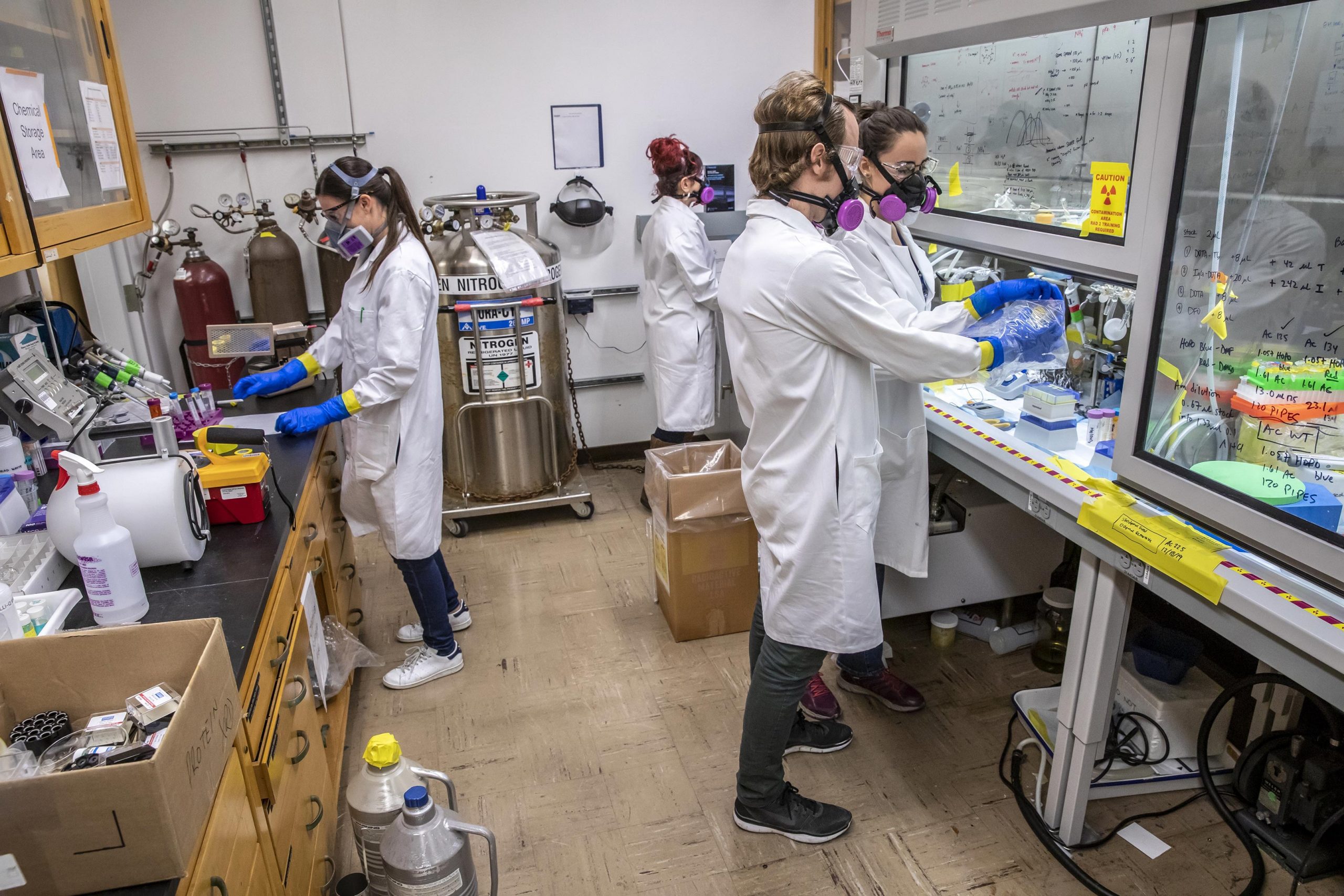 Berkeley scientists Jennifer Wacker(from left to right), Leticia Arnedo-Sanchez, Corey Carter, Catherine Shield work in Rebecca Abergel's chemistry laboratory. Credit: Marilyn Sargent / Berkeley Lab
So they had to give up theirthe original plan to use X-ray crystallography, which is considered the gold standard for obtaining structural information about highly radioactive molecules, but requires a pure metal sample, and instead came up with a new way of making samples and using elemental research methods. Researchers at Los Alamos provided critical assistance during this phase by developing a sample holder that is uniquely suited to address the inherent problems of Einsteinium.
Then another problem was the fight againstradioactive decay. The Berkeley lab team conducted their experiments with einsteinium-254, one of the most stable isotopes of this element. Its half-life is 276 days, which is the decomposition time for half of the material. While the team was able to conduct many experiments before the coronavirus pandemic, they had plans for follow-up experiments that were interrupted due to outages related to the pandemic. By the time they managed to return to their laboratory last summer, most of the sample had already disappeared.
What did the scientists find out?
However, the researchers were able to measurebond distance with Einsteinium, and also found some physicochemical behavior that was different from what would be expected from a number of actinides. These are the elements on the bottom line of the periodic table.
Having received a picture of the arrangement of atoms in a molecule,including einsteinium, scientists measured the length of a chemical bond and discovered some interesting chemical properties. The features of the luminescence and spin-orbit coupling of Einsteinium were different from what one would expect from an element of the actinide series - the bottom line of the periodic table.
This series contains elements or isotopes thatuseful for the production of nuclear energy or radiopharmaceuticals. With new data, we will better understand how the entire range of actinides behaves.
Rebecca Abergel from Berkeley Lab
Surprisingly, this research also provides an opportunity to explore beyond the periodic table and perhaps discover a new element.
Read more
Look at an 8 trillion pixel image of Mars
Scientists have developed a replacement for the theory of relativity. What is the essence of the "theory of everything"?
Scientists have found evidence of interbreeding of modern humans with Neanderthals
Curium, or rather certain isotopes of curiumproduced in nuclear reactors. Accumulation of curium atoms occurs through the successive capture of neutrons by the nuclei of target elements. Further, when curium accumulates in sufficient quantities, it is isolated by methods of chemical processing, concentrated and mainly curium oxide is produced. Curium metal is extremely expensive and is still used in the most important areas of nuclear technology, nevertheless, there are so-called curium programs in the USA and Russia.
Named after Pierre and Marie Curie.
Motu are small islands surrounding the central island of the atoll, formed as a result of the rise of a coral reef. Motu is found only in tropical waters.