Fulgurite was discovered near a power line that collapsed during a storm in 2008. In general
The quasicrystal discovered in Nevada is a mixturesand and metal materials in the electrical line, including manganese, silicon, chromium, aluminum and nickel. To combine them, the temperature of the sand had to reach at least 1,710 °C for a short time, the researchers said.
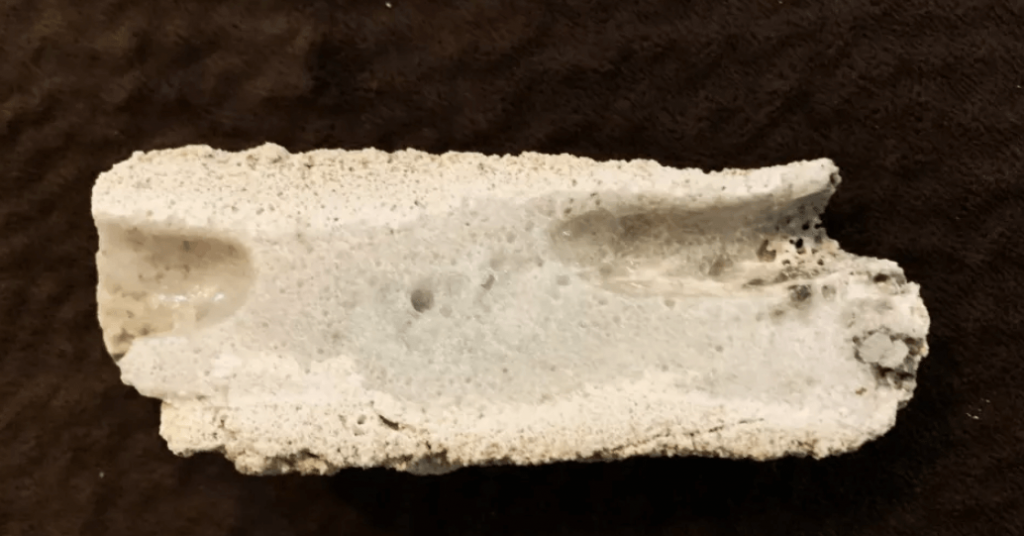 Fulgurite, found in Nebraska, contains a rare material known as a quasicrystal. Image credit: Luca Bindi
In the search for quasicrystals, scientists are studyingfulgurites. They are formed when lightning strikes sand, fusing the sand grains together into a branched glass tube. One of them was found in the Sandhills, Nebraska, USA, near the village of Hyannis. This area consists of grass-covered sand dunes.
Quasicrystals are materials that disrupttraditional rules of crystallography. Before they were first reported in 1984, scientists thought the materials could be either crystalline—with symmetrical, repeating patterns—or amorphous, meaning randomly arranged. In addition, scientists believed that crystals could only be symmetrical a limited number of times when rotating around an axis—two, three, four, or six.
Quasicrystals “violate” these rules.They are distinguished by rotational symmetry, which is inaccessible to a conventional crystal. For example, a quasicrystal with icosahedral symmetry exhibits fivefold symmetry around six different lines of rotation.
Read more:
The most beautiful photos of "Webb" for 2022: see what the $ 10 billion telescope did
The sun opened the year with a flash of the most powerful class
The secret of the durability of Roman concrete is revealed: it can be restored