Physicists at the US Department of Energy's Princeton Plasma Physics Laboratory (PPPL) have taken an important step towards
Why is it so important to achieve nuclear fusion?
Nuclear fusion is a physical process thatpowers our Sun. It occurs when atoms are forced together at extremely high temperatures and pressures, causing them to release enormous amounts of energy by fusing with heavier atoms.
Scientists around the world are working tocapture and direct the process of atomic fusion on Earth to develop a clean, carbon-free and possibly inexhaustible source of energy. They have already made several attempts, but only for a few seconds. One reason is thermal collapse.
Why does thermal collapse occur and what is it?
One problem that scientists have previously been unaware of in their study of thermal collapse is the three-dimensional shape or topology of the erratic field lines caused by turbulent instability.
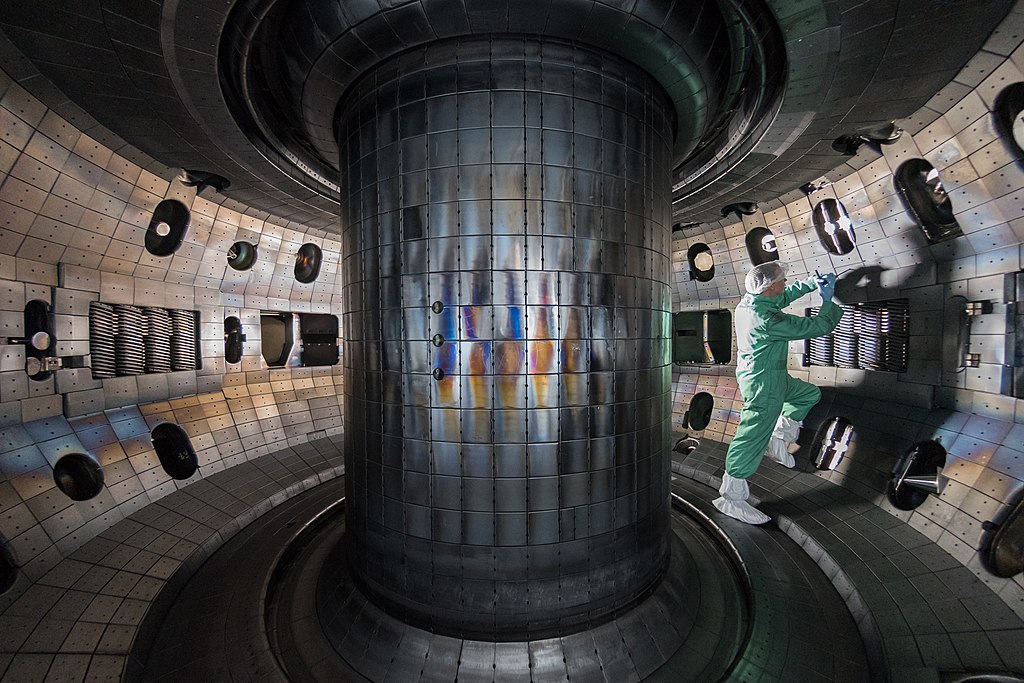 Photo: Rsvilkoks, CC BY-SA 4.0, via Wikimedia Commons
She caused the creation of tiny "hills"and “valleys,” where some particles are retained while others roll down “hills” and impact the walls of the object. The existence of these "hills" causes a rapid temperature collapse, the so-called thermal quenching.
In a new study, scientists tracedcollapse to three-dimensional disorder of strong magnetic fields. They are used in thermonuclear installations as substitutes for powerful gravity, which holds fusion reactions in celestial bodies, for example, in the Sun.
However, in laboratory experiments these fieldsdisordered due to plasma instability. In the event of a serious violation, the field lines become completely disordered, “tangling like spaghetti,” the scientists write. Because of this, a large number of particles “stick” to the wall of the tokamak. The resulting heat can damage the walls of the fusion facility.
What have the scientists done?
As part of a new study, scientistsfigured out how to create a special map to understand the topology of power lines. This levels out the magnetic “hills”. Without them, most electrons would be trapped and would not be able to cause the thermal quenching observed in experiments.
Thus, scientists simulated the topology of thermalcooling as a complex three-dimensional structure. Notably, they avoided the oversimplifications that so often mislead physicists. This topology is notoriously difficult to understand due to the complex interaction between electric and magnetic fields. PPPL researchers used the Lab's GTS code to understand it .
How it works?
The code models the effect of turbulentinstability on particle motion. It shows how the electric field created in the installations throws particles between the magnetic field lines and then contributes to the resulting movement of the trapped particles. This is what leads to thermal quenching.
Why is it important?
New study explains in terms ofphysics, how plasma loses energy towards the wall in the presence of magnetic field lines. This is very useful for finding innovative ways to mitigate or prevent thermal quenching and plasma breakdown in the future.
Read more:
It turned out what happens to the human brain after one hour in the forest
It became known which tea destroys protein in the brain
Strange sea creatures in the depths of the ocean turned out to be similar to humans
Cover photo: Eye Steel Film