Astronomers have found evidence of an unusual type of supernova near the center of the Milky galaxy.
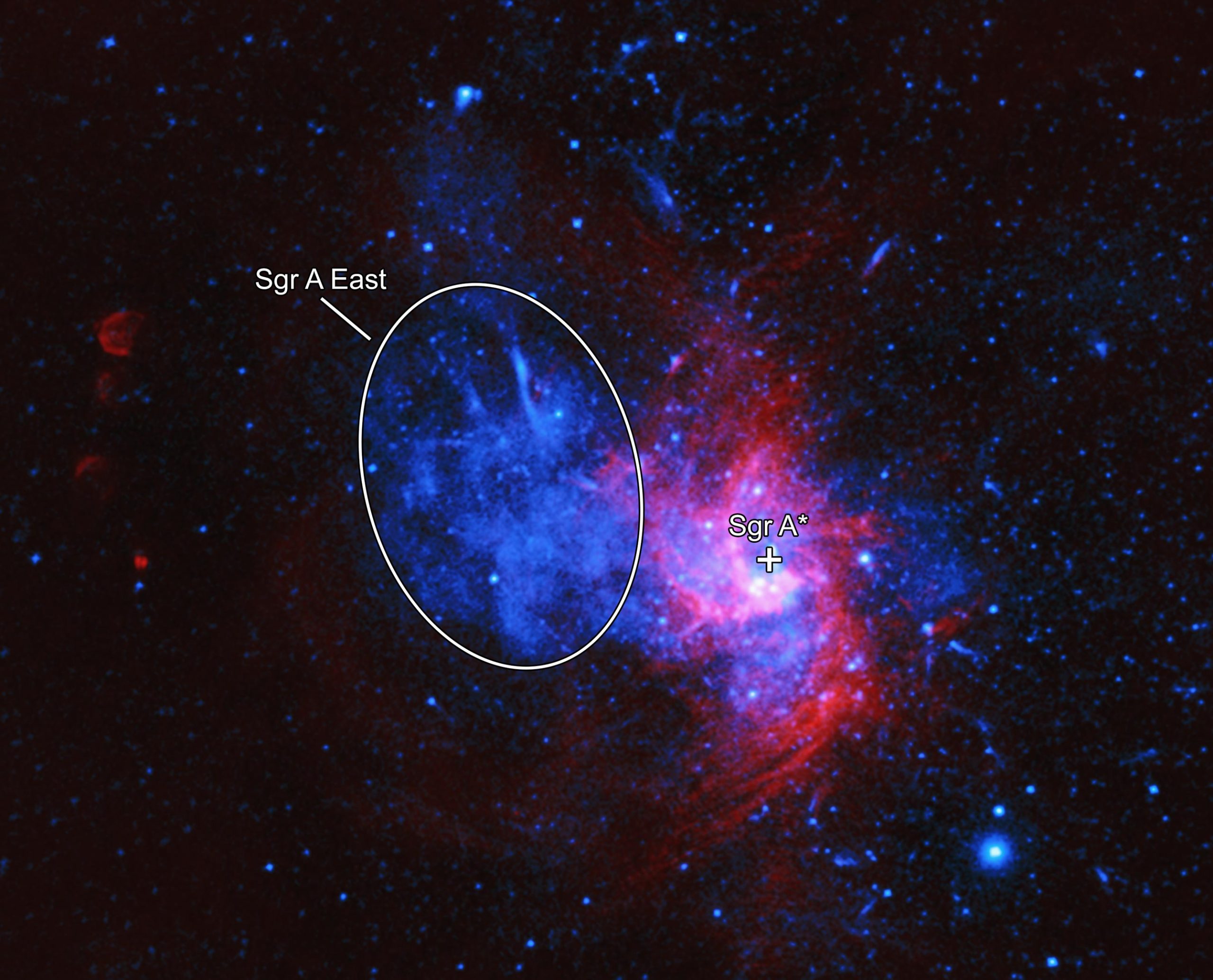
This object is located very close to the supermassive black hole at the center of the Milky Way and is likely to extend beyond the black hole's accretion disk.
The X-ray spectrum of Sgr A East shows thatit is a strong candidate for a so-called Iax supernova. These are a special class of Type Ia supernova explosions that are used to accurately measure distances in space and study the expansion of the universe.
Type Ia supernovais a subcategory in the classification schemeMinkowski-Zwicky supernovae, developed by German-American astronomer Rudolf Minkowski and Swiss astronomer Fritz Zwicky. This classification was based on the spectral characteristics of the radiation and does not coincide with the mechanism of the processes occurring: type Ia supernovae are associated with a thermonuclear explosion of the white dwarf substance, while supernovae Ib, Ic and all type II supernovae are associated with the collapse of the star’s core.
In 2013, it was proposed to additionally identify a separate class of supernovae Iatype Iax supernovaethat differ in less luminosity,the preservation of the white dwarf after the explosion (at least by some of the stars) and the acquisition by their remnants of high speeds. The actual difference between these two types is the degree of involvement of the dwarf matter in thermonuclear "combustion" - in classical Ia, thermonuclear fusion affects the entire volume of the star, completely dissipating it, while in Iax, due to the asymmetry of the processes, only part of the star explodes, and the rest remains as a compact object.
Astronomers still argue about the causes of the explosionstype Iax supernovae, but the main theory is that they involve thermonuclear reactions that travel through the star much more slowly than in normal type Ia supernovae. This relatively slow rate of explosion leads to weaker explosions and therefore to different amounts of elements produced during the explosion. Researchers found this characteristic pattern of elements in Chandra's observations over Sgr A East.
Iax supernovae occur in other galaxiesabout three times faster than Type Ia supernovae. The Milky Way has three confirmed Type Ia supernova remnants and two candidates that are less than 2,000 years old. If Sgr A East is less than 2,000 years old and is an Iax supernova, new research suggests the Milky Way matches the relative amount of Iax seen in other galaxies.
The results of the work will be published on Wednesday, February 10, 2021, in The Astrophysical Journal, and the preprint is already available online.
Read more
Look at an 8 trillion pixel image of Mars
A nuclear rocket engine is being built for flights to Mars. How is it dangerous?
Abortion and science: what will happen to the children who will give birth
Very large array
Accretion disc is a structure that occurs inas a result of the fall of a diffuse material with a rotational moment on a massive central body. Accretion disks appear around stars in close binaries, in rotating galaxies and in protoplanetary formations.