A study of the ancient remains of Homo Sapiens found at Bacho Kiro in Bulgaria revealed that the cave's inhabitant,
Scientists believe that colonization by our speciesEurasia occurred as a result of several waves of active expansion, which ended in partial extinction. The distribution of all waves, according to scientists, was carried out from a single center, the ancestral home of all Eurasians, which was formed after Homo Sapiens first left Africa about 60-70 thousand years ago. According to anthropologists, the exact location of this center is not yet known, but they believe that it should be sought in the Middle East and the Arabian Peninsula.
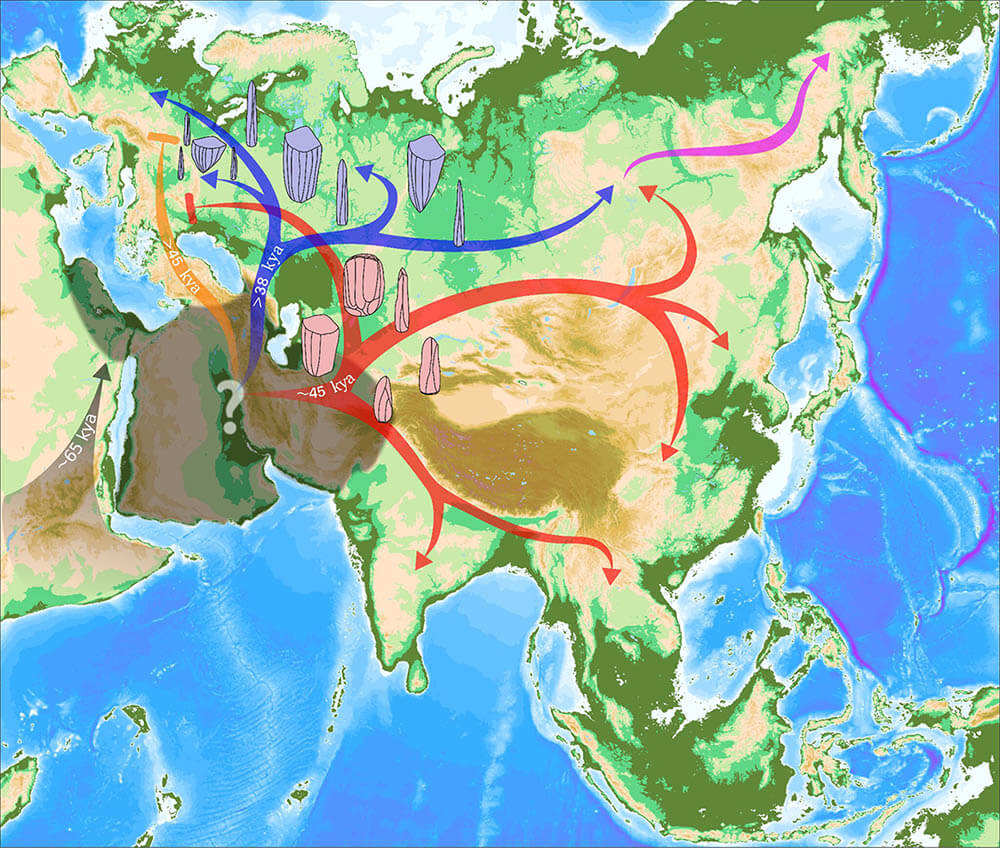 The scheme of the settlement of Eurasia.Orange - the first wave (more than 45 thousand years ago), red - the second wave (about 45 thousand years ago), blue - the third wave (about 38 thousand years ago). Source: Leonardo Vallini, Giulia Marchiani
The first expansion took place over 45,000 years ago.years ago and ended in failure. The remains of the only representative (more precisely, the only representative) of this migration wave were found in the town of Zlaty Kun in the Czech Republic. Genetic analysis of the woman's skull showed no links to either modern Europeans or modern Asians. The researchers note that it is not yet clear how widely representatives of this wave have spread across Eurasia.
Then, about 45 thousand.years ago, a new wave of expansion began from the center of distribution, which captured a vast territory from Europe to East Asia and Oceania. This wave is associated with the production and use of stone tools dating back to the initial Upper Paleolithic.
Leonardo Vallini, molecular anthropologist at the University of Padua and leader of the study
As the researchers note, the fate of the second waveexpansion turned out to be different: the settlers who settled in Asia, for the most part, survived and became the ancestors of the modern inhabitants of this part of the world. At the same time, almost nothing remained of the European part of this migratory wave except for individual finds, for example, the remains from Bacho Quiro in Bulgaria, from Peshtera cu Oase in Romania and some others. Scientists note that the last Neanderthals died out around the same time.
“Finally, the last expansion occurred around 38thousand years ago. These settlers re-colonized Europe from the same population center, the location of which has yet to be clarified,” says Luca Pagani, co-author of the study from the University of Padua.
Anthropologists believe that in Europe there were onlyrare, random interactions between the new settlers and the surviving descendants of the second wave of colonizers. Extensive and massive mixing between representatives of the two waves occurred only in Siberia and led to the creation of a special genotype, known as the Ancient North Eurasian. These settlers later became the ancestors of the indigenous peoples of America.
Scientists associate the third wave of colonization withcultural finds of the Upper (Late) Paleolithic. The researchers note that they differ significantly from the finds of the initial Upper Paleolithic of the second wave.
It is noteworthy that from a cultural point of viewIn general, the new stone tools of the Upper Paleolithic were often portrayed as an independent development rather than as a development of pre-existing technology in Europe. It's good to see a complex scenario that integrates genetic and cultural data.
Telmo Pievani, co-author of the study from the University of Padua
Scientists plan to continue their work to establish where the center, the single ancestral home of the Eurasians, was located. In addition, they want to understand what causes each of the waves of settlement.
Read more:
There is another “planet” inside the Earth: how it saved nascent life
Nuclear fusion no longer needs millions of degrees: how the new method works
New study refutes light energy transfer theory