Ophthalmological researchers and programmers from the University of California, Irvine combined filming,
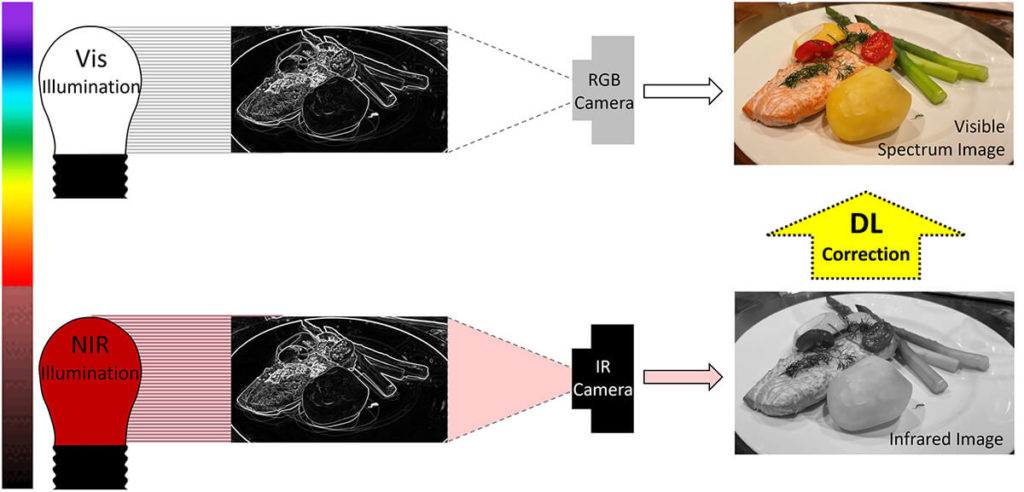
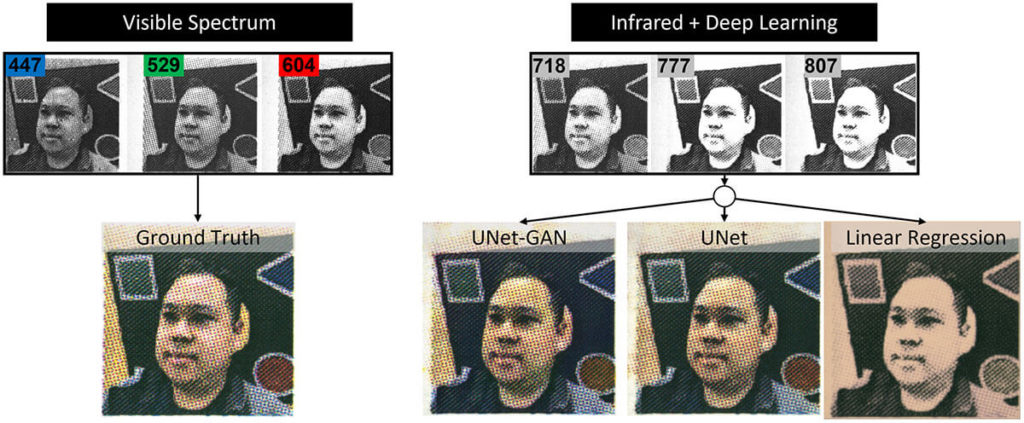
The authors of the development experimented with the camera,sensitive to both visible and near infrared light. The resulting images were processed by the researchers using a convolutional neural network. They used this system to analyze 140 images of faces printed using cyan, magenta, yellow and black ink illuminated with multispectral illumination spanning both visible and infrared wavelengths.
Scientists have found that when testing 20printed faces that were illuminated only by invisible near-IR light, their system was able to successfully predict and reconstruct how those faces would look in visible light.
 Source: Plos One, A.W. Browne et al.
As the researchers note, systems of nightVisions based on IR light usually render scenes only in green, losing the hues seen in normal lighting. Innovative devices try to use ultra-sensitive cameras to amplify visible light, but even these are ineffective in complete darkness, where there is no light to amplify. Using a trained neural network solves this problem.
 Source: Plos One, A.W. Browne et al.
Scientists point to a wide range of possibleindustries in which their development can be used. According to the authors of the study, the imaging technology will be useful for military instruments and devices, in the chemical industry when working with reagents that are sensitive to visible light, in medicine and scientific research.
For example, researchers are currently working onusing technology when performing eye surgeries using low-energy light (that is, light in the red and infrared part of the spectrum).
“If you illuminate the retina with ordinary visiblelight for a long period of time (which is often required for surgery), the retina can be damaged, explains Pierre Baldi, one of the authors of the study. “So we want to use low-energy light so as not to damage the retina, but still allow the surgeon to see everything just like normal light.”
Read more:
MIT builds stationary heat engine that outperforms turbines
After ten years of work, scientists questioned the standard model of physics
One of the largest ice shelves collapsed due to water flows