It took 25 years and $10 billion to develop the James Webb Space Telescope (JWST).
Being in the orbit of the second Lagrange point (L2) forbeyond the moon, he has almost completed preparations for science missions that will forever change the way people study space. His discoveries will influence astronomy, astrophysics and many other scientific fields.
But over the last few weeks, "Webb"has already managed to show itself by sending several images to Earth. And although these are just test photos, each of them hints at the unprecedented power of the successor to the Hubble Space Telescope.
The first image of the Webb telescope
At the end of the procedure, which is called precisephasing, the main mirror of the James Webb Space Telescope, which consists of 18 hexagonal segments, was focused, pointing at the singular star 2MASS J17554042+6551277. As a result, on March 11, 2022, Webb sent the alignment image to Earth. However, by combining 18 different photographs, the resolution accuracy was increased to 50 nanometers. And this is only part of the wavelengths that Webb will pick up when it begins full operation.
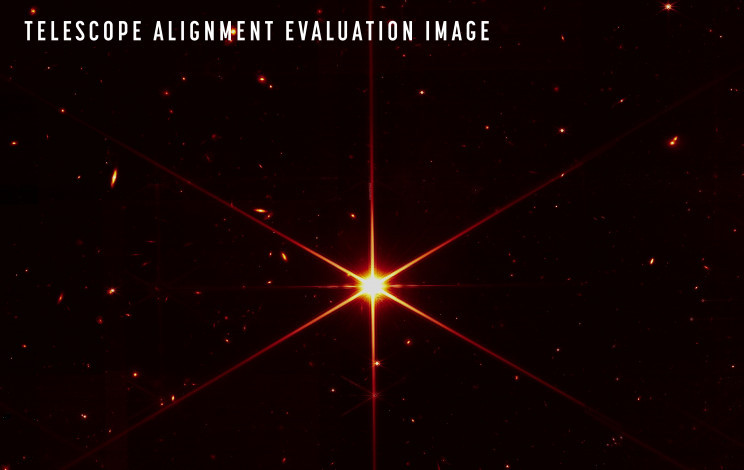 Every point of light behind a star is an ancient galaxy.
Source: NASA/STScI
“Although so far we have only seenSome test images from the Webb telescope, my favorite is probably the alignment image,” said Klaus Pontoppidan, a research scientist at the Space Telescope Science Institute (STScI), in an interview with IE. “This star shows that the telescope is almost perfectly focused, which is a groundbreaking feat of engineering.”
Most people only see the star in the middle,which, of course, is very beautiful. But the real beauty is the abundance of ancient galaxies in the background. “The stunning field of distant galaxies in this test image by «Webb» shows that he has already extended his hand through the Universe,” added Pontoppidan. And this is just the beginning.
If Webb spends more than 20 minutes filming, the background of galaxies will rival or even surpass in detail the famous Hubble Deep Field image. (Hubble Deep Field).
Mosaic of 18 stars made by "Webb"
The first object on which I “trained”telescope, became the sun-like star HD 84406, which is located about 260 light-years from Earth in the constellation Ursa Major. The space observatory took a series of photographs of HD 84406, or more precisely, of the light emanating from it.
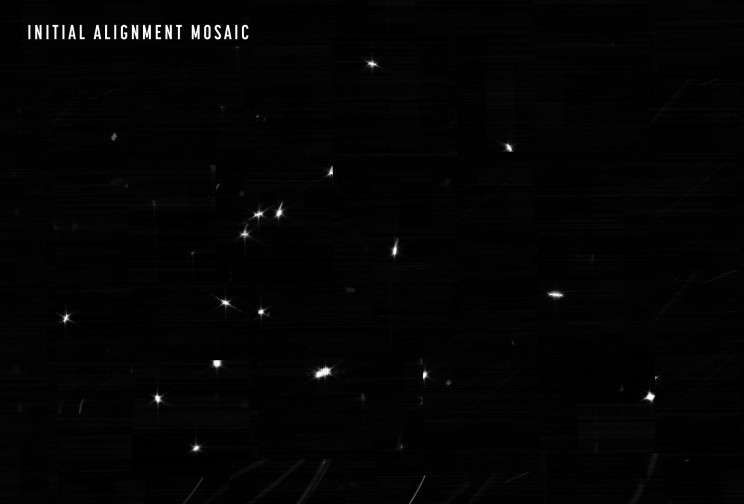 "Dummy image" of HD 84406 in Ursa Major, divided into 18 different stars.
Source: NASA
As a result, in February 2022, Webb showed a photo from18 stars scattered on a black background. But this image is deceptive; it is actually a mosaic of 18 points of light reflected from uncalibrated segments of the telescope's primary mirror, which in turn reflected light from the same star back to the James Webb secondary mirror and to the NIRCam detectors.
Webb takes first telescope selfie
The telescope's first selfie came from using a special lens inside the NIRCam instrument, which is designed to image segments of the main mirror, not space.
During the image capture process, whichbegan on February 2, Webb was redirected to 156 different positions around the star's predicted location and generated 1,560 images using 10 NIRCam detectors, amounting to 54 GB of raw data. The entire process took nearly 25 hours, but remarkably the observatory was able to locate the target star in each of its mirror segments within the first 6 hours and 16 exposures. These images were then stitched together to create a single large mosaic that captured the signature of each segment of the primary mirror in a single frame. The images shown here are just the centerpiece of this large mosaic, a huge 2 billion pixel image.
NASA blog post
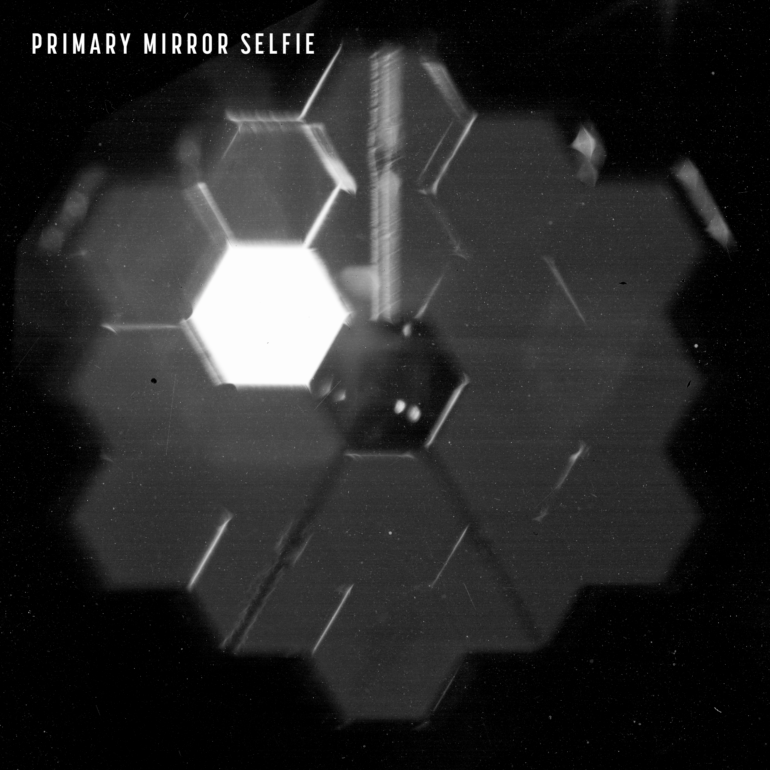 Selfie "James Webb" in the main mirror. Photo: NASA
NIRCam is the observatory's wavefront sensorand a key imager. It was specifically chosen to work in the initial tuning stages of the James Webb because of its wide field of view and its unique ability to operate safely at higher temperatures than other instruments. It is also distinguished by the presence of special components that have been developed to help in this process. Artifacts on the test image appeared during the alignment of NIRCam when it was operating at a temperature above the optimum.
"Webb" photographed the neighbor of the Milky Way
The latest image of "Webb" appeared on 9May: The photo shows the Large Magellanic Cloud. The satellite galaxy near the Milky Way was imaged using the coolest instrument on board the telescope: the mid-infrared instrument (MIRI). It zoomed in on the star field in the satellite galaxy and tested the James Webb Space Telescope's imaging ability.
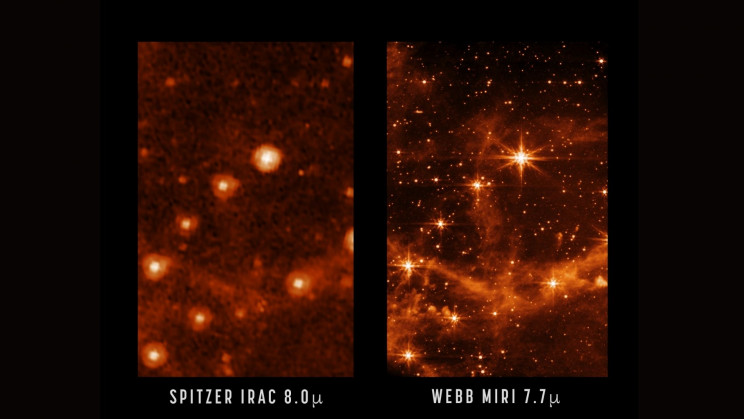 Combined images from Spitzer (left) and Webb (right), demonstrating the latter's superior resolution.
Source:NASA/JPL-Caltech (left), NASA/ESA/CSA/STScI (right)
The image was compared to a photograph,which was made by another, older Spitzer space telescope (now it has already been decommissioned). This highlighted the strength of Webb's high-resolution near- and mid-infrared capabilities. “The Webb Telescope, with its huge primary mirror and improved detectors, will allow us to observe the infrared sky with improved clarity, leading to even more discoveries,” another NASA blog post said.
When will James Webb start operating?
All the achievements of the telescope are just the beginning.This summer he will finally begin real scientific missions. Perhaps in the near future he will provide people with the first “true” image of the atmospheres of exoplanets. Webb will also explore moving objects within the solar system. The telescope's work will even help reveal the evolution of ancient and supermassive black holes. One thing is certain: once Webb begins science missions in earnest, the frequency of updates and new images will increase.
Read more
Something strange is happening in the Universe: how to explain inconsistencies in the Hubble constant
New magnetic waves have been found in the Earth's core. Every seven years they distort the field of the planet
Gravity and dark matter do not exist: the main thing about the new work of physicists
</ p>