Researchers from the Massachusetts Institute of Technology have developed a robotic arm with high
The development is based on a robotic finger witha rigid skeleton enclosed in a soft outer layer. Inside the finger, the researchers placed several high-resolution GelSight sensors embedded under a transparent silicone “skin” to provide cross-sectional images. They use a camera and three LEDs to collect visual information about the shape of an object, providing continuous reading along the entire length of the finger.
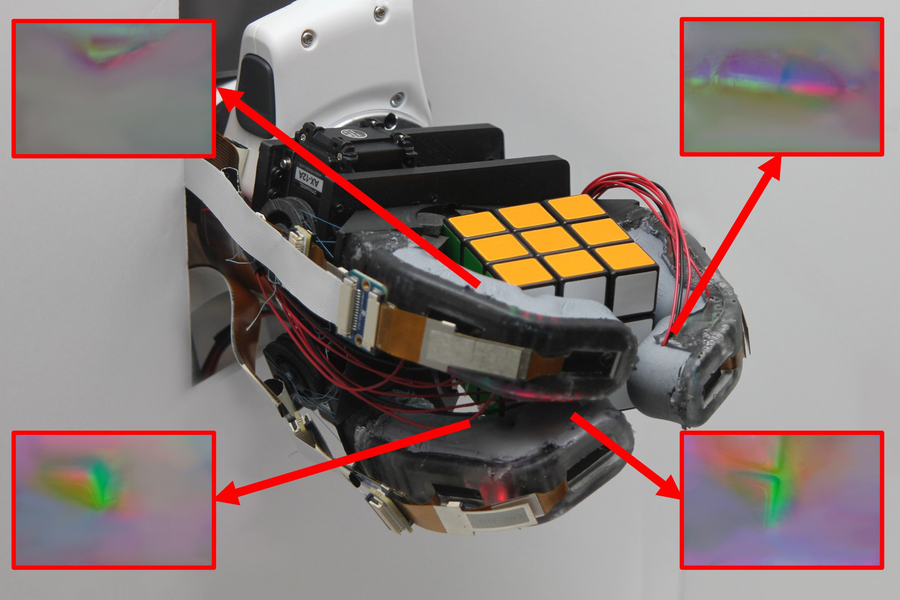 Each finger has two cross-view cameras and six LEDs. Image: MIT News
When a finger grabs an object, the camera capturesimage as colored LEDs illuminate the skin from within. Using the illuminated contours that appear on soft skin, the algorithm performs inverse calculations to map the contours on the surface of the captured object. The researchers trained a machine learning model to identify objects using raw image data from a camera.
Most alternative roboticgrippers use powerful sensors mounted on the fingertips, the researchers note. Therefore, an object must be in full contact with them in order to be identified. Other designs use lower resolution sensors distributed throughout the finger, but do not capture as much detail. Both options require multiple captures to analyze the item.
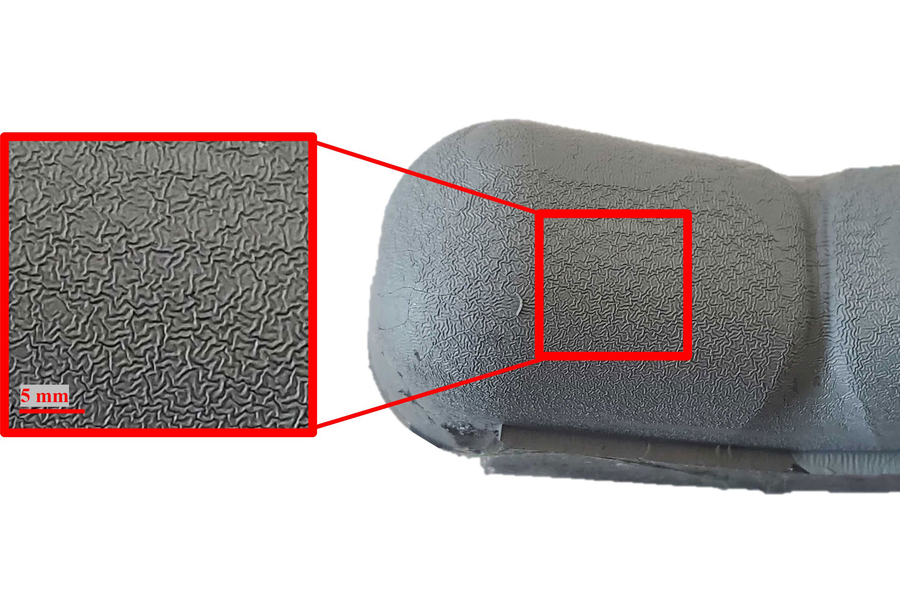 Tiny "wrinkles" on the surface of the silicone help the finger glide over the surface of the object for better identification. Image: MIT News
The study showed that the new deviceone capture is enough to identify various objects with an accuracy of up to 85%. At the same time, the rigid skeleton makes the fingers strong enough to lift heavy objects such as a drill. And soft leather allows you to securely squeeze, but not crush, pliable objects, such as an empty plastic water bottle.
Our goal in this work was tocombine everything that makes our human hands so good into a robotic finger capable of performing tasks that other robotic fingers currently can't handle.
Sandra Liu, study co-author, MIT graduate student
Read more:
It turned out that photosynthesis does not work the way scientists thought. Now they want to hack it
Distant radio galaxy turned out to be a black hole, which is directed directly at Earth
Found a way to reduce weight and blood sugar. Scientists promise the effect of surgery
Cover image: MIT News