Robot centipede, created by engineers from the Max Planck Institute for Intelligent Systems, modified
The 3.7mm robot is made fromferromagnetic-elastic sheet body, controlled deformations of which provide movement. At the ends of the sheet there are two soft cylindrical ring-shaped pads covered with hydrogel spikes that provide adhesion to surfaces.
Under the influence of a magnetic field, the body of the robotbends, which allows you to control movements. It moves across a slime-covered surface by first placing a foot and attaching itself, and then flipping its body over, freeing the other leg. Researchers call this "flaking and loading."
We demonstrated that the robot could carry cargoswith a large weight and volume while climbing tissue surfaces, as well as overcome the mucus layer with its microspikes for pH-triggered drug delivery. pic.twitter.com/XdAdnfYocD
— Xiaoguang Dong (@xdcmu) May 28, 2022
Researchers have shown that the robot canclimb in any direction, even upside down, and maintains its grip even when exposed to liquid. In tests, the researchers had the robot navigate a pig's lung and digestive tract. In addition, the robot is capable of lifting loads three times its size and 20 times its weight.
The researchers believe that the development can be used for biopsy and drug delivery.
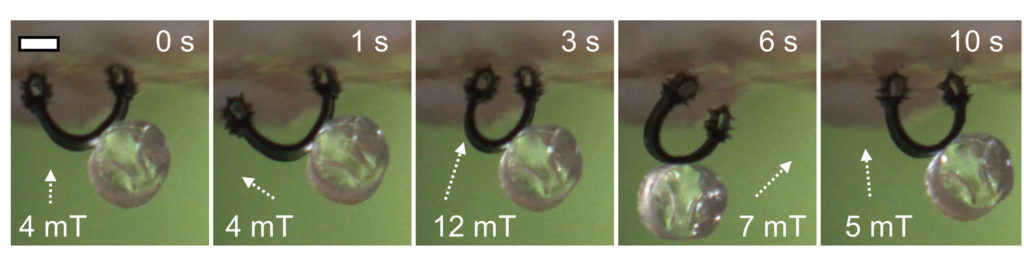 Image: Yingdan Wu et al, Science Advances
Read more
Something strange is happening in the Universe: how to explain inconsistencies in the Hubble constant
New magnetic waves have been found in the Earth's core. Every seven years they distort the field of the planet
Gravity and dark matter do not exist: the main thing about the new work of physicists