French engineers from the Federal Polytechnic School of Lausanne have created a robotic
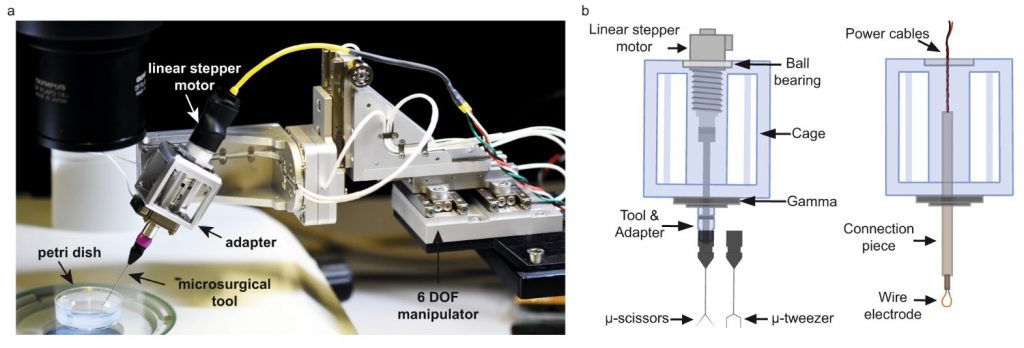 Robotic platform for microsurgery. Image: Özelçi et al., Nature Communication
To conduct research, engineers developedcompact manipulator. Its dimensions are 200 × 100 × 70 mm, while it provides high resolution with fixation on a point with an accuracy of 4 nm. The manipulator has six degrees of freedom and a modular structure to accommodate various tools (scissors, tweezers, etc.), which allow you to perform various operations.
The device is optionally equippedstereo microscope and operating camera. This allows you to fix the operation and accurately aim at a given area. Using the platform, the scientists were able to target precise areas of the zebrafish embryo. During the operation, they removed the lengthening tail of the embryo and raised it separately. This operation is called explantation and is often used in embryo research.
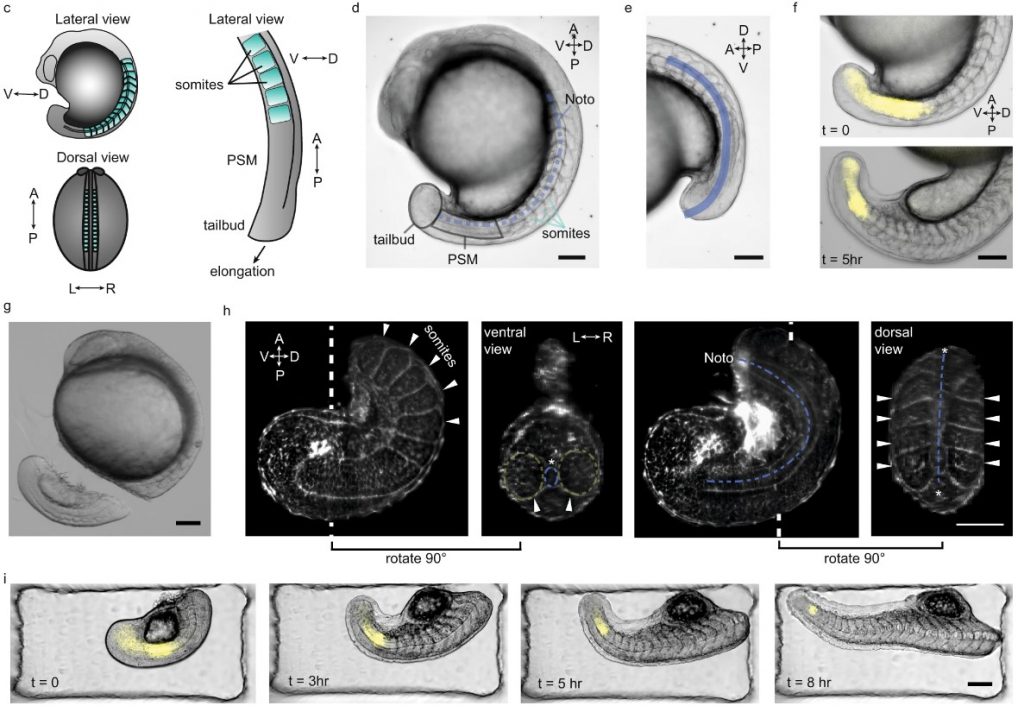 An operation to cut off the tail part of the embryo and observe changes in the growth of this area. Image: Özelçi et al., Nature Communication
Study Reveals Surprising Chord Behaviorembryo, which acts as an early "backbone" for the fish fry. “The notochord pushes so hard into the tail that it can bend,” says Andy Oates, one of the authors of the study. “Normally, the embryo would elongate uniaxially, but once we physically stopped that process, the notochord continued to elongate, creating compressive stresses that led to curvature.”
Embryo growth. Video: Ecole Polytechnique Federale de Lausanne (EPFL)
Scientists note that the platform's capabilities formicrosurgery is not limited to embryo research. With its help, it is possible to observe the development of various tissues in high detail and in a natural environment.
Read more:
The secret of the durability of Roman concrete is revealed: it can be restored
Geneticists have determined how the age of conception in humans has changed over 250,000 years
The sun opened the year with a flash of the most powerful class