Researchers from the Idiap Research Institute in Switzerland, the Chinese University of Hong Kong (CUHK) and
“Our recent work is a joint workthree laboratories. We have been studying this technique for about ten years now and are interested in creating intelligent robots that can cook food for people,” the researchers note.
They decided to focus on Chineseculinary arts, in particular deep-frying, a technique that involves frying ingredients over high heat, where they need to be constantly stirred. “Despite the fact that such robots have already been developed in recent years, creating a robot chef in a semi-structured kitchen environment is still a formidable task,” the scientists note.
They added that the new mechanism is consideringcoordination as a problem of sequencing between the movements of both hands and uses the combined model of the transformer and GNN for this. Therefore, in an interactive process, the movement of the left hand is corrected according to the visual feedback, and the corresponding movement of the right hand is generated by the pre-trained structure-transformer model based on the movements of the left hand.
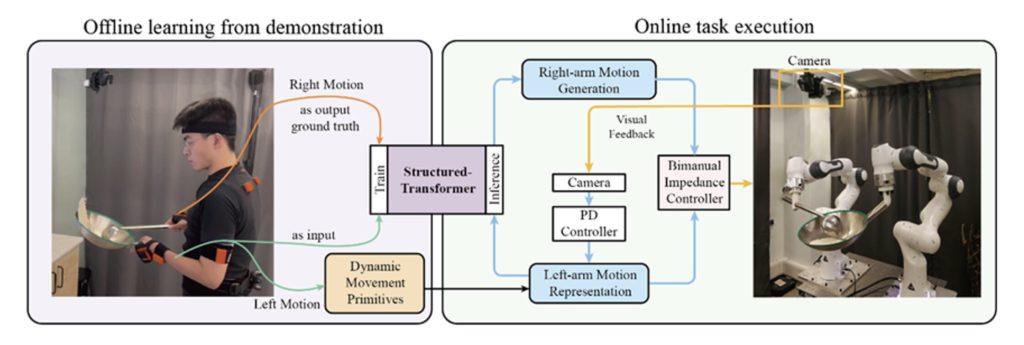
The researchers rated the performance of their model assimulations, and on a physical two-handed robotic platform. In these tests, the model allowed the robot to successfully and realistically reproduce the movements associated with cooking fried potatoes.
In the future, the model presented by the groupresearchers, may allow the development of robots capable of cooking both at home and in public places. In addition, the same approach can be used to train robots for other tasks that involve the use of two arms and hands.
“Now we will introduce a higher dimensionalinformation for studying the movements of humanoids when working in the kitchen, for example, visual signals and electromyography signals, the scientists note. “Thus, we also plan to offer a more complex system that will include both the movements of the bimanual manipulators and the change in the state of the object.”
Read more
Quantum simulator showed the division of an electron into parts in one-dimensional space
Physicists have created an atomic laser that can work forever
Two planets found not far from Earth that are very similar to ours