Researchers from Canada, Australia and the USA have provided evidence of the existence of uncontrollable
As scientists explain, this happens during a mergergalaxies. This leads to the formation of a binary supermassive black hole in the center. A binary SMBH can live for a very long time, about a billion years before the next merger. If during this time the third supermassive black hole reaches the galactic center, then the interaction of the three bodies will accelerate one of them and it will escape from the galaxy. Scientists call such black holes “rogues.”
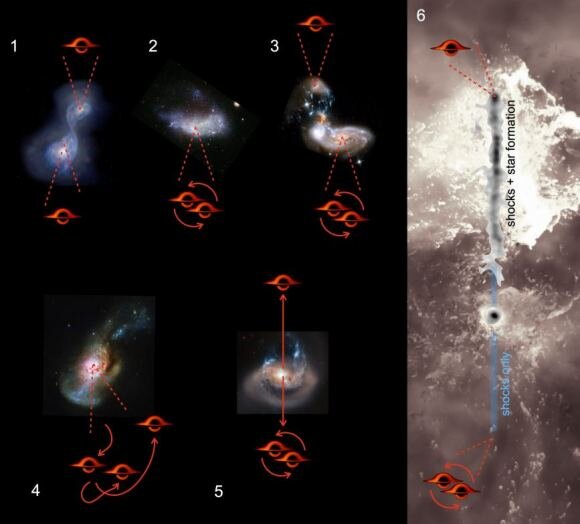 This diagram from the study shows how a rogue black hole is born. Credit: van Dokkum et al. 2023
The problem is that finding these supermassive black holesdifficult. Astronomers have discovered a suitable candidate in 2021. It is located at a distance of about 230 million light years. The study authors noticed the corresponding movement and speed of the object. However, they couldn’t figure out whether it was an ongoing galaxy merger, a binary black hole system, or a gravitational wave “recoil” event.
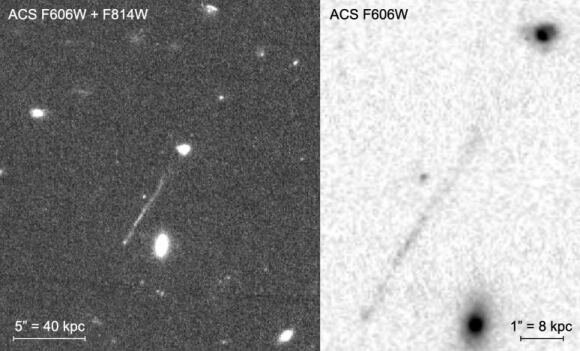 Images from Hubble's Advanced Camera for Surveys show a linear feature that results from a rogue SMBH. Credit: van Dokkum et al. 2023
In the end, they recognized a potential rogue SMBHby its effect on diffuse gas in the circumgalactic medium as it passed through it. “The ratio of lines, colors and overall morphology are consistent with an ejected supermassive black hole moving through the circumgalactic medium at high speed, causing star formation,” the scientists conclude.
Read more:
A powerful flare erupted on the Sun: it has already affected the Earth
Medieval fortress accidentally discovered in the forest: the find surprised scientists
Scientists have found a new genetic disease in children: how it manifests itself