One of the most notable innovations of the iPhone 14 series is the ability to send short messages in emergency situations.
Globalstar has experienced a lot in itshistory - and bankruptcy at the beginning of the 2000s, and the degradation of satellites in 2007-2008, but was able to restore high quality communications. SpaceX played an important role in this, launching part of the company's second generation of satellites into space. (All the more ridiculous are the headlines that Globalstar's choice over Starlink is a "declaration of war on Elon Musk.") Globalstar's high quality of communications is due to the lack of inter-satellite communications; instead, each satellite acts as a repeater, relaying the signal to the ground station that connects Globalstar to the conventional telephone network. In those regions where there are no such stations (for example, the South Pacific Ocean), Globalstar is powerless.

Utqiagvik is a city in the USA where Globalstar does not catch
In addition, Globalstar is powerless in polarareas due to the peculiarities of the orbit of their satellites: more than 70 degrees polar, communication is available only for a limited time, and more than 74 degrees is not available at all. Therefore, in northern Alaska (including the city of Utqiagvik) and the Canadian Yukon, NWT and Nunavut territories (including the cities of Pond Inlet and Resolute), Globalstar communications are not guaranteed. Separate restrictions are imposed on the use of the iPhone as Globalstar terminals: they will only work in the United States and Canada, and the territory does not include Guam, American Samoa, the Northern Mariana Islands and the US Minor Outlying Islands (however, it includes Hawaii, Puerto Rico and the US Virgin Islands). islands). At the same time, iPhones purchased outside the United States (except China) will be able to send messages via satellite in the same way as American models when they enter the United States and Canada.

Qualcomm GSP-1700
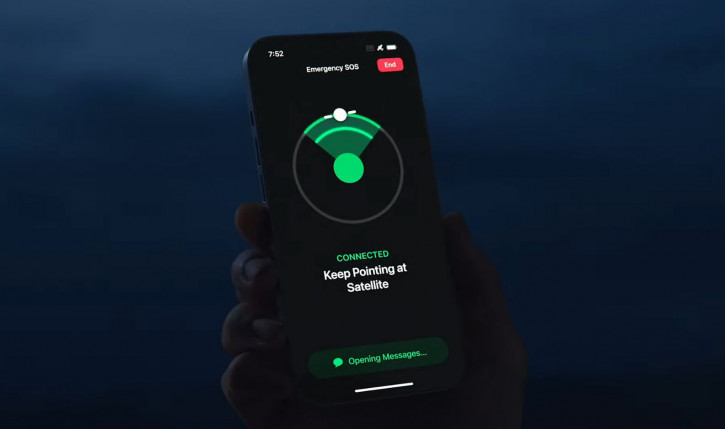
Another significant limitation is imposediPhone dimensions. Full-fledged Globalstar terminals, produced by Qualcomm (yes, it can do more than just processors) and some other companies, are intimidating in size and have large retractable antennas, which the iPhone does not have. Accordingly, the iPhone will only be able to send messages when the satellites fly over your latitude - and you will have to point the smartphone directly towards the satellite to send messages (the software will help you navigate). Of course, with such restrictions, there can be no talk of any Globalstar voice communication on the iPhone, although full-fledged Globalstar terminals provide good voice quality, even when the satellite is far enough away.

Teaser satellite smartphone Bullitt
Note that in the near future we will see a lotother implementations of satellite communication technology - Huawei taught the Mate 50 to send SMS via Beidou navigation satellites, Bullitt Mobile (CAT brand) is preparing its satellite phone, and the American operator T-Mobile is going to launch cellular base stations into space. Which of these implementations will be more convenient and less limited in terms of geographic availability, data transfer speed and persistence of work, time will tell.
© Ilya Nerybov.
Sourced from Blog of Mobile