How far from Earth is Titan?
Titan is the sixth moon of the planet Saturn, the sixth planet from the Sun.
Most
This giant moon is the only moon inA solar system with a dense atmosphere. In addition, this is the only world besides the Earth, on the surface of which there are rivers, lakes and seas. Like Earth, Titan's atmosphere is composed primarily of nitrogen and small amounts of methane. This is the only place in the solar system, besides the Earth, where, as you know, there is a familiar cycle of fluids. From the clouds they fall on the surface of the moon and fill the lakes and seas, and then evaporate and evaporate back into the sky. It is also believed that Titan has an under-ice ocean that is similar in salinity to the Dead Sea.

Size and distance
Titan's radius is about 2,575 kilometers.he's almost 50% wider than the Moon. Titan is approximately 1.2 million km from Saturn, which itself is approximately 1.4 billion km from the Sun, or about 9.5 AU. (astronomical units). One a.u. is the distance from the Earth to the Sun. Light from the Sun takes about 80 minutes to reach Titan; Because of their great distance, sunlight on Saturn and Titan is about 100 times weaker than on Earth.
Titan takes 15 daysand 22 hours to complete a full revolution around Saturn. Like Earth's Moon, Titan always shows the same "face" to the planet as it orbits. Saturn takes about 29 Earth years to orbit the Sun, and the gas giant's rotation axis is tilted like Earth's, meaning the seasons change. True, each such season lasts more than seven earthly years. Each of them on Titan is on the same schedule as Saturn - seasons last more than seven Earth years, a full cycle takes 29 Earth years.
Formation
Scientists are not sure about the origins of Titan.However, its atmosphere provides a clue. Several NASA and ESA Cassini-Huygens instruments measured the isotopes nitrogen-14 and nitrogen-15 in Titan's atmosphere. The instruments found that the ratio of nitrogen isotopes on Titan is most similar to the ratio of nitrogen isotopes in comets from the Oort Cloud, a sphere of hundreds of billions of icy bodies thought to orbit the Sun at a distance of 5,000 to 100,000 AU. - approximately 150 million km. The ratio of nitrogen in Titan's atmosphere suggests that the building blocks of this moon formed early in the solar system's history in the same cold disk of gas and dust that formed the Sun (the so-called protosolar nebula),
Surface
By the way, the surface of Titan is one of the mostsimilar to the Earth places in the solar system, although the temperatures there are much lower, and the "coating" itself has a different chemical composition. It is so cold here (-179 ° C) that the ice from the water looks more like rocks. On Titan, as on Earth, volcanic activity is possible, but with liquid water "lava" instead of molten rock. Titan's surface is formed by streams of methane and ethane that cut riverbeds and fill large lakes with liquefied natural gas. No other world in the solar system other than Earth has such liquid activity on its surface.
Atmosphere
Our solar system is home to morethan 150 moons, but Titan is unique in that it is the only moon with a dense atmosphere. On the surface of Titan, atmospheric pressure is about 60% higher than on Earth - about the same as a person would feel if swimming about 15 meters below the surface in the ocean on Earth. Since Titan is less massive than Earth, its gravity does not hold its gas shell as much, so the atmosphere extends to an altitude 10 times the Earth's - almost 600 km into space.

Titan's atmosphere is mostly nitrogen(about 95%) and methane (about 5%) with a small amount of other carbon-rich compounds. High in Titan's atmosphere, methane and nitrogen molecules are separated by ultraviolet light from the Sun and high-energy particles accelerated in Saturn's magnetic field. Portions of these molecules recombine to form various organic chemicals (substances containing carbon and hydrogen) and often include nitrogen, oxygen, and other elements essential to life on Earth. Some of the compounds formed from this breakdown and recycling of methane and nitrogen create a kind of smog - a thick orange haze that makes the lunar surface difficult to see from space. (However, spacecraft and telescopes can see through haze at certain wavelengths of light beyond the human eye.)
How was Titan studied and what missions await it?
"Cassini-Huygens"
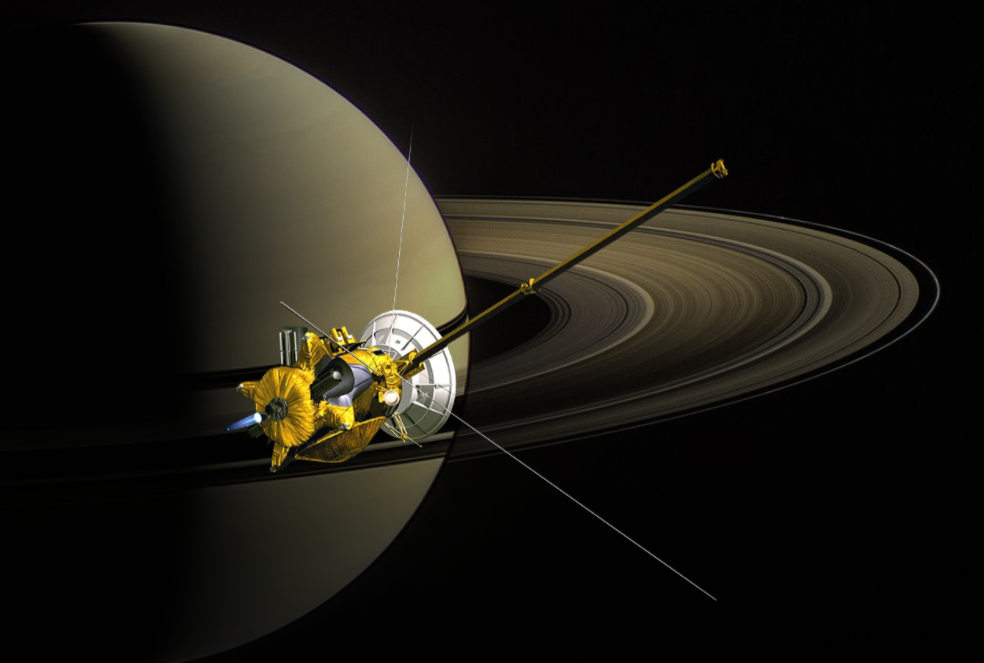
For more than ten years, spaceNASA's Cassini spacecraft shared the wonders of Saturn and its family of icy moons, taking us to wondrous worlds. Cassini delivered a passenger to Saturn's moon system - the European Huygens probe - the first artificial object to land on a planet in the distant outer solar system
After 20 years in space, 13 of which exploredSaturn, the ship has run out of fuel. To protect the planet's moons, NASA explained, Cassini was sent on a daring final mission that sealed its fate. On September 15, 2017, at 14:55:06 Moscow time, the spacecraft completed its 20-year mission in the Saturn system and burned up in the atmosphere of the gas giant, having managed to poison the latest data on the gas giant to Earth. NASA broadcast the last minutes of the life of the space probe live.
Cassini-Huygens showed that Titan is one of thethe most Earth-like worlds we have encountered, and shed light on the history of our home planet. The fact is that Cassini was, in a sense, a time machine. He identified processes that likely shaped the development of our solar system. Cassini's long mission allowed it to observe weather and seasonal changes on another planet. The mission showed that Saturn's moons are unique worlds with their own stories to tell.
Cassini-Huygens showed that Titan is one ofthe most Earth-like worlds we have encountered, and shed light on the history of our home planet. The point is that Cassini was in a sense a time machine. He identified the processes that likely shaped the development of our solar system. The long Cassini mission made it possible to observe the weather and seasonal changes on another planet. The mission revealed that the moons of Saturn are unique worlds that can tell their stories. Numerous measurements of the gravity of Titan by the Cassini spacecraft have shown that the Moon hides an underground ocean of liquid water (probably mixed with salts and ammonia).
European Space Agency probeHuygens also measured radio signals during its descent to the surface in 2005, which provided strong evidence of an ocean 55–80 km beneath the icy ground. The discovery of a global ocean of liquid water adds Titan to the handful of worlds in our solar system that could potentially host habitable environments. Additionally, Titan's rivers, lakes and seas of liquid methane and ethane could serve as habitable environments on the moon's surface, although any life there would likely be very different from life on Earth. Although there is no evidence yet of life on Titan, its complex chemistry and unique environment have made it a destination for further research.
Dragonfly
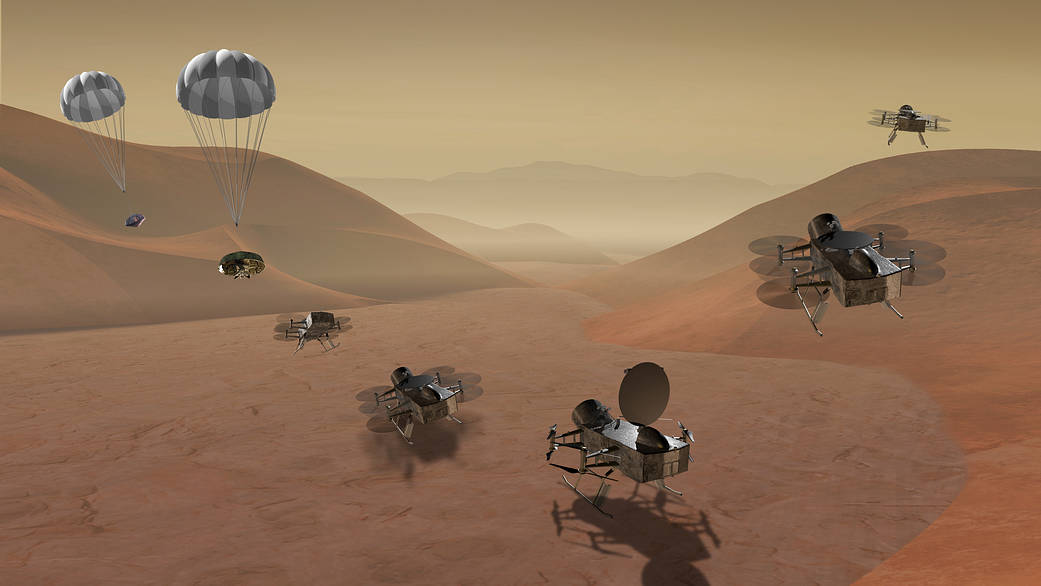
In the summer of 2019, NASA announced that the next targetin the solar system - the unique, richly organic world of Titan. Furthering the search for the building blocks of life, the Dragonfly mission will take multiple sorties to explore and explore the areas around Saturn's icy moon.
Dragonfly was originally scheduled to launch on2026 with and arrival in 2034. However, in September 2020, NASA asked the Dragonfly team to clarify an alternative launch readiness date of 2027. No changes to the mission architecture will be required to accommodate this new date, and launching at a later date will not impact Dragonfly's operations.
The rotorcraft will fly in dozenspromising sites on Titan in search of prebiotic chemical processes common to both Titan and Earth. Dragonfly marks NASA's first multi-rotor science vehicle flight on another planet; it has eight rotors and flies like a large drone. It will take advantage of Titan's dense atmosphere—four times denser than Earth—to become the first vehicle to ever carry its entire scientific payload to new locations for repeatable and targeted access to surface materials.
Titanium is analogous to the very early Earth andcan provide a clue to how life could arise on our planet. During its 2.7-year base mission, Dragonfly will explore a diverse environment from organic dunes to the bottom of an impact crater, where liquid water and complex organic materials key to life once coexisted for perhaps tens of thousands of years. His instruments will study how far prebiotic chemistry has advanced. They will also investigate the properties of the Moon's atmosphere and surface, its subsurface ocean and liquid reservoirs. In addition, the tools will look for chemical evidence of past or present life.
How will Titan still be useful to humanity?
First, let's make it clear that Titan isa moon that is in many ways more like a planet. It has a thick atmosphere that is approximately 1.5 times the pressure at the surface of the Earth's atmosphere. None of the 177 other satellites in the solar system have such an atmosphere. In addition, Titan is the only place in the solar system, other than Earth, with stable liquids on the surface: on the surface of Titan there are lakes and seas. So, Titan is a wonderful and very similar world to Earth.
The dense atmosphere of Titan is useful because itmeans you don't need to wear a bulky spacesuit when you're on Titan. But the main reason I like it is simple: Titan's atmosphere will help us survive. In space, radiation is deadly. Energy particles from the Sun, and especially galactic cosmic rays (GCR), penetrate human tissues, causing cancer and cognitive impairment. To stay within NASA's current cancer risk limits, astronauts can travel beyond Low Earth Orbit (LEO) for as much as 200 days; a trip to Mars will probably take over 600 days. But these destructive particles cannot reach the surface of Titan; they are absorbed by the atmosphere, which means that it is a safe environment for humans. The atmosphere of Mars is not dense enough to provide reliable protection from GCR and the Earth.
People living on Titan can walk (or,rather, jump — since gravity is 14 percent of Earth's, slightly less than the Moon) wearing suits to keep warm. Titan is cold (surface temperature is about -290 degrees Fahrenheit). And people will need to wear respirators to breathe oxygen, since the atmosphere is mostly nitrogen. The light on Titan is a bit dim, like just after sunset here on Earth, due to haze particles in the dense atmosphere. People living in one hemisphere of Titan, always facing Saturn, will have a wonderful view of the ringed planet.
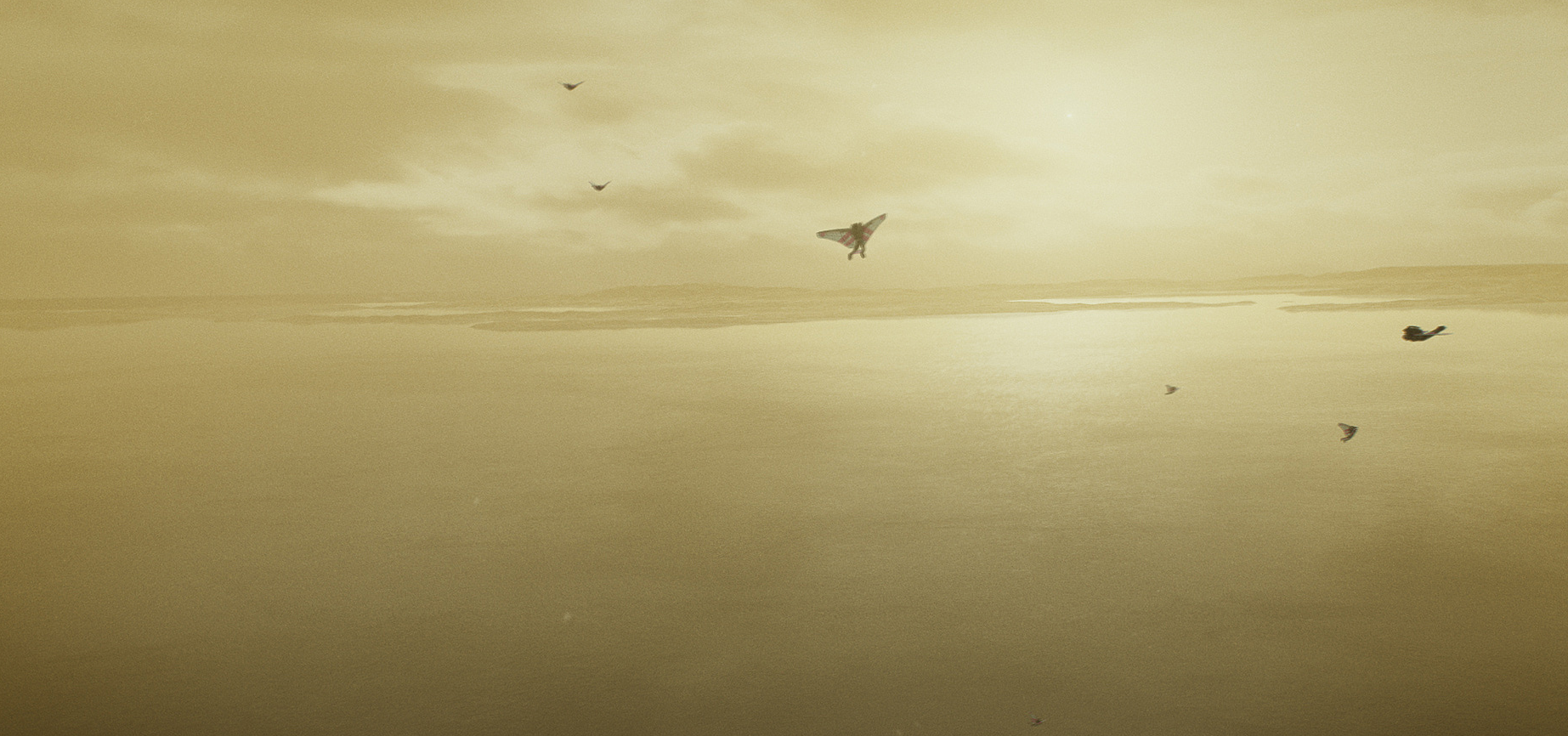
Really funny (and potentially useful)The thing is, thanks to the low gravity and dense atmosphere, people on Titan can easily fly under their own power if they tie their wings to their hands! In the future, people can go boating on lakes and seas, which are mostly in higher latitudes.
Because Titan is so cold, all the waterfrozen—lakes and seas consist of liquid methane and ethane. These hydrocarbons (like natural gas here on Earth) are in abundance on Titan—not just in the lakes and seas, but on the surface and in the atmosphere. They provide a ready source of materials for creating building materials such as plastics. Humans could burn methane for energy, perhaps using a nuclear reactor to electrolyze water (since Titan's atmosphere doesn't contain the oxygen we'd need to burn methane).
Recently, astronomers measured the depth ofa large sea of methane on Titan. It turned out that it is at least 0.3 km: this is enough to study it on a robotic submarine. It turned out that the depth of the small Sea of Sinus, which is located on Titan, is 85 m. But the largest sea of Kraken has not yet been measured . Both reservoirs consist of a mixture of ethane and methane, the second component predominant. This is a huge amount of energy.
Another option for chemical energy is the hydrogenation of acetylene (ie 3H 2 + C 2 H 2); both hydrogen and acetylene are present in Titan's atmosphere.
In addition, we may consider the possibilityusing wind turbines as an alternative energy source. The air density on Titan is about five times greater than on Earth, so the potential wind energy is significant. Although there is not much wind on Titan's surface (Cassini measurements show wind speeds of about 1 m/s; for comparison, typical wind speeds on Earth are about 4 m/s), Huygens measurements showed wind speeds of about 20 meters per second at an altitude of 40 km means that tethered airborne wind farms can produce hundreds of megawatts of energy.
What is the problem?
If Titan is so good and interesting, then why hasn't it been mastered yet? Why are most missions directed to Mars and the Moon? The problem is distance.
Flight time to Saturn can vary from 4years up to almost 7 years, depending on the orbital relationship to Earth at the time of launch. Without significant advances in energy, this would mean an extremely long journey to and from any potential colony.
In addition, there is a lot to overcomeobstacles, not the least of which is learning how people will live and work in microgravity. Additionally, growing food on Titan using crops as we do here on Earth would not be efficient given the lower flux of solar energy reaching Titan's surface and the already low efficiency of photosynthesis here on Earth. People on Titan will need biotechnology and unconventional products. Perhaps future humans on Titan will be able to use some kind of artificial photosynthesis.
It remains only to wait for a breakthrough in science.
Read more
Abortion and science: what will happen to the children who will give birth
Scientists have proposed to colonize the satellite of Ceres
Look at the rarest lightning bolts: blue jet and elf taken from the ISS