Researchers from ETH Zurich have produced a mechanical resonator in which
To explain quantum mechanics, the Austrianphysicist Erwin Schrödinger came up with a thought experiment. He placed the cat in a locked metal box with a radioactive substance, a Geiger counter, and a flask of hydrocyanic acid. In a certain period of time, an atom of a substance can decay with a certain probability. This activates the Geiger counter and sets off a mechanism that shatters the poison flask. As a result, the cat dies.
Because the outside observer doesn't knowwhether the atom has decayed, he also does not know whether the cat is alive or dead. According to quantum mechanics, at this moment the cat should be in a state of superposition: it is both alive and dead. Until now, scientists have imitated this experiment at the micro level: they used atoms or molecules in states of quantum mechanical superposition.
In their study, Swiss physicists createda system in which vibrations in a crystal act as a cat, and a layer of superconducting piezoelectric material acts as a capsule with poison. It creates an electric field when the crystal changes shape as it vibrates. In such a system, the superposition of a qubit can be transferred to the crystal, as a result of which vibrations are observed in it in two directions simultaneously.
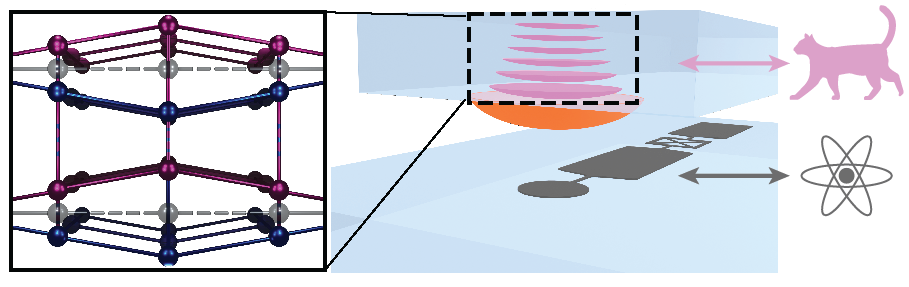 Experiment scheme:vibrations within the crystal and the superconducting substrate mimic a cat and an atom of a radioactive substance bound to a poison capsule from Schrödinger's thought experiment. Image: Yiwen Chu, ETH Zurich
In order for the vibrational states to correspond"Schrödinger's cat", it is important that they are macroscopically distinguishable, scientists explain. This means that the distance between the up and down states must be greater than any thermal or quantum fluctuations of the atoms within the crystal.
The researchers measured the spatialseparation of two states using a superconducting qubit. It turned out to be large enough to clearly distinguish the states. “By putting the two vibrational states of the crystal in superposition, we actually created a 16 μg Schrödinger cat,” says Ewen Chu, a professor at ETH Zurich.
The researchers note that the resultsexperiments have not only theoretical but also practical significance. For example, quantum information stored in qubits can be made more reliable by using Schrödinger's cat states, which consist of a huge number of atoms in a crystal, rather than relying on individual atoms or ions, as is currently done. In addition, the sensitivity of massive objects in superposition states to external noise can be used to accurately measure tiny perturbations such as gravitational waves or dark matter particles.
Read more:
New solar cell breaks world efficiency record
It turned out what is happening with the documents of Leonardo da Vinci: they began to change
Listen to the sound of solar plasma as it hits the Earth
On the cover: an artistic illustration of Schrödinger's cat. Image: Yiwen Chu, ETH Zurich