American physicists used two laser pulses sent through a jet of hydrogen gas.
Classical particle accelerators aregiant structures, scientists explain. The aim of the new work was to create a device that could achieve the same effect in a room-scale laboratory. To achieve this, a more powerful impulse is required, which will accelerate the particles even at a short distance.
To create such a field, scientists usedlaser wake acceleration method. The essence of this technology is that a highly focused laser beam is directed through the plasma. The impulse of the light wave creates perturbations and drags the electrons with it. This can be compared to a boat that moves through the water and captures particles in its wake (behind itself), the scientists explain.
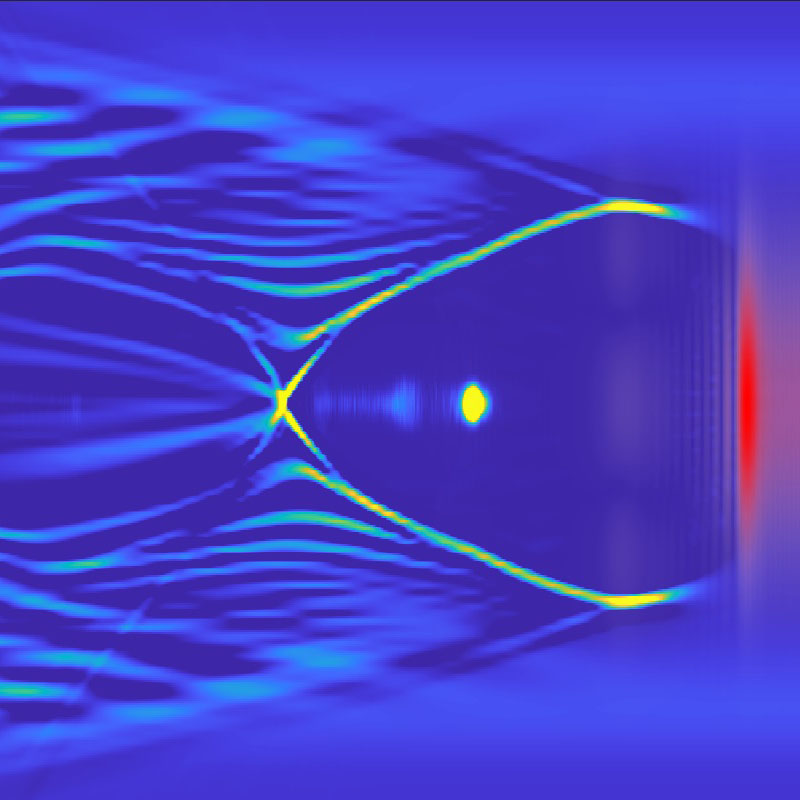 Simulation of the experiment: a red laser beam creates a stream of accelerated electrons behind it (yellow). Image: Bo Miao, IREAP
This method has been proposed for decadesago, but so far it has been possible to accelerate electrons with its help by only a few centimeters, after which the energy of the beam is dissipated in the plasma. In their work, physicists proposed using a laser to pierce a waveguide in the plasma, along which a stream of electrons captured by light would move.
To create a plasma waveguide, the commanduses an additional laser beam and a jet of hydrogen gas. When this additional "guiding" laser passes through the jet, it strips electrons from hydrogen atoms and creates a plasma channel. The plasma is hot and rapidly begins to expand, creating a lower density "core", while the higher density gas forms a cylindrical shell. Then the main laser beam is directed through this channel.
With the help of their technology, scientists dispersedelectrons to speeds close to the speed of light in a section of only 20 cm: the energy of some of them reached 5 GeV. This is only three times smaller than the SLAC accelerator at Stanford, which is more than 3 km long.
Read more:
Look at a phenomenon that is simply impossible on Mars
A huge satellite can outshine all the stars and planets in the night sky
China says they will have fusion power in 6 years