Where is Ceres located?
Ceres is the closest to the Sun and the smallest of the known dwarf planets
With a diameter of about 950 km, Ceres isThe largest and most massive body in the asteroid belt, it is larger in size than many large satellites of the giant planets and contains almost a third (32%) of the total mass of the belt.
The orbit of Ceres lies between the orbits of Mars andJupiter is in the asteroid belt and is very "planet-like": it is weakly elliptical and has a moderate (10.6 °) inclination to the ecliptic plane compared to Pluto (17 °) and Mercury (7 °). The average distance between Ceres and the Earth is ~ 263.8 million km. Cererian days are approximately 9 hours and 4 minutes long.
In 2011, the staff of the Paris Observatory,after computer simulations, taking into account the behavior of 8 planets of the solar system, as well as Pluto, Ceres, Moon, Pallas, Vesta, Iris and Bamberg, they found Ceres and Vesta's orbital instability and the possibility of their collision with a probability of 0.2% within one billion years.

What are the conditions on a dwarf planet?
Several bright spots are visible on the surface of Ceres.and dark structures, presumably craters. In the spectra obtained in 2015 by the Dawn station, water is absent, but a hydroxyl OH band and a slightly weaker ammonium band are visible - most likely, this is ammoniated clay, in which water is chemically bound, in hydroxyl form. The presence of ammonia has no explanation yet; its snow line lies far beyond the orbit of Ceres.
After analyzing the images from Dawn's main camera,Geologists from the USA, Italy, France and Germany have discovered traces of activity on the surface of Ceres associated with a high water content in the upper layers of the rock.
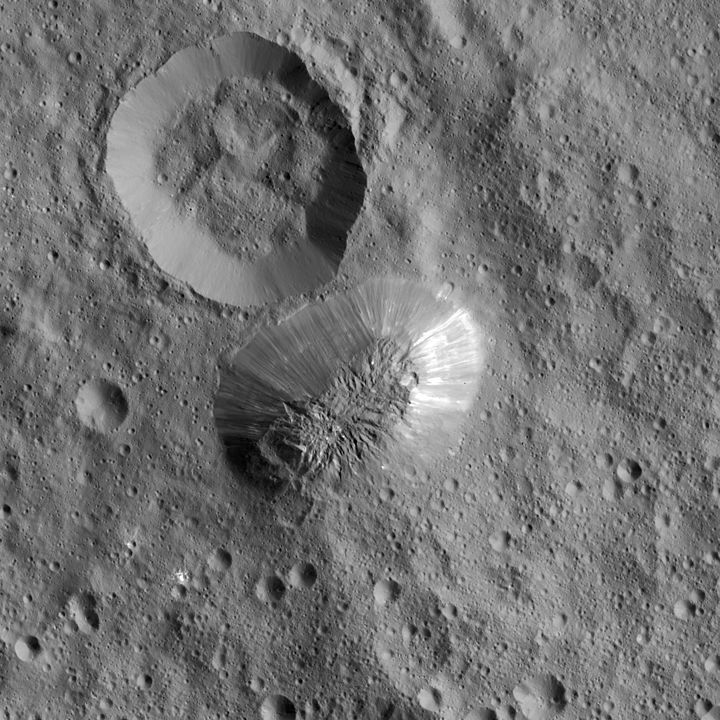 Mount Akhuna: photo of the Dawn probe
Three types of matter flows have been identified:
- The first is mainly found at high latitudes - it resembles the earth's glaciers - these are layers of earth that shift and collapse the edges of craters.
- The second type of displacement, also predominant near the poles, is an analogue of landslides.
- The third is usually associated with large craters andhas a structure reminiscent of mudflows; Scientists compare it to specific craters where liquid emissions occur - these are often found on Mars, and on Earth an example is Nördlingen Fig.
All of these displacements are very common on the surface of the planetoid - they can be found near 20-30 percent of all craters over 10 kilometers in diameter.
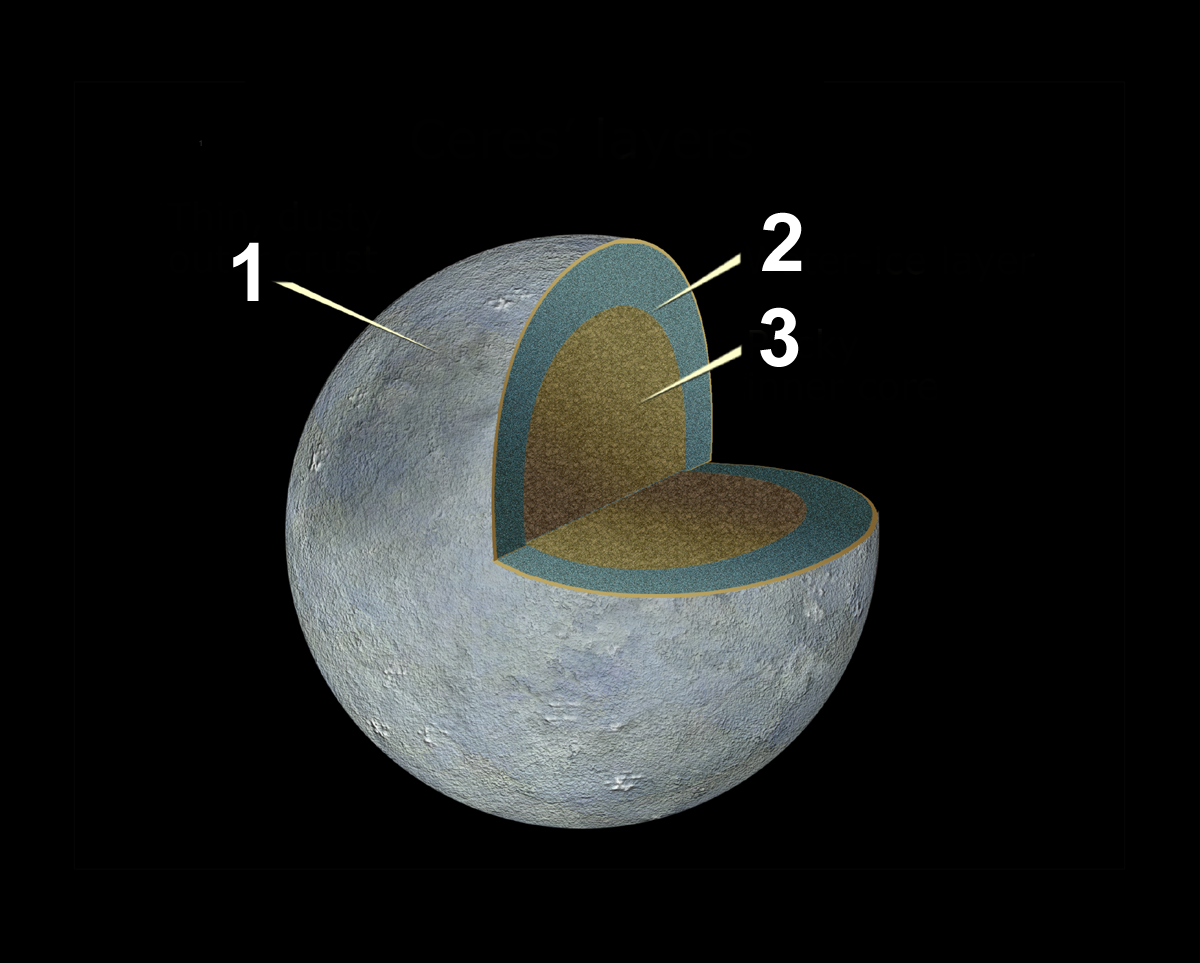 Ceres structure:
1 - thin layer of regolith;
2 - icy mantle;
3 - stone core
Colonization of Ceres
Colonization of Ceres is one of the potentially possible space colonization projects.
As NASA scientist Al Globus notes, orbital settlements have a much higher potential for colonization compared to the surfaces of planets and their satellites:
The Moon and Mars have a combined surface area ofapproximately equal to only a third of the Earth's surface. If material from the dwarf planet Ceres is used to create orbital space colonies, their total living area will be approximately 150 times the surface area of the Earth.
Since most of the earth's surface is occupiedthe world's oceans or sparsely populated areas (deserts, mountains, forests), settlements created from the material of Ceres alone can provide comfortable housing for more than a trillion people.
According to the results of the competition for the best space projectNASA's 2004 Settlement Project, a Ceres orbiting space station for 10-12 people (project author: Almut Hoffmann, Germany) was among the top-ranked projects.
Astronomers estimate Ceres to be 25 percentconsists of water, and may have water reserves in excess of all fresh water supplies on Earth. The waters of Ceres, unlike the Earth, as astronomers believe, are in the form of ice in its mantle.

Problems of developing Ceres:
- Being in the asteroid belt increases the danger of damage to the space base and spaceships.
- Ceres does not have a magnetic field, which will adversely affect human health.
- Due to its low gravity, Ceres does not have a dense atmosphere.
- There is relatively little sunlight.
Colonization of a megasatellite in orbit of Ceres
Physicist Pekka Janhunen from FinnishThe Meteorological Institute has developed a new idea to colonize a giant satellite orbiting Ceres, a dwarf planet in the asteroid belt between Jupiter and Mars.
He believes that humanity can build a huge colony on the artificially created “megasatellite” of Ceres.
The inhabitants of this colony will live in the thousandscylindrical volumes anchored in a disk orbiting Ceres. Each such cylinder will be able to accommodate up to 50 thousand inhabitants, have an artificial atmosphere and simulate Earth's gravity due to centrifugal force during rotation.
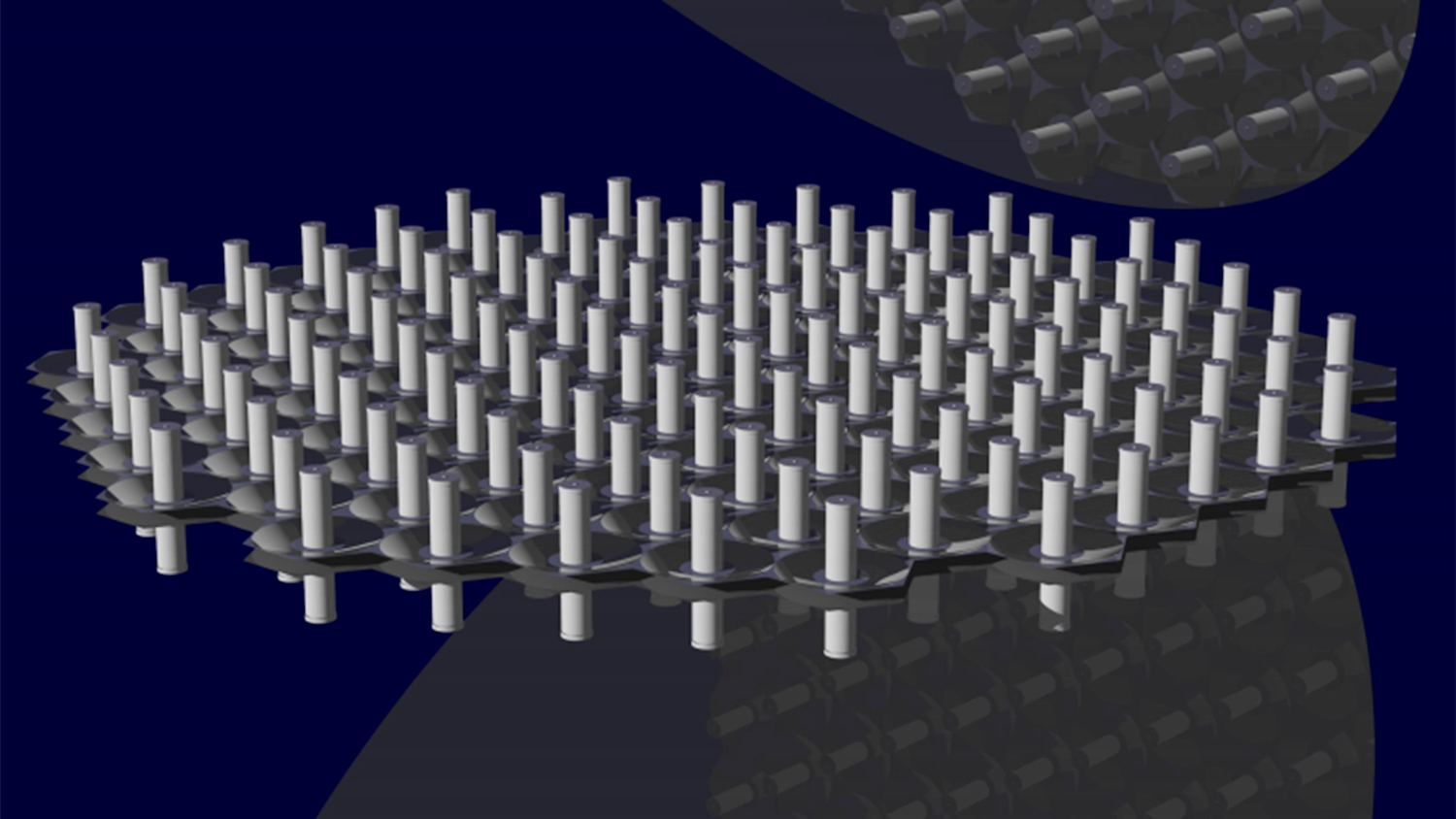
“The cylinders provide a terrestrial gravitational acceleration of 1 g, which is necessary for human health, in particular for children for the full growth and development of muscles and bones.
Ceres has nitrogen to fill the artificialatmosphere and it is large enough to provide almost unlimited resources. And at the same time, it is small enough to make it cheap to lift materials from its surface, ”the theoretical physicist explained to Universe Today.
I am sure that in the Martian settlement there are no childrenwill be able to grow into healthy adults (in terms of muscles and bones) due to the gravity being too low. So I began to look for an alternative that would provide gravity on a tethered world.”
Pekka Janhunen, scientist at the Finnish Meteorological Institute
According to the project, each cylinder will be 10kilometers, a radius of 1 kilometer and make a complete revolution in 66 seconds to simulate gravity. All cylinders will be able to rotate inside a common disk and be held in it by powerful magnets.
In addition to the huge cylinders and their massive diskthe foundations of the other important design element are two giant mirrors tilted to the disc at an angle of 45 degrees. They will send enough sunlight to the colony.
Part of each cylinder will be retracted forgrowing crops and planting trees that will grow in soil 1.5 meters deep, delivered from Ceres itself. Plants will provide people with food, oxygen and absorb excess carbon dioxide.
What do we still don't know about Ceres?
Among the main questions of scientists regardingCeres and data received from the Dawn probe - whether there are conditions for life on Ceres or at least historical prerequisites for its appearance, where and how this dwarf planet arose - between the orbits of the giant planets or immediately in the Kuiper belt.
Also, scientists do not know the composition of the upper crust of Ceres, the reasons for the appearance of steam plumes on the dwarf planet, as well as the composition of the ocean.
Read more:
Abortion and science: what will happen to the children who will give birth
A third of those who have recovered from COVID-19 return to the hospital. Every eighth - dies
Named a plant that is not afraid of climate change. It feeds a billion people