Researchers have observed a massive black hole and discovered new details regarding
The black hole is called Cygnus X-1 and has a mass of 21times greater than that of the Sun. It is also one of the brightest X-ray sources in the Milky Way and has a companion star in orbit with a mass 41 times that of the Sun.
The new measurements were received by the Imaging X-Ray Polarimetry Explorer (IXPE) mission, which is part of a collaboration between NASA and the Italian Space Agency (ASI).
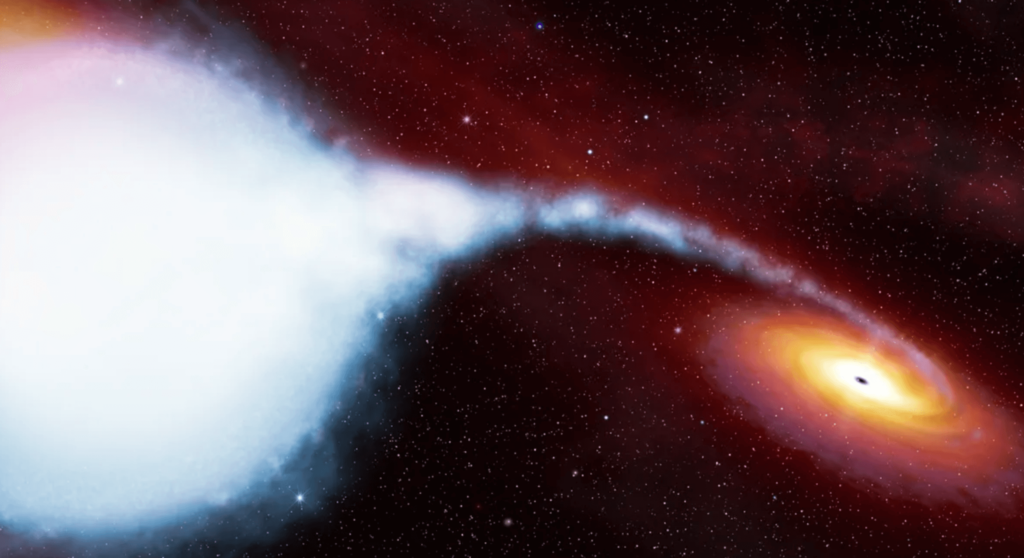 Cygnus X-1
Previously, only the direction of black holes was measured andX-ray energy from hot plasma. Now IXPE measures linear polarization, which contains more information about how X-rays were emitted if they scatter from material that is near the black hole.
IXPE is also capable of detecting X-rayrays emitted by a hot plasma at a distance of about 1240 km from the event horizon. Through this, the researchers combined data with observations made by NASA's NICES and NuSTAR X-ray observatories. So they managed to analyze the geometry of the plasma.
The researchers found that their plasmaextends perpendicular to the long plasma flow. This allows us to confirm the hypothesis that processes in the X-ray bright region near the black hole play an important role in jet launch.
Their observations support some modelswhich can predict the behavior of hot plasma around black holes. It also refutes one of the models that predicts that the black hole corona is a narrow column of plasma along the jet's axis. Scientists believe that their observations could help in understanding the mysterious behavior of a black hole and how it accumulates mass.
Read more:
Chinese reusable spacecraft launched a mysterious object into orbit
An ancient stone from a cemetery, which is 1,500 years old, “broke” the history of the Celts
Scientists have seen what is on the territory of the Mayan capital. The find surprised them.