The researchers improved on previous methods that could easily resolve only two electrons using
Scientists have shown how to read the spinthe state of many electrons trapped in a tiny quantum dot made of gallium and arsenic. Quantum dots act like artificial atoms with properties that scientists can tune by changing their size or composition. However, the gaps in the energy levels usually become smaller and more difficult to resolve as the number of captured electrons increases.
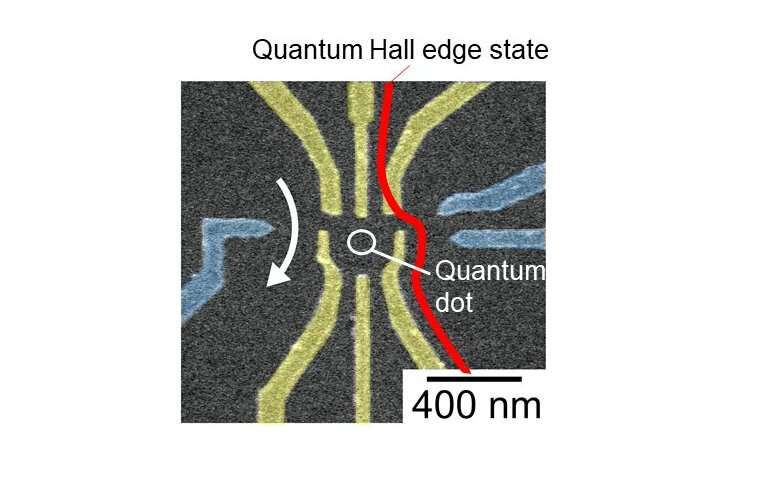 Scanning electron micrograph of the quantum dot device used in this work. Source: Osaka University.
To overcome this, the team useda phenomenon called the quantum Hall effect. When electrons are confined to two dimensions and exposed to a strong magnetic field, their states are quantized, so their energy levels can only take on certain specific values.
"Previous methods for reading spin measurementscould only process one or two electrons, but by using the quantum Hall effect, we were able to resolve up to four spin-polarized electrons,” says lead author Haruki Kiyama.
To prevent disturbances from heatfluctuations, experiments were carried out at extremely low temperatures, about 80 millikelvin. "This readout method could pave the way for faster and more powerful spin-based quantum information processing devices with multi-electron spin states," adds senior study author Akira Oiwa.
Read on:
Giant iceberg A74 collides with the coast of Antarctica
Two new dinosaur species discovered in China
What is the Kessler effect, and also when and what will the collision of satellites in orbit lead to?