“Spiders” on Mars—unusual branching systems and fractal depressions—are found only in the south polar
After their discovery a few years ago, scientistsimmediately put forward a version of the origin of these formations, but she found her confirmation only now. Researchers have obtained the first physical evidence to support the most popular model for the formation of such structures, known as the Kieffer hypothesis. According to this idea, spider forms are formed by direct sublimation of frozen carbon dioxide.
Giant forms up to 1 km in size are unlike anythingwhat's on earth. However, scientists have been able to successfully recreate a smaller version of such formations in the laboratory. To do this, they used a plate of carbon dioxide (dry ice) ice. Scientists also recreated the Martian atmosphere. When cold ice touched a much warmer layer of Martian sediment, part of it instantly turned from a solid to a gas in the process of sublimation. As a result, spider-web cracks formed, from which the gas was pushed through the ice.
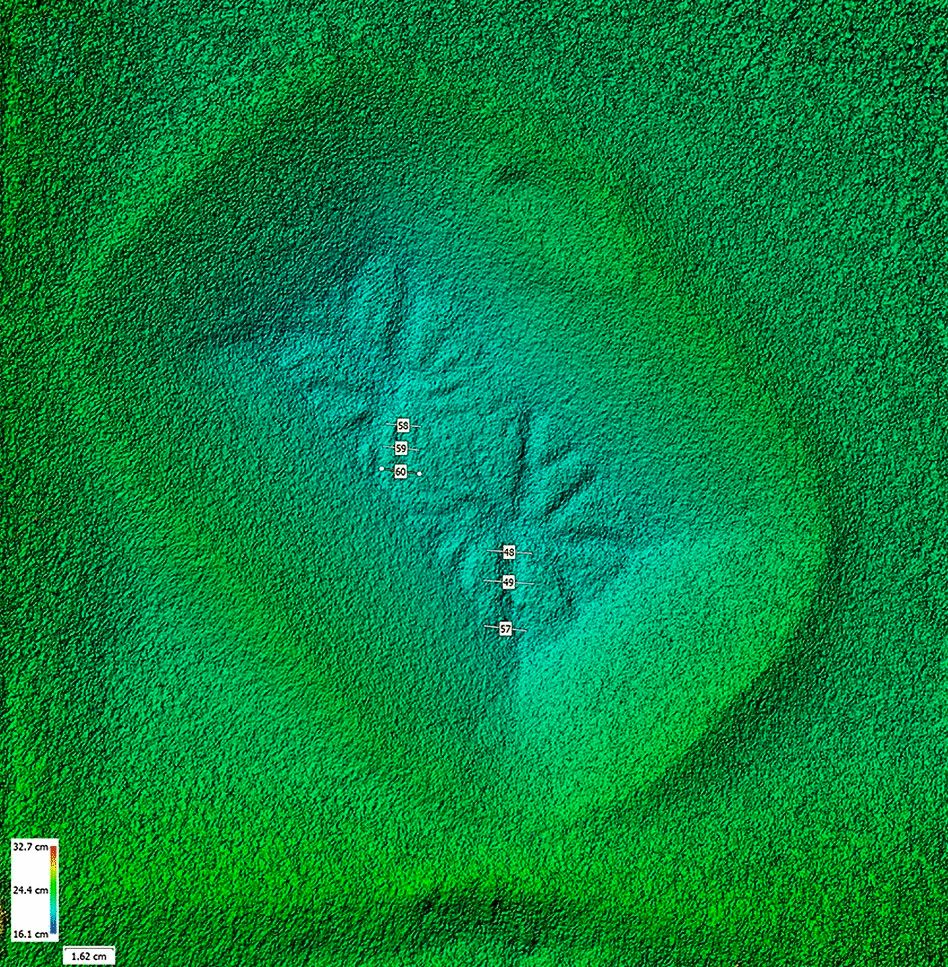 An example of "spiders" created in the laboratory, withcross sections showing that the depth of the depressions decreases with distance from the millstone center, as happens on Mars. (Image credit: Scientific Reports, CC 4.0)
This study represents the first set ofempirical evidence for a surface process believed to be altering the polar landscape on Mars, lead author Lauren McKeown, a planetary scientist at the Open University in England, said in a statement.
Read more
The first accurate map of the world was created. What's wrong with everyone else?
Researchers plunged for the first time to the deepest sunken ship
Algorithm has discovered a new mysterious layer inside the Earth