A new study finds that nearly 3,600 years ago, the severed right hands of 12 people were sold for gold.
Scientists Discover Severed Hands Buriedin three pits, during excavations in 2011 in the palace courtyard. It is located in the ancient city of Avaris (modern Tell el-Daba) in the eastern Nile Delta in northern Egypt. The authors of the new study believe that 11 of the hands belonged to men, but the gender of the 12th person is unknown. Perhaps it belonged to a woman. The hand bones showed no signs of age-related degeneration: most likely, these remains belonged to adults aged between 14 and 21 years.
At the time when the hands were deposited,The Hyksos controlled part of Egypt and ruled during the 15th Dynasty (around 1640 BC) from ;Avarisa. The Hyksos are the name of the peoples who conquered part of Ancient Egypt in the 18th–16th centuries BC during the 13th–17th dynasties. They established a capital at Avaris, located on the so-called Pelusiac branch of the Nile River in the Eastern Delta.
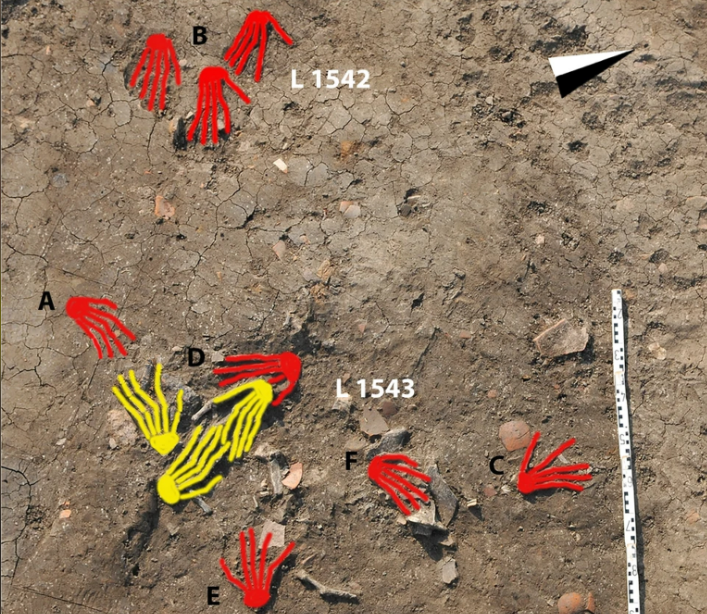 Digital overlay showing buried hands. Yellow hands were on the top side and red hands were on the palms. Image credit: Gresky, J. et al. Nature (2023); (CC-BY 4.0)
According to researchers, severedThe hands are the earliest known physical evidence of a practice known as "honor gold." In this ceremony, described in ancient Egyptian records, warriors brought the severed right hands of their enemies in exchange for a reward—a collar of gold beads.
The enemies who suffered this fate were usuallymen of fighting age, but the presence of a possible female hand is not so strange. “Women have always participated in wars. They are inextricably linked with the political, social and religious spheres. Therefore, we cannot exclude that the particular hand attested at Tell el-Daba belonged to a woman,” the scientists write in the study.
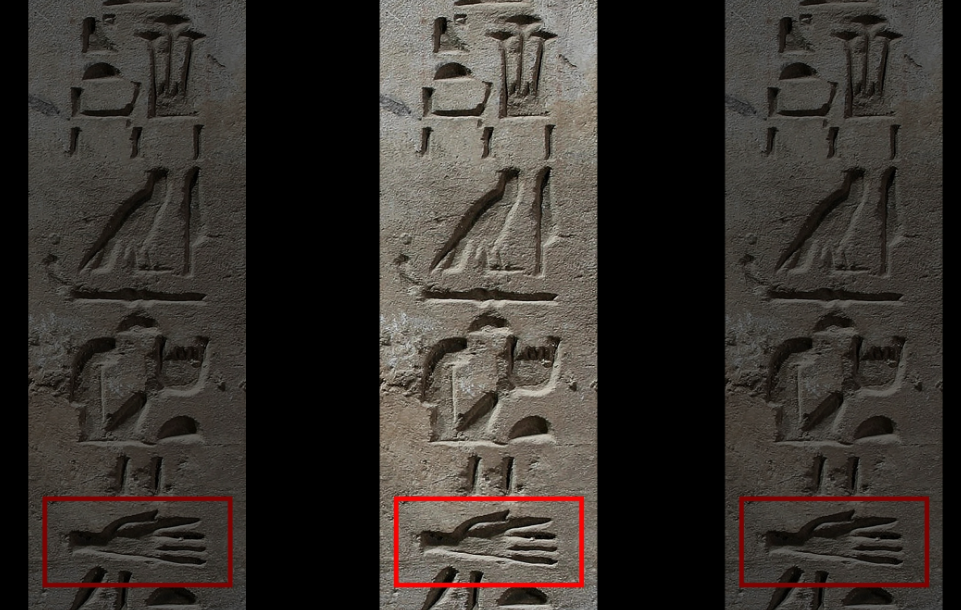 Hieroglyphic evidence of a severed hand,found in the tomb of Ahmose at El-Kab. Image credit: Gresky, J. et al. Nature (2023); by William Vivian Davies, Oxford; (CC-BY 4.0)
According to researchers, these severedthe remains were probably treated as trophies and handed over during a public event in the palace. They suggested that the Hyksos may have introduced the practice to Egypt, and it was later adopted by local rulers. The researchers note in the article that there are no Egyptian records of this practice existing before the Hyksos period.
Read more:
Tumor size reduced by implanting 'edited' fat
New solar cell breaks world efficiency record
No longer a toy. What will the evolution of GPT and Midjourney lead to?
On the cover: some of the splayed right arms (with the addition of digital colors) that were found buried in the courtyard in front of the throne room in the ancient Egyptian palace
Image credit: Gresky, J. et al. Nature (2023); (CC-BY 4.0)