Photoimmunotherapy, a combination of phototherapy and immunotherapy, can effectively improve the effectiveness of
Employees of the Suzhou Institute of Biomedicalof Engineering and Technology (SIBET) of the Chinese Academy of Sciences (CAS) recently developed a multifunctional nanoplatform. It is based on mesoporous hexagonal zinc-porphyrin-silica nanoparticles (MPSN) loaded with R837 (a toll-like receptor-7 agonist). They can be used to integrate photodynamic therapy and photothermal therapy, as well as tumor-specific immunotherapy for breast cancer.
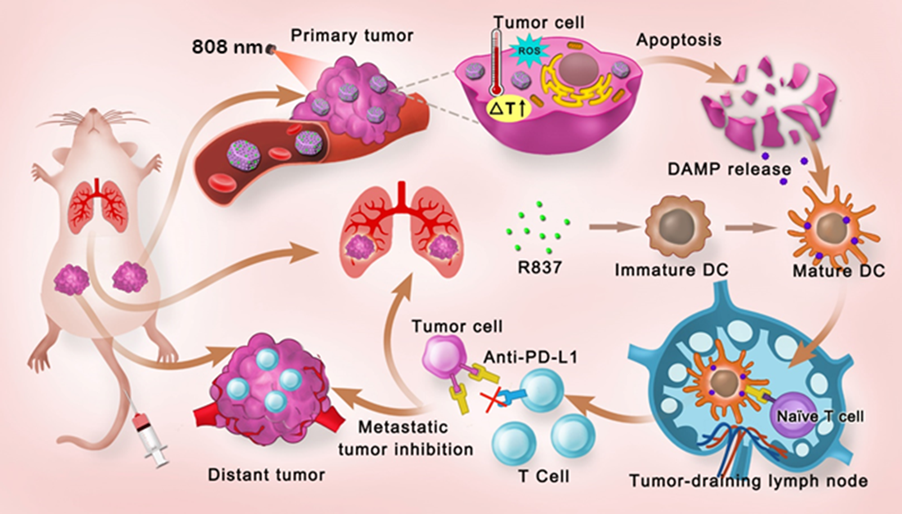 Schematic diagram of nanomaterials for photoimmunotherapy of breast cancer.
Image: SIBET
According to the researchers, nanoparticles withzinc phosphide(ZnP) as the core and mesoporous silica framework as the shell can efficiently generate singlet oxygen and convert photons into heat using a single light source.
Meanwhile, excellent mesoporous structureThe silica shell will promote efficient loading of R837. Hence, the therapeutic strategy based on MPSN@R837 not only eliminated primary tumors through phototherapy techniques, but also effectively inhibited distant metastasis due to the strong immune response caused by the two-way mechanistic interaction.   ;
Cancer immunotherapy is a methodtreatments against tumor growth and metastasis by stimulating the host immune response. Phototherapy, including photodynamic therapy (PDT) and photothermal therapy (PTT), is a less invasive treatment modality compared to chemotherapy. PDT and PTT-induced immunogenic cell death can release tumor-associated antigens and molecular patterns associated with damage, stimulating an immune response.
Read more
Something strange is happening in the Universe: how to explain inconsistencies in the Hubble constant
New magnetic waves have been found in the Earth's core. Every seven years they distort the field of the planet
Gravity and dark matter do not exist: the main thing about the new work of physicists