Helium production for space and medicine
Marina Sokolova, Director of the Institute of Oil and Gas Problems
Helium is a unique raw material that is commerciallyvolumes are only in natural gas. The demand for it is only growing due to the fact that it is needed in space programs, cryogenic technologies, medicine (MRI research, helium-oxygen mixtures) and to increase the world production of superconductors for electronics.
The largest reserves of helium in the world are in Russia, butproduction, the country is not even in the top three, it is about 2.5-3% of the world market. Industrial production of helium in Russia is carried out only at the Orenburg oil and gas condensate field, where the helium content is depleted every year and already amounts to 0.045%.
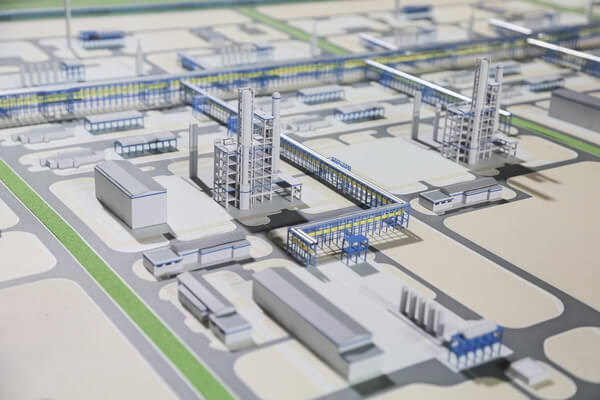 Helium production complex in Yakutia. PJSC Gazprom
In the Republic of Sakha (Yakutia) there are 22oil and gas condensate fields containing helium. Currently, natural gas is produced in the region without isolating helium as a separate product. If a system for its collection, transportation and storage is not created, then within 20 years helium losses will reach 1 billion m3.
We launched a technology development projecthelium extraction and collection of helium concentrate at oil and gas production sites with a system of product pipelines and storage facilities. New helium projects will help Russia occupy a leading niche in the global market. Such a system will facilitate the collection, transportation and storage of helium, it will improve the Yakut infrastructure - pipeline transport, roads, energy supply networks.
Graphene fabric and smart clothes
Zakhar Evseev, Researcher, North-Eastern Federal University
— We are in the Graphene Nanotechnologies laboratoryFor more than 10 years, NEFU has been engaged in the synthesis and application of graphene and graphene-like materials. One recent trend is graphene fabric, or electronic textiles. We started developing it after getting acquainted with similar works from the Graphene Institute (Manchester) in collaboration with Nobel Prize winner Konstantin Novoselov.
Electronic textiles, and in our case grapheneTextile is a nanomaterial applied to ordinary fabric. Depending on the type and composition of the nanomaterial, the tissue can acquire different properties. For example, graphene fabric becomes stronger, acquires electrically conductive properties, has UV protection, exhibits antimicrobial properties, and becomes more fire resistant. But most importantly, other electronic devices can be created on the basis of such fabric. When you live in the Far North, you yourself feel how important the right clothes are not only for comfort, but also for safety.
In the last 10 years, sensors and devices have appeared ongraphene base. All of these devices can be embedded in clothing, creating smart devices. This is how clothes with a built-in graphene battery powered by solar cells based on two-dimensional materials appeared. They also have temperature, pulse and respiration sensors.
Of course, there are many performance requirementssuch coverages and unsolved problems. For example, the resistance of graphene coatings to washing and mechanical stress. We solved this problem and achieved good results - we applied the chemical modification of graphene materials. Now the conductivity of our coatings is twice as high, and the resistance to washing is 50 times higher than that of foreign analogues.
 Graphene clothing is suitable for extremely low temperatures, but does not harm the environment
We will be able to make devices for entering information,built into clothing, vital activity monitoring tools for workwear, medical diagnostics and therapy, built-in heating for winter clothing, sports monitoring. Graphene does not harm the environment and the body, does not lose elasticity and vapor permeability.
So far, e-textile technologies are still in their infancy. But the first products are already on the market - for example, you can buy Xiaomi jackets with built-in carbon nanotube heating.
Rapid healing of burns and injuries
Nina Timofeeva, Leading Engineer of the Laboratory "Technologies of Polymer Nanocomposites" of the North-Eastern Federal University
— We are developing biocompositemedical products. They are based on polylactide, a biodegradable, biocompatible and thermoplastic polymer of lactic acid. It completely decomposes in about 6–18 months, depending on the chemical composition and form.
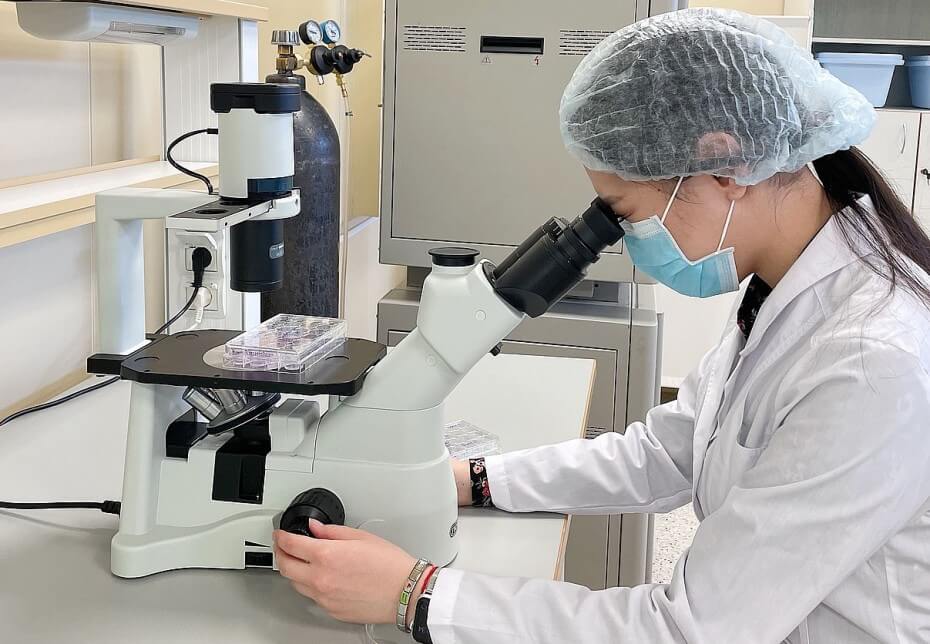 Skin substitute with polylactide as a substrate does not cause allergies and does not leave scars. Source: Ministry of Education and Science
We develop matrices for dermal equivalentsbased on polylactide. The dermal equivalent is a skin substitute, we use polylactide as a substrate (framework, scaffold) for fibroblasts. Dermal equivalents are used to heal injuries such as burn wounds. Unlike dermal equivalent matrix counterparts, polylactide is inexpensive, non-allergic and does not need to be reapplied to the wound, helping to heal wounds without scarring. The most common analogue is the collagen-based dermal equivalent, which can cause an allergic reaction and rejection, after which it must be removed and reapplied. This injures the skin and leaves scars.
We process polydactide in our laboratoryusing extrusion and 3D printing. By extrusion we obtain flexible films that can be cut with scissors. Extensive physico-mechanical, chemical and biomedical studies of samples have already been carried out to establish the optimal characteristics of dermal equivalents.
cancer vaccine
Aitalina Golderova, Chief Researcher, Head, Professor of the Department of Public Health and Health Care, General Hygiene and Bioethics, North-Eastern Federal University
– Individualized (autologous) vaccineagainst cancer is based on the patient's immune cells and cancer cells that are derived from a tumor or established human cancer cell lines. Traditional methods of treatment - surgery, chemotherapy and radiation therapy - are not always effective in the later stages and cause side effects. And immunotherapy is directed against the fight against the tumor, it minimally affects healthy tissues and cells.
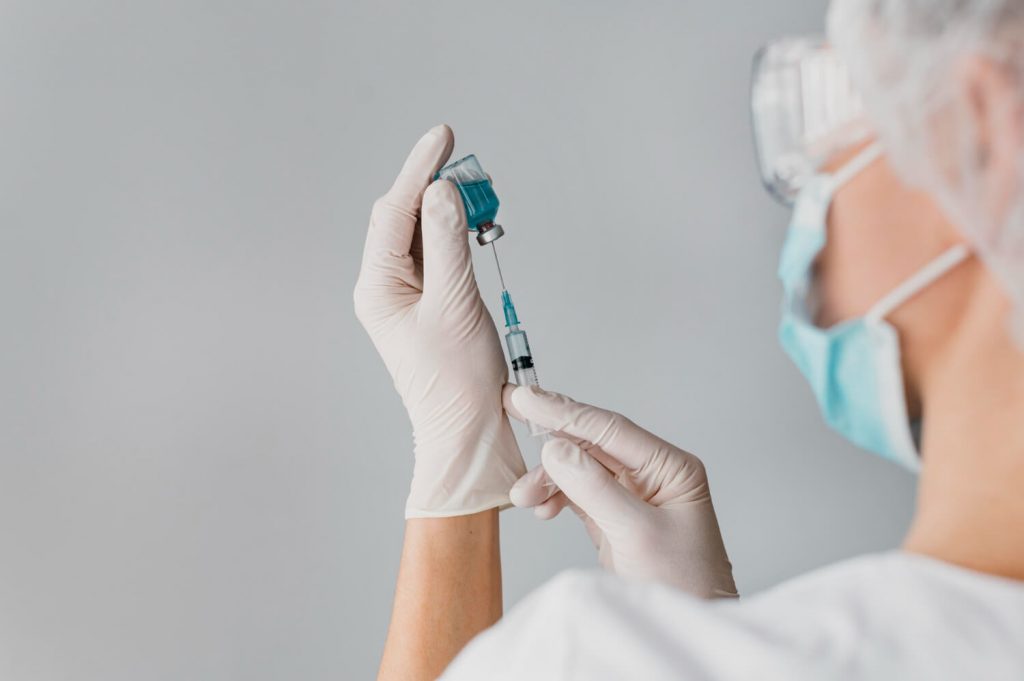 Breast cancer vaccine could save hundreds of thousands of lives
To simplify, we “train” in a Petri dishdendritic cells (cells of the immune system that are able to indicate their "enemies" to T-cells - ed.) with cancer antigens, and then we return the trained cells to the body, activating T-cells, the main function of which is the destruction of cancer cells. There are now more than 200 clinical trials in different phases in the world using DC for the treatment of melanoma, kidney cancer, multiple myeloma, prostate cancer, colon cancer, breast cancer, glioblastoma, lung cancer, lymphoma, esophageal cancer, sarcoma, multiple sclerosis, viral hepatitis, HIV infection. According to the N. Petrov National Medical Research Center of Oncology, a clinically significant antitumor effect was observed in 46.2% of patients.
We have already implemented the cooking methoddendritic cell vaccine obtained data on phenotypes of dendritic cells on a flow cytometer (a system for analyzing particles (usually cells) in a fluid stream - ed.), indicating differentiating markers of maturation and activation of dendritic cells. Our object of study is the venous blood of cancer patients. We want to evaluate the features of maturation and activation of dendritic cells depending on the subtype of breast cancer.
We hope that this method will be introduced into the clinicalpractice. The goal of our project is to develop and optimize an antitumor vaccine based on autologous dendritic cells in patients with breast cancer.
Very durable concrete
Alexander Popov, Deputy Director of the Engineering and Technical Institute of the North-Eastern Federal University for Research
– My project is the development of concrete with increaseddurability based on Yakut raw materials. The idea was born when I realized that the conditions for the production and operation of building materials in Yakutia are very different from the central regions. Under our conditions (the climate of Yakutia is sharply continental, with long, severe, little snowy winters and short summers. The average temperature in January is about -40 ° C, and sometimes -60 ° C - ed.), no one has adapted these materials - and this is not only technological task, otherwise it would be quickly solved by specialized specialists.
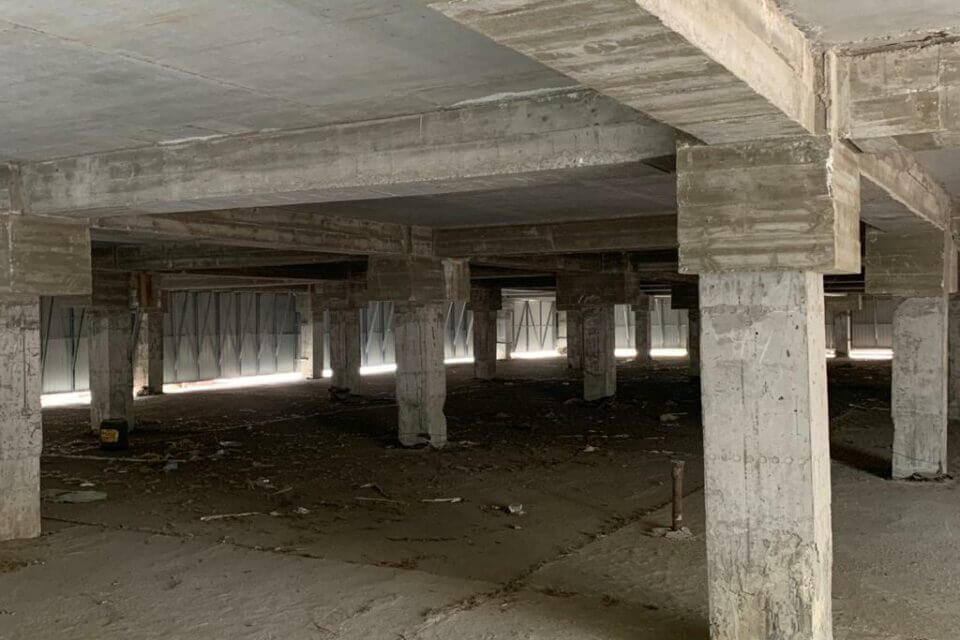 Permafrost and global warming are affecting concrete structures. Source: ysia.ru
For the development of the building materials industry inYakutia needs to solve fundamental problems to determine the optimal raw material and its activation for concrete components. Now, to obtain high-strength concrete, we use imported components, so construction is expensive.
The essence of the development is to make activation technologiesnatural raw materials, and then use them in concrete. For example, natural zeolites of Yakutia (mineral of sedimentary-volcanic origin - ed.) have great potential as an active mineral additive to cement, but not in its original form. This requires modification - special heat treatment conditions. This will improve the acid-base reactions in cements when adding such zeolite.
This work will help in the development of constructionindustry in Yakutia, but may affect this area as a whole. It will expand the raw material base for construction - perhaps in the future each region and sub-region will produce materials for its own needs.
Read more:
A magnetic storm is about to hit Earth
The true meaning of mummification is revealed: all this time, scientists were wrong
Named the main danger of the lunar mission "Artemis"