Experts in the study of plants in space took a few teaspoons (12 grams) of lunar soil.The soil was
For comparison, the researchers also plantedArabidopsis in AO-1A, a terrestrial substance that mimics real lunar soil, as well as simulated Martian soils and terrestrial soils taken from areas with extreme climatic conditions. Plants grown in these non-lunar soils formed the control group of the experiment.
Before the experiment, the researchers were unsure whether seeds planted in lunar soil would germinate. But they did it.
“We were amazed. We didn't foresee this,” Paul said. “This tells us that lunar soils do not interrupt the hormones and signals involved in plant germination.”
However, over time, researchers have noticeddifferences between plants grown in lunar soil and the control group. For example, some of the plants grown in the lunar soils were smaller, grew more slowly, or differed in size.
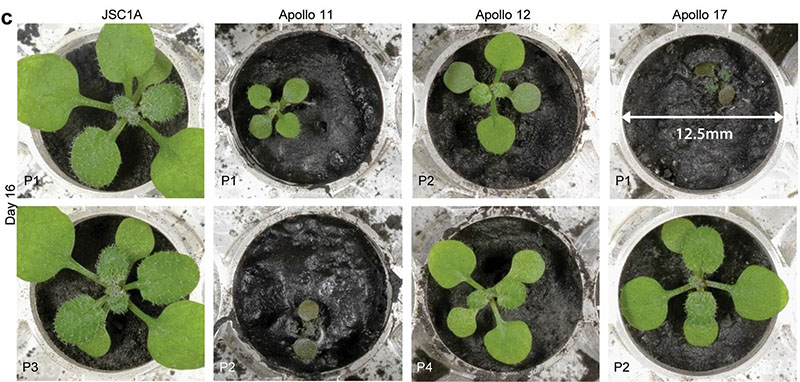 Source: Anna-Lisa Paul et al., Communications Biology
According to the researchers, these physicalsigns suggest that the plants were working to cope with the chemical and structural makeup of the lunar soil. This was further confirmed when the researchers analyzed the gene expression patterns of the plants.
“At the genetic level, plants usedtools commonly used to deal with stressors such as salt and metals, so we can conclude that plants perceive the lunar soil environment as stressful, says Paul, one of the scientists. “Ultimately, we would like to use gene expression data to help decide how we can improve our stress response to the point where plants, especially cereals, can grow in lunar soil with very little impact on their health.”
According to experts, the reaction of plants to the lunarsoil can be related to where the soil was collected. For example, the researchers found that the plants with the most signs of stress were grown in what lunar geologists call mature lunar soil. They are more exposed to the cosmic wind, which changes their composition. On the other hand, plants grown in comparatively less mature soils performed better.
“We wanted to do this experiment because for years we wondered if plants would grow in lunar soil,” says Furl, one of the researchers. “The answer, it turns out, is yes.”
Future research will be based ondata obtained during the experiment. It also shows how plants biologically respond to the Moon's soil, known as lunar regolith, which is radically different from Earth's soil.
Arabidopsis (rezukhovidka), or Tal's rezushka -annual flowering herb. Today it can be found on almost all continents and in all climatic zones, excluding the permafrost zone. Arabidopsis was the first plant grown in space, in the absence of gravity. In 1982, on board the Salyut-7 space orbital station, it was possible to obtain a full-fledged plant from seeds brought from Earth, which, after flowering, gave new seeds.
Read more
Look at the "silent" drone with a new generation of ion propulsion
Ancient trilobite males strapped females on during mating
Russia and the United States have Doomsday planes: how and where they will fly in the event of the end of the world