A team of astronomers led by Anna Trindade Falcao from the Harvard-Smithsonian Center for Astrophysics in
AGNs (active galactic nuclei) are compactareas at the center of the galaxy that are brighter than ambient light. They are very energetic, either due to the presence of a black hole or active star formation.
As a result of observations, scientists found morelow total energy extension in the direction of the major axis of NGC 5728. The study also showed that diffuse radiation propagates in the direction of the transverse cone. In addition, the data indicate the presence of hard X-ray emission on the scale of kiloparsecs, which indicates the inhomogeneous structure of the torus, which allows radiation to escape from the near-nuclear region to large radii.
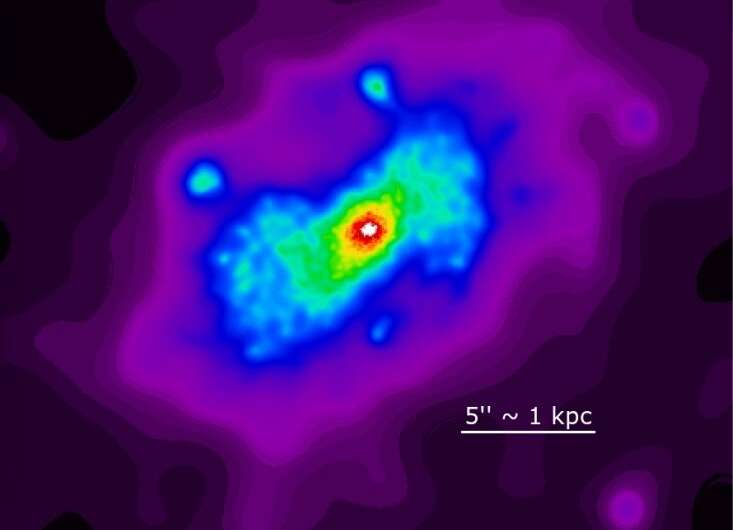
NGC 5728: Full range emission (0.3–7.0 keV).
Credit & Copyright: Falcao et al., 2023
NGC 5728 is an active spiral galaxy withalmost 100,000 light-years across and with an estimated mass of about 72 billion suns. It is located approximately 146 million light-years from Earth in the constellation Libra. It is also a type 1.9 Seyfert galaxy with a highly obscured and complex AGN that is fed by a supermassive black hole (SMBH) at its center.
Read more:
Named a vitamin that protects the brain from dementia
See how the Earth has changed over 100 million years on the most detailed map
It turned out which men are the most fertile: their sperm is 50% better than the rest
Cover photo: rawpixel.com