The solar wind forms a huge protective bubble around the solar system that repels 70%
The bubble itself is known as the heliosphere, and its edge isheliopause. If you move from the Sun, then at some distance there comes a moment when the pressures of these two colliding flows - the solar wind from the inside and the interstellar plasma from the outside - are equalized. It is in this place that the heliopause is formed, and the space inside it is called the heliosphere.
Unlike most borders on Earth, scientistshave no idea how big this boundary is or what it might look like. A new study published in The Astrophysical Journal describes the creation of the first three-dimensional map of the heliosphere.
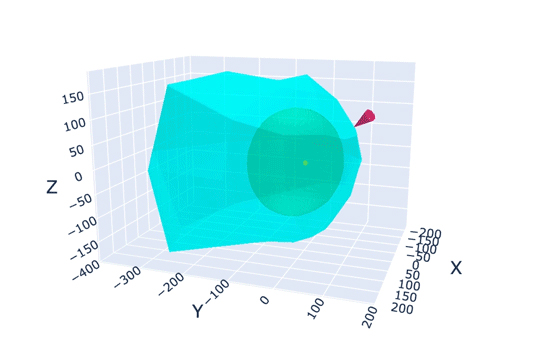 3D map of the heliosphere compiled byteam, shows that the bubble is much thinner on the side facing the interstellar wind than on the opposite side. (Image credit: Reisenfeld et al)
Using 10 years of satellite dataNASA's Interstellar Boundary Explorer, the study's authors tracked solar wind particles as they travel from a star to the edge of the heliosphere and back. So the team calculated how far the wind blew them in a given direction before it was reflected by interstellar radiation. In turn, this allowed scientists to map the edges of the solar system in a similar way to how bats use echolocation.
“Like bats send impulsessonar in all directions and using the return signal to create a mental map of our surroundings, we used the solar wind, which comes in all directions, to create a map of the heliosphere, ”the scientists explain.
As can be seen on the group map, the heliosphere is not quitecorresponds to the "spherical" part of its name. The barrier around the solar system is more like a wobbly blob, which is much thinner on one side than on the other.
Read more
Damage to the skin, brain and eyes: how COVID-19 enters human organs
It turned out that huge cosmic filaments in the Universe rotate like drills
Scientists have found out who is at risk of re-contracting COVID-19 and when