The development was made possible thanks to the combination of many homogeneous metalenses (metal lenses) -
"In order to create an extremely compactwide-angle camera, we used a set of metal lenses, each of which captures certain parts of the wide-angle scene,” said Tao Li, one of the developers. “The images are then stitched together to create a wide-angle image without compromising image quality.”
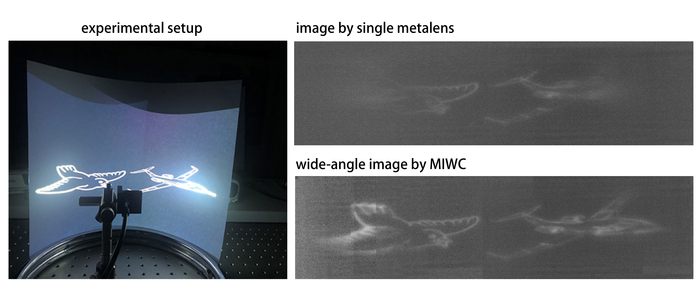 Shooting with a wide-angle camera
An array of silicon nitride metalins was mounted onCMOS image sensor. The result was a flat camera measuring about 1 cm × 1 cm × 0.3 cm. Scientists used it to image a wide-angle scene. To do this, they placed a curved screen around the camera, at a distance of 15 cm, and illuminated it with the help of two projectors. The camera produced an image that clearly showed each letter and had a field of view of more than 120°, more than three times that of its traditional metalens counterpart.
“Thanks to the flexible design of metasurfacesthe focus and image quality of each lens can be optimized independently of each other,” Lee said. “This allows for a high-quality final wide-angle image after the stitching process. Moreover, the array can be manufactured using just one layer of material, which helps reduce cost.”
In the future, researchers plan to increasemetalens diameter from 0.3mm to 1-5mm to improve camera image quality. Once optimized, the array could be mass-produced to reduce the cost of each device.
By eliminating bulky and heavylenses normally needed for this type of imaging, the new approach could enable wide-angle cameras to be built into smartphones and portable imaging devices for vehicles such as cars or drones.
Read more:
After ten years of work, scientists questioned the Standard Model of physics
MIT builds stationary heat engine that outperforms turbines
Startup has created tiny robots that work in the human brain