Researchers have deciphered an ancient manuscript that they believe was written in the first century AD
Written in Greek on parchment, the text was first discovered by Angelo Mai, a Roman Catholic cardinal and researcher of ancient texts.In 1819, he found it hidden in the library of Bobbio Abbey in northern Italy.
Now, a team of researchers from the Sorbonne in Paris and New York University has deciphered much of the mysterious text and uncovered its contents.They detailed their work in a study published March 9 in the journal Archive of the History of Exact Sciences.It was very difficult, they write, because the textPtolemy was hidden under another work.
At some point, in the sixth or seventh centuries AD, someone printed another work on the pages — in this case, the Etymologies of the Spanish theologian Isidore of Seville. To make out the letters on the ancient pages, the scientists used a multispectral imaging technique.So they were able to "read more than half of what was written," the scientists write.
Notably, they discovered a manual written by Ptolemy that explained how to build a meteoroscope , an armillary instrument used to track distances and study the stars.The device, which consists of nine metal rings rotating around each other, helpsAccording to the study, in the text, Ptolemy advised to construct an instrumentwith a diameter of not 0.3 meters.
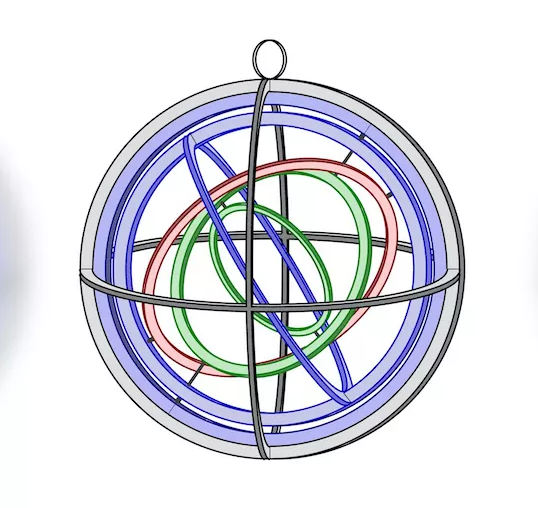 Drawing of Ptolemy's meteoroscope, a nine-ringed instrument used by astronomers. Image courtesy of Alexander Jones
Despite the fact that at the disposalresearchers do not have the first and last pages and, accordingly, the name of the author, the researchers still found several evidence of Ptolemy’s authorship. The ancient astronomer has a special style and uses certain phrases and words, scientists write.
“We also found a certain passage,in which the author speaks in the first person: “I have introduced new terminology for certain angles used in astronomy.” We also have another book by Ptolemy in which he used the same terminology for new names for these angles. This is our most convincing evidence that the manuscript belongs to him,” the scientists conclude.
Read more:
A red halo flared up over Italy. Now its nature has been explained
Named a way to reduce appetite without surgery
Chia seed experiment confirms Alan Turing's famous mathematical model
Cover: multispectral logarithmic color image showing inverted Latin text in brown and intensified traces of Greek overtones
Image courtesy of Veneranda Biblioteca Ambrosiana/Mondadori Portfolio