Using a combination of observable stars and a realistic model of the Milky Way, scientists from the Institute of Extraterrestrial
The age of ring stars can be used tofind out when the jumper appeared. A preliminary estimate showed that it is about 7 billion years old. The existence of the inner ring proves the importance of gas entering the galaxy for star formation in the early era of the Universe.
Over the past decade, scientists from the Instituteextraterrestrial physics them. Max Planck were able to combine data from various observational campaigns with sophisticated computer simulations to create a state-of-the-art model of the Milky Way's interior.
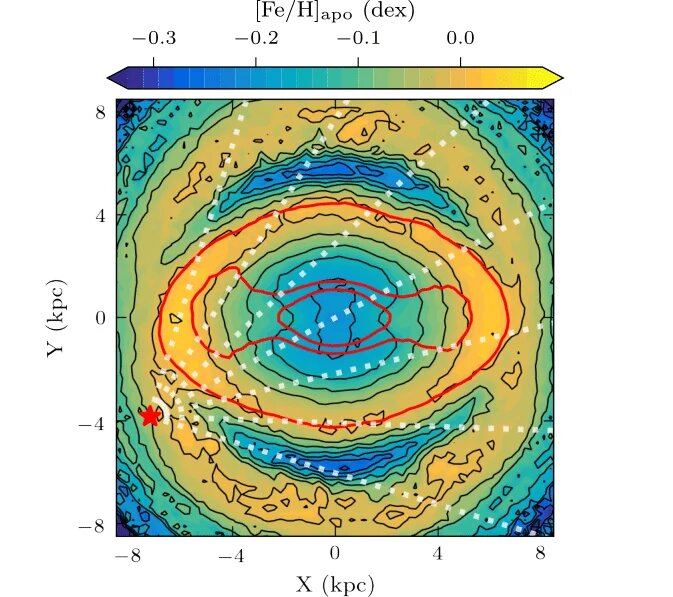 This image shows a map of the metallicity of the interior of the Milky Way, based on orbital data calculated in the new study.The red star marks the position of the Sun, and the white dotted lines mark the different directions of the "view" of the instruments from the Earth.The red contours emphasize the ring-like structure of the galactic center around it.
Recent studies have yielded a wealth of new data about the interior of the Milky Way.The scientists used data from APOGEE, a large-scale stellar spectroscopic survey conducted in the near-infrared.In contrast to optical light, IR light penetrates more easilythrough the dust, allowing APOGEE to detect stars located in dusty regions of the Milky Way, such as the disk and bulge.
They also used information from the Gaia mission,which has already mapped over a billion stars. The data was combined with an internal model of the Milky Way, created by scientists at the Institute of Extraterrestrial Physics. Max Planck.
Around the central lintel, scientists foundinner ring structure, which is richer in metal. Previously, such star formation rings were found in other disk galaxies, but it was not clear whether the Milky Way had them.
Read more
Bacteria have appeared that synthesize the right drug directly in the human body
The new message for extraterrestrial civilizations is different from the rest: why is it dangerous
Look at a picture of a galaxy that looks like ours