Superclusters of galaxies, containing different structures with a range of masses, are among the largest
Detailed detection and researchsuperclusters of galaxies is important for understanding the formation and evolution of large cosmic filaments or galactic filaments. Recall that the galactic filament is the largest observable cosmic structure in the Universe in the form of threads of galaxies. Their average length ranges from 50 to 80 megaparsecs (163 - 260 million light years). They are located between voids - large voids. The filaments and voids may together form “great walls”—relatively flat complexes of clusters and superclusters. Galactic filaments are filled with very hot (millions and tens of millions of degrees) and very rarefied gas.
A group of astronomers led by Vittorio Ghirardinifrom the Max Planck Institute for Extraterrestrial Physics in Garching, Germany, reports the discovery of a new supercluster. The structure was identified during the eFEDS study during the performance verification (PV) phase. Recall that eFEDS (eROSITA Final Equatorial Depth Survey) is a project of the final study of the equatorial depth of eROSITA, an X-ray telescope built by the Max Planck Institute for Extraterrestrial Physics in Germany.
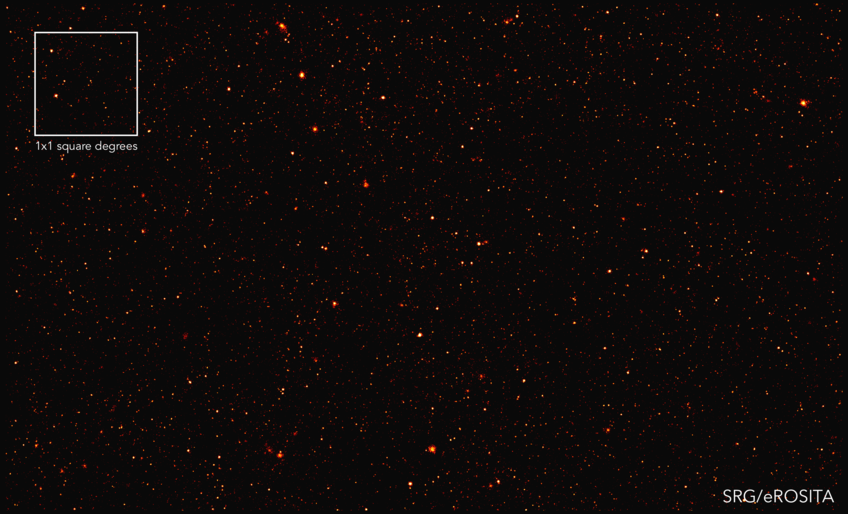 The X-ray portion of the sky coveringan area of about 1/1000 of the entire celestial sphere observed by eROSITA and being part of its eFEDS validation study. At the end of the 4-year all sky survey, maps of the same quality and depth will be available for the entire sky. The image was created from photons in the energy range 0.5–2 keV.
Credit: V. Girardini. MPE / IKI
The discovered supercluster consists of a chain ofeight galaxy clusters with a redshift of 0.36. Observations indicate that the northernmost clusters of this structure are now experiencing a major merger.
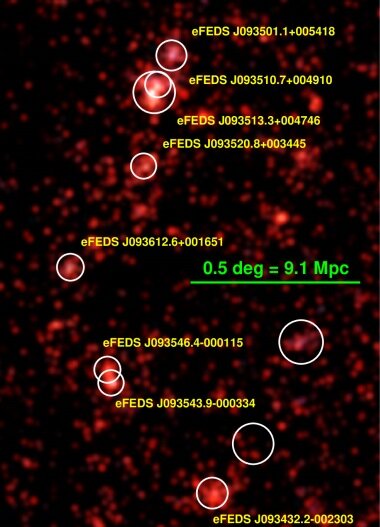 Color image of the density map of the galaxy atredshift of 0.36 obtained with the eROSITA Hyper Suprime-Cam (HSC). White circles mark eight galaxy clusters forming a new supercluster. Credit: Girardini et al., 2020.
First cluster, eFEDS J093513.3 + 004746, is located in the northern part of the supercluster and is the most massive and brightest of the eight clusters. It is one of the most massive and brightest clusters in the entire eFEDS region. Its mass was estimated at 580 trillion solar masses.
The least massive clusters of thissupercluster, eFEDS J093546.4-000115 and eFEDS J093543.9-000334, the mass is 130 trillion solar masses. The masses of the other five clusters are estimated at 140 to 250 trillion solar masses.
Read also
Abortion and science: what will happen to the children who will give birth
Check out the most beautiful pictures of Hubble. What has the telescope seen in 30 years?
NASA published a photo of the Earth from the moon, which was taken in 1968