Excavations in the Dzungarian Basin in China have shed light on the secret of the dominance of dinosaurs on Earth during
It was believed that during the Triassic period,before the extinction of giant reptiles, and in the subsequent Jurassic period, which marked the beginning of the era of dinosaurs, the world was hot and stuffy. In a paper published in the journal Science Advances, the researchers showed that this was not the case everywhere. Even in the greenhouse conditions of the Triassic in the subpolar regions of the Earth, the temperature decreased to negative values.
Researchers believe dinosaurs were the firstappeared in the Triassic period in temperate southern latitudes about 231 million years ago. At this time, most of the planet's land was united into one giant continent, which geologists call Pangea. They reached the far north about 214 million years ago, the authors of the work note.
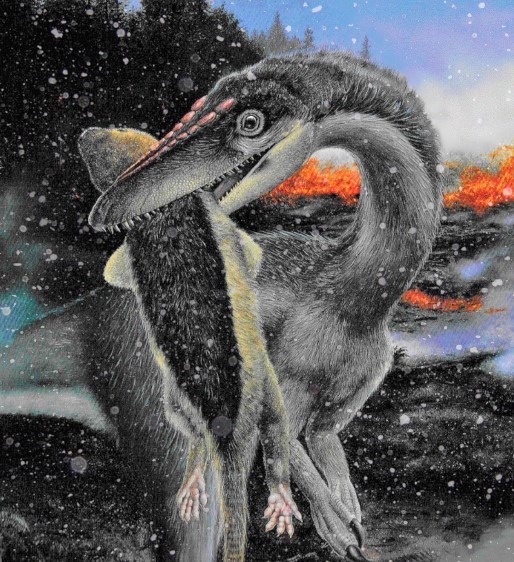 A feathered theropod dinosaur carries off a mammalian prey during a snowy volcanic winter. Image: Larry Felder, Lamont-Doherty Earth Observatory, Columbian University
Researchers believe that over millions of yearsdinosaurs that lived in subpolar latitudes adapted to the cold climate. At the end of the Triassic, in about a million years, more than three-quarters of all land and sea species on the planet became extinct on Earth, including armored creatures, corals and all large reptiles.
There are various hypotheses explaining the Triassic-Jurassicextinction, the authors of a new study believe that the main reason is volcanic eruptions. They released a lot of sulfur into the atmosphere, these particles reflected sunlight and caused repeated global volcanic winters. Such climate change killed cold-blooded reptiles, but cold-adapted, feather-covered dinosaurs were able to survive, scientists say.
Severe winter periods during eruptionsVolcanoes could lead to sub-zero temperatures in the tropics, where large, naked, non-feathered vertebrates seem to have died out. Whereas our beautiful feathered friends, who have adapted to cooler temperatures at higher latitudes, have done just fine.
Dennis Kent, geologist at Columbia University and study co-author
Read more:
A black hole in the galaxy proved Einstein right. The main thing
"James Webb" will show space before the Big Bang: astronomers on the verge of a global discovery
Look at the celestial "Titanic" that will run on nuclear power