The authors of the new work used a systematic approach to compare how colonizers
The main criterion was weight.The researchers assumed that a rocket carrying a crew to Mars could carry a payload of about 100 tons, excluding fuel, and calculated how much of this payload would go to a device to generate energy. The journey to Mars and back will take about 420 days - 210 days each way. The authors found that the weight of the power system would be less than 10% of the entire payload. For example, for a landing site near the equator, the weight of solar panels plus hydrogen storage would be about 8.3 tons, compared to 9.5 tons for a kilowatt nuclear reactor system.
The analysis showed that almost half of the surfaceMars is more suitable for solar power than nuclear power, considering the weight of solar panels and their efficiency. And also provided that part of the energy is used to produce hydrogen gas - this is necessary for fuel cells that will feed the colonies at night or during sandstorms.
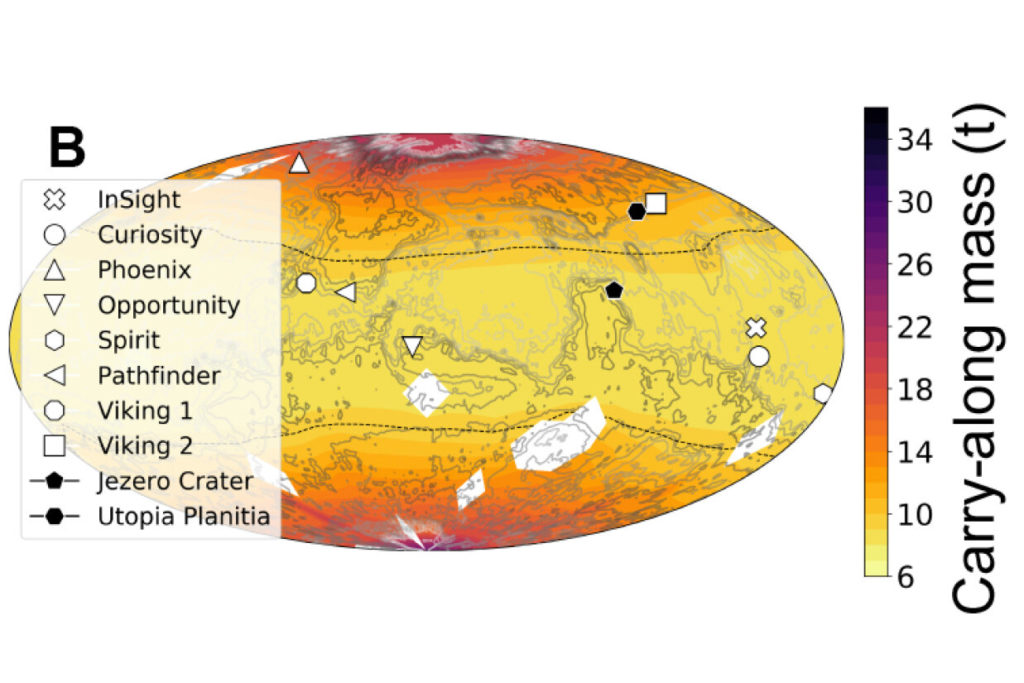 Map of Mars, where yellow marks the area where it is most effective to receive solar energy
"Production of photovoltaic energy and itsstorage using molecular hydrogen is more efficient than nuclear and fusion reactors on more than half of the planet. Mostly in regions around the equatorial strip," said UC Berkeley bioengineering doctoral student Aaron Berliner, one of the paper's two original authors.
Scientists say their study will helptake a fresh look at the colonization of Mars. And it will facilitate the creation of a roadmap for the necessary technologies and developments that are needed when planning manned missions to other planets or satellites.
Read more:
It has been hunted for centuries: what do we know about the planet Vulcan next to the Sun
Astronomers have found a planet near the Earth: it has a very strange orbit
Inexplicable duality found in elementary particle physics: what will it lead to